

A tribute to Robin Stubbs: The Prince of Plainmoor
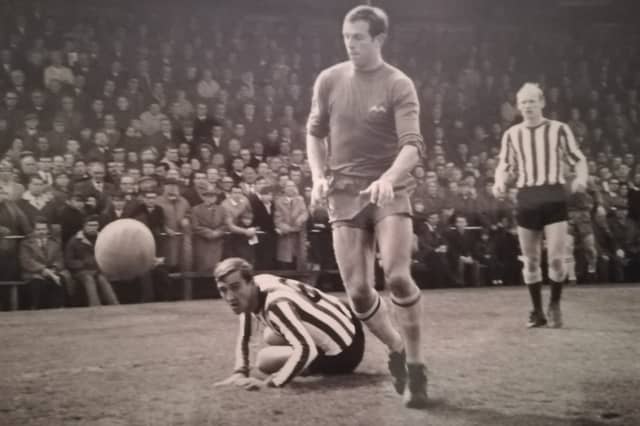

A moving tribute to legendary Torquay United striker Robin Stubbs
It was a damp, dull day in Birmingham early in the summer of 1963 when Robin Stubbs boarded a train at New Street Station bound for the English Riviera. He had mixed feelings about the whole idea.
Just 22, Stubbs, who has died at the age of 85, had been sidelined by Gil Merrick, the manager of Birmingham City.
But the Blues were his hometown club, and he’d scored 18 goals in 63 games in the old First and Second Divisions and the Inter Cities Fairs (Europa) Cup.
Sixty years ago football’s £20-a-week maximum wage had just been abolished, but the gap between the top and bottom divisions of the Football League was still a narrow one.
Torquay, with a clutch of former West Midlands businessmen on the board, were offering Stubbs the same as he was on at St Andrews, plus a few ‘incentives’.
“As the miles went by, I thought what a hell of a long way it was, but when I got to Torquay, the sun was shining and the palm trees were waving in the breeze,” he recalled.
“I remember the sea front, and looking over the wall onto Torre Abbey Sands. Everyone was having fun, and I’d never seen so many bikinis in my life.”
The Sixties were in full swing. Suddenly it all felt like a long way from Birmingham.
Future chairman Tony Boyce met Stubbs and took him to meet manager Eric Webber at the Livermead Cliff Hotel. A fee of £6,000, a club record, had already been agreed.
“I can’t remember a lot they said to me. Eric was very nice. My job would be to score goals and nothing else,” he said.
“But to be honest, I’d made my mind up – I’d have signed a loo roll if they’d put it in front of me.”
Whether they knew it or not, United had just hired one of the most exciting forwards in their history.
And Stubbs was about to enjoy himself on a scale he’d never dreamed of.
Over the next six years he scored 132 goals, including 64 in his first two seasons. In those early campaigns he played alongside a gifted but often underrated centre-forward in Tommy Northcott.
Torquay born and bred, Northcott was good enough to have played for England School boys, and later for Cardiff City and Lincoln City before returning to Plainmoor.
They could have been made for each other.
It wasn’t just the goals Stubbs scored, it was the way he scored them. He was built for the job – just over six feet tall, with the body of an Olympic swimmer, a good first touch, pace to burn and a voracious appetite for hitting the net.
‘We All Live In A Robin Stubbsmarine!’ sang the Plainmoor crowd, from the Beatles hit.
He scored hat-tricks (4), fours (2) and even five against Newport in October 1963. In one devastating spell from October to January 1964/65 he hit 21 goals in 16 games.
He finished that year with 39, and if he hadn’t caught glandular fever and missed the last five matches, he would surely have beaten Sammy Collins’ all-time record of 42 in 1955-56.
Robin always admitted that his two most famous goals, the pair he scored in the last few minutes to earn a 3-3 draw with Spurs in the FA Cup Third Round in January 1965, were mishits.
But there weren’t many of those.
He outplayed England centre-half Maurice Norman in both ties, just as he’d done for Birmingham a couple of years before, scoring a sumptuous goal in the replay in front of 55,000 at White Hart Lane.
Stubbs had as good a time off the pitch as he had on it. His good looks and personality made him a favourite wherever he went.
Anthea Redfern, the daughter of a local bookmaker, later became Mrs Bruce Forsyth and co-host of hit TV show The Generation Game, but when she and Robin married in Torquay, the crowds and the cameras were also there – for him.
The arrival of Frank O’Farrell as manager in 1965 signalled the end of Stubbs’ days as an out-and-out striker. O’Farrell wanted a bit more ‘work’ out of him.
He still scored 60 goals in three-and-a-half years under O’Farrell, stressing: “People always thought Frank and I didn’t get on, which wasn’t really true.
“He wanted to make me a better player. And, of course, the team did quite well.”
United immediately won promotion in 1966 and then, with average gates topping 10,000, finished 7th, 4th and 6th in Division Three (League One).
Stubbs never wanted to leave when, after O’Farrell left and United wanted to cash in, he was sold to Bristol Rovers for £15,000 in 1969.
He scored another 32 goals in 90 games for Rovers before returning to Plainmoor, diminished by a persistent knee injury. He retired in 1973.
Not for Robin the round of part-time clubs or the cares of management. He forged a new career in the office equipment and stationery business.
He stayed here with his wife Joanne and their family, overcoming a series of health issues, ever cheerful, always up for a game of golf or tennis.
He hugely enjoyed his regular outings to Plainmoor, where United made him their honorary life president in 2020.
Only Collins (219gls/379games 1948-57) stands ahead of Stubbs (133/263 1963-69/1972-73) in United’s all-time scoring list.
Collins was a master finisher, but for sheer out-of-your-seat excitement, Robin was hard to beat.
“My job was to put the ball in the back of the net as often as possible,” he said.
“I could never understand people who said I didn’t work hard enough. They said the same about Jimmy Greaves.
“Scoring is the whole point of the game after all, and it’s never been easy.”
Those holidaymakers at Torre Abbey in 1963 went home, of course. But Robin, the ‘Prince of Plainmoor’, never did. This became his home. And weren’t we the lucky ones.