

AA Milne's Winnie the Pooh turns 100: A century of beloved characters
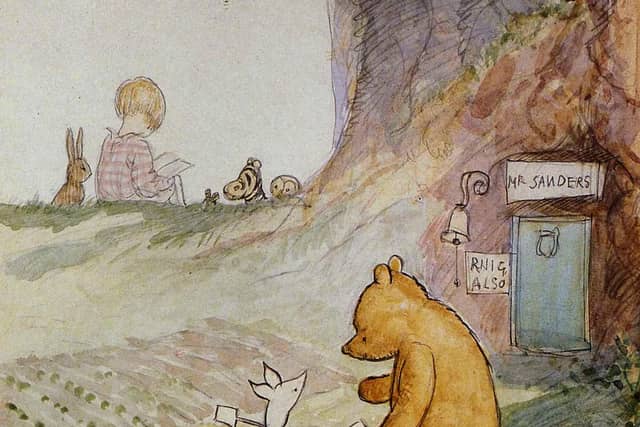

A century after its publication, Winnie-the-Pooh remains a much-loved classic, with characters so familiar they have become part of our language. But did A.A. Milne realise the literary legacy he was creating — and was the success of Pooh as rewarding for his creators as it was for generations of readers?
When Philip Hammond stood up to give his budget speech in 2018, he started by saying that he was feeling tiggerish. Everyone immediately knew the meaning of tigerish. He was feeling bouncy, a useful emotion for a Chancellor of the Exchequer. Next week John Healey is likely to be more like Eeyore, rather boggy and sad.
One hundred years on from the first Winnie the Pooh book, these characters need no explanation. If he had quoted Charles Dickens. Shakespeare or Jane Austen, there would have been a few people who did not understand the reference. Does this make Winnie the Pooh one of our greatest pieces of English literature?
AA Milne wrote two children’s classics with Winnie the Pooh and The House at Pooh Corner as well as two books of children’s poems. He also wrote plays and contributed to the satirical magazine Punch. Although hugely successful, he was not entirely happy. He wanted to be seen as a serious writer. He did not understand that in Winnie-the-Pooh he had created a classic.
In some ways this was similar to the situation Arthur Sullivan found himself with the Gilbert and Sullivan light operas. He saw himself as a serious classical composer, but his real talent lay in writing light-hearted, memorable tunes for the theatre.
Richard Sherman was also highly successful in a genre that he believed did not utilise his real talent. He played the piano, flute and piccolo. In 1946 at High School graduation, he played the flute in a duet with Andre Previn on the piano. He studied at the Bard College of Music in New York, wrote sonatas and hoped that one day he would write a great American Symphony. Eventually, with his brother Robert, he wrote over 200 songs, including many of the classic Disney songs including feed the birds (Mary Poppins), I wanna be like you (Jungle book) and Winnie the Pooh. Away from Disney, he wrote Chitty Chitty Bang Bang as well as adapting it for the stage. He met up with Andre Previn again when they both received Oscars, Andre Previn for adapting the music in My Fair Lady and Richard Sherman for Supercalifragilisticexpialidocious. Sadly, he never wrote a symphony.
Why has Winnie the Pooh survived a century? All great literary works, whether Shakespeare, Dickens or Jane Austen, contain recognisable characters. So does Winnie the Pooh. We all know a bouncy, cheerful Tigger, although they can be irritating. We also know Eeyore, boggy and sad, moaning about everything. The same characteristic was used by Douglas Adams in “The Hitchhickers Guide to the Galaxy” when he created Marvin the Paranoid Android. In the spaceship, all the robots were programmed with real people’s personalities. Marvin was one of Douglas Adams’ most popular creations. “I am fifty thousand times more intelligent than humans, yet no one listens to my advice”. We all know people who spend their life moaning.
Middle-class families in the 1920s would have employed a nanny to look after the children as well as other staff. A child’s relationship with his parents would have been formal. It has been suggested that AA Milne wrote Winnie the Pooh as a substitute for the warm relationship he wanted with his son.
AA Milne was not the only person to have mixed feelings over the success of Winnie the Pooh. Christopher Robin Milne became deeply unhappy. He was bullied at boarding school and suggested that his father had taken his name and “left him with nothing but the empty shoes of a fictional child”. There is a local connection. In 1948 he opened the “Harbour Bookshop” in Dartmouth, which he ran with his wife for over twenty years. He was also a successful author, publishing three memoirs.
The only person to come out of the success of Winnie the Pooh entirely happy was the illustrator, E H Shephard. He was a cartoonist working with AA Milne at Punch. His illustrations were a vital part of the books. He visited the woods which had inspired AA Milne, and his pictures reflected the real world. He understood that he had found his niche. Perhaps he was the most successful of the three people who created Winnie the Pooh.
With real characters which have become a part of the English language, I expect that these beautifully written, delightful stories will still be read in another hundred years.