

Hammer Films' horror legacy lives on in vampire, zombie and werewolf myths
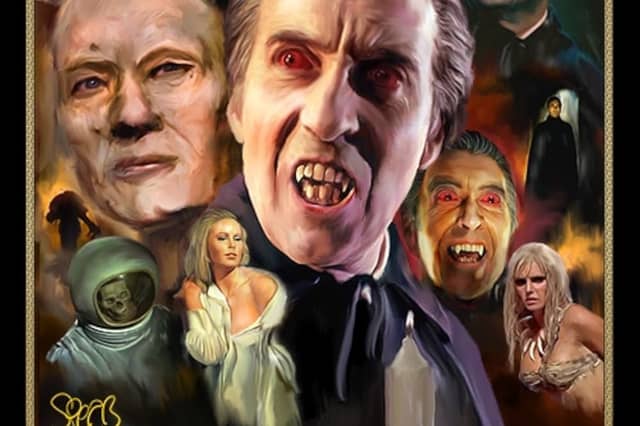

From Hammer Horror films and Christopher Lee’s wartime secrets to the medical mysteries behind vampires, zombies and werewolves, Halloween’s most terrifying creatures have some surprisingly human origins. And, as ever, the truth is almost as strange as the fiction.
It’s Halloween. Should we all dress up as Dracula, a werewolf or a zombie? My expertise with these horrors started as a teenager watching Hammer Films. For younger readers, by which I mean anyone under seventy, these were a series of horror films churned out in the 1960s. They were all X rated which made them more exciting when I crept in at the age of sixteen lying about my age.
They nearly always starred Peter Cushing and Christopher Lee. I once heard Peter Cushing being interviewed about another film. One scene had taken several hours. The interviewer asked, “Did you ever take this long filming a scene for the Hammer Horror films?”
“In this time”, he answered, "we would have finished the film and started the next one”.
But Christopher Lee had a dark side which he never discussed. When filming a World War Two movie there was a scene in which a sentry was stabbed in the back and killed. Christopher Lee turned to the director and said, “that is not the noise a victim would make”.
“How do you know?”
“I was in the special forces in the war.” He never added anything else and no one asked.
Where did the idea of Vampires, Zombies and Werewolves come from? There were legends in Eastern Europe before they appeared on the screen.
One idea about zombies comes from the fact that bodies need oxygen to decompose (sorry if you’re squeamish but it is Halloween). Burial in some soils can lead to the coffin being deprived of air. If dug up the body would appear as though it was not decomposed but opening the coffin would allow oxygen in which would speed up decomposition. This could be the basis of the myth that the undead are destroyed by sunlight. It was not sunlight but oxygen but that does not make such a great horror movie.
One medical theory explaining vampires is the idea that they had porphyria. This is a rare inherited condition when there is build-up of porphyrins in the body. These natural chemicals are used to make haemoglobin in the blood. Sufferers experience extreme photosensitivity. Going out in the sun is very painful. They also have receding gums which could make their teeth look like fangs. Their skin is disfigured and they have a severe reaction to some foods including garlic. I am sure that a steak through the heart, whether sirloin or rump would also have an adverse reaction. Hammer movies could not afford fillet.
The most famous vampire, Dracula, has a more recent history. He was invented by the writer Bram Stoker in his book in 1897, although based of Eastern European folklore. He was supposed to be inspired by the fifteenth-century Romanian Vlad the Impaler which must be the best example of nominative determinism. Was he asked when he was a child, “Vlad, what do you want to do when you grow up?” He did derive his other name “Dracula” from an order of the knights meaning “son of the dragon”. He impaled thousands of Ottoman soldiers and political rivals which would not be compatible with the European Convention of Human Rights. Although an accepted theory none of Bran Stoker’s notes mention Vlad. Bram Stoker was originally going to call his vampire Count Wampyr until he found the name Dracula. Wampyr sound too much like Wimpy who would be killed by a 99 flake through the heart.
Werewolves go right back into antiquity from ancient Greeks and Romans, through Norse folklore and into mediaeval times. King Cnut a thousand years ago passed laws banning them. I am sure that worked well but I do not think the idea will be in the manifesto of any major party come the next election. There are again some medical theories. Rabies causes a fear of water, spasms, disorientation, agitation at night and foaming at the mouth. Could the tragic excluded people with rabies be mistaken for werewolves?
There is a rare condition called lycanthropy when someone has a delusion that they have become an animal. Were werewolves people who genuinely believed they were wolves? Today it might be argued that if they relate to being a wolf, we must accept it.
Enjoy Halloween. No one needs to take the history too seriously. Although the TV series and film “Ghosts” is defiantly not a Hammer Horror film one day I would like to haunt Torbay in a similar way. My column would then be ghost written.