CGI image of the proposed St Boniface development
Search


09 Mar 2026

Please allow ads as they help fund our trusted local news content.
Kindly add us to your ad blocker whitelist.
If you want further access to Ireland's best local journalism, consider contributing and/or subscribing to our free daily Newsletter .
Support our mission and join our community now.
To continue reading this article, you can subscribe for as little as €0.50 per week which will also give you access to all of our premium content and archived articles!
Alternatively, you can pay €0.50 per article, capped at €1 per day.
Thank you for supporting Ireland's best local journalism!


Whilst several of the planets are still in view in the evening sky, the astronomical highlight of March is the Sun.
The Spring or Vernal Equinox occurs on the 20th March. This day marks the beginning of Spring and is the day when day and night are of almost equal length (hence equinox) with 12 hours of light and dark. Following the equinox, days will get longer and nights will be shorter, allowing less time for astronomical observation.
Consequently (and somewhat paradoxically) it is at this time of year, on nights where the Moon does not interfere, that astronomer’s attempt a considerable observing challenge. Known as a Messier Marathon, after the French astronomer Charles Messier, who compiled a list of “faint and fuzzy” objects which were not to be confused with the comets he was searching for, the challenge is to view as many of the 110 objects in the list, in a single night, as possible.
I have taken part in a number of Marathons from the UK, from where some of the most Southerly objects barely rise above the horizon and only appear in the dawning light before sunrise, and the greatest number of objects I have achieved is 98.
We now know that these faint, fuzzy objects are a collection of gaseous nebulae, planetary nebulae, supernova remnants, galaxies and star clusters, all of which are worth observing and imaging in their own right. The Marathon only really allows for a “quick glimpse and tick it off the list” race against time but is still fun to do.
If the weather is good enough, members of the Torbay Astronomical Society will be at the observatory site on whichever one of the following dates proves possible: March 13th or 14th, or March 20th or 21st, with the second pair being the favourite as it is closest to the New Moon and there will be no moonlight to drown out the faint targets.
Although this is am all-night session, it is possible to “drop in” for just a short session and leave as one wishes. Arrangements to allow for access and yes/no decisions on the evening going ahead will be posted on the Society website and Facebook page.
Remember, this event will ONLY happen on ONE of the dates suggested above, and ONLY if the sky is mostly cloud-free.
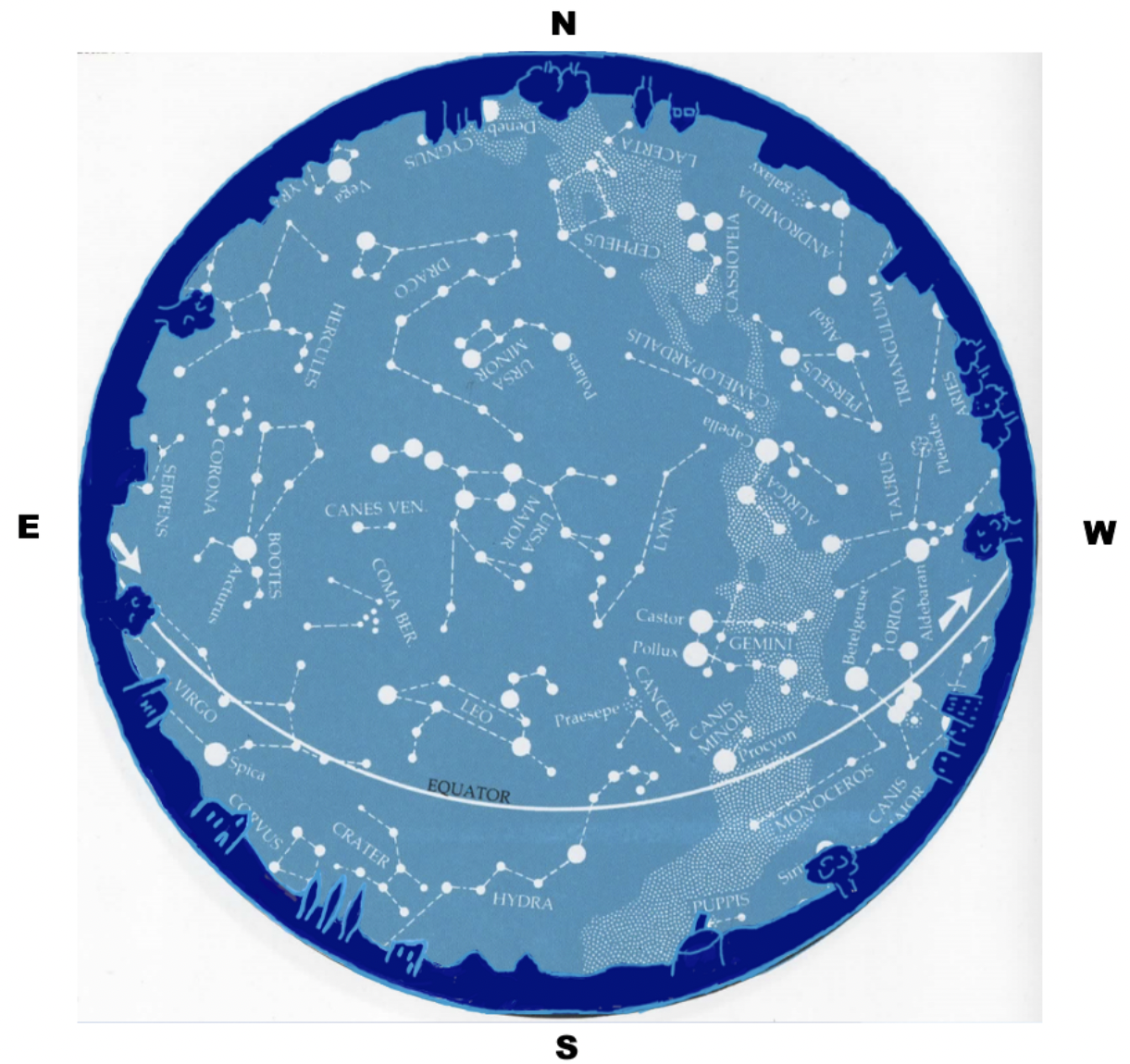
The Star Chart
The sky will look like the chart on March 7 at 9pm and again on March 21 at 8pm. And four minutes earlier on each successive night e.g. 8.56 on March 8.
To use the chart hold it above your head whilst facing South so that you can look directly from the chart to the sky.
Skynotes
Please note all times given in this article are in GMT which is the current time until the end of the month.
Sun: From the beginning to the end of March the hours of daylight increases from 11 to 13 hours. The Spring or Vernal Equinox (the day when night and day are of equal length) occurs on March 20. The clocks go forward by 1 hour to British Summer Time at 02.00am on March 30th.
Mercury: For the first couple of days of March, Mercury is technically visible before it sinks into the twilight at 7.00pm. It lies just to the right of much brighter Venus.
Venus: Venus is a brilliant object seen low in the West after sunset. Venus sets at 7.30pm so is also a brief visitor to our skies at the moment.
Mars: Mars is too close to the Sun to be visible this month.
Jupiter: The giant planet, Jupiter is visible most of the night, setting around 4,00am. It is easily visible to the naked eye and a good pair of binoculars will show the disc and the Galilean satellites.
Saturn: Saturn lies just above Venus in the Western sky, seen against the background constellation of Pisces and setting around the same time. It is technically visible at the beginning of the month but, like Mercury, will soon be lost in the Sun’s glare.
Uranus and Neptune: Uranus is visible until midnight, just below the Pleiades, in Taurus. This may offer an imaging opportunity although the planet is now too faint to be seen without very good binoculars or a telescope. Neptune lies in Pisces, just to the right of Saturn and suffers from the glare from the Sun.
Meteor Shower: There are no regular meteor showers this month. However stray or sporadic meteors can still be seen at any time. Some of these can be very bright.
Deep sky: March is also the time of year when the greatest number of deep sky object – star clusters, nebulae and galaxies can be seen. Amateur astronomers often do an “all-nighter” observing session to see as many of the brighter “Messier” objects as they can in a single night. This is known as a Messier Marathon. (see main article)
The Full Moon occurs on March 3rd with Last Quarter on 11th, New Moon then follows on 19th March and First Quarter on 25th.
Data supplied by Dale Giles, Torbay Astronomical Society
The next meetings of the Torbay Astronomical Society will be held at Torquay Boys Grammar School, Shiphay Manor Drive, TQ2 7EL.
On March 12th in the Sixth Form Suite, our speaker will be Former Torquay Boys’ Grammar School student and Torbay Astronomical Society member, Will Gater FRAS who is a successful and highly regarded Astronomy blogger, presenter, contributor and author and who will give a talk entitled .
“Drawing Inspration from the Moon”. And, on March 26th, an observational evening will be held in Room PL4 and the Observatory (weather permitting) when members will be delighted to provide views of the objects discussed in this article.
In the event of bad weather, short talks and videos will be presented alongside informal discussion and an opportunity to get to know the Society.
For details, contact the Secretary TAS on astrosecretary@gmail.com Visitors and prospective members especially welcome.

Subscribe or register today to discover more from DonegalLive.ie
Buy the e-paper of the Donegal Democrat, Donegal People's Press, Donegal Post and Inish Times here for instant access to Donegal's premier news titles.
Keep up with the latest news from Donegal with our daily newsletter featuring the most important stories of the day delivered to your inbox every evening at 5pm.