Search


31 Jan 2026
Search
31 Jan 2026

Please allow ads as they help fund our trusted local news content.
Kindly add us to your ad blocker whitelist.
If you want further access to Ireland's best local journalism, consider contributing and/or subscribing to our free daily Newsletter .
Support our mission and join our community now.
To continue reading this article, you can subscribe for as little as €0.50 per week which will also give you access to all of our premium content and archived articles!
Alternatively, you can pay €0.50 per article, capped at €1 per day.
Thank you for supporting Ireland's best local journalism!

Alison Hernandez in Torquay

Devon Crime Commissioner proposing an increase in the police part of next year’s council tax of £15 a year for an average Band D property.
Devon Crime Commissioner Alison Hernandez was today proposing an increase in the police part of next year’s council tax of £15 a year for an average Band D property.
This increase, if supported at a meeting of the Police and Crime Panel, would mean an average Band D household would pay an extra £1.50 a month (if paid over 10 months).
Commissioner Hernandez said she feared officer numbers would be at risk if councillors on the Panel did not approve the increase, equal to 5.2 per cent a year, after a government grant settlement which has left the force with a budget shortfall or around £3million for 2026-7.
43 per cent of the funding for Devon and Cornwall police comes from council taxpayers, a far higher proportion than many other parts of the country, with the rest of the budget coming from central government.
Devon and Cornwall have received one of the lowest government funding settlements for policing nationally, with only four policing areas in England and Wales being left with less spending power (Cleveland, Greater Manchester, Norfolk and South Wales).
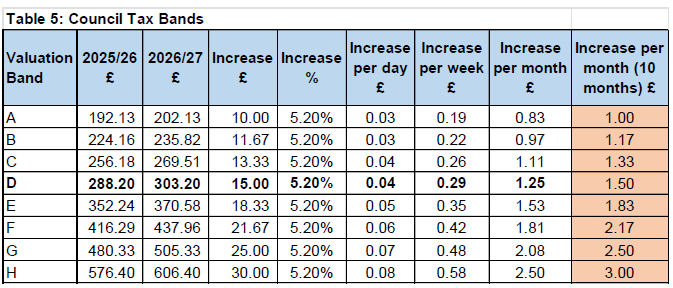
Devon council tax bands
The government caps the amount that police commissioners are allowed to increase council tax at £15 for a Band D property, but even with the maximum increase allowed, the budget for Devon and Cornwall Police will only increase by 4.2 per cent in 2026-7 compared to the national average of 4.5 per cent.
One of the reasons for the shortfall is that money which was previously linked to the recruitment of extra officers has been reduced by half. A figure of £5million which had previously been allocated to cover the cost of recruiting 95 officers has been reduced in this funding settlement to £2.5million. This means the Devon and Cornwall force has been left with a funding gap equivalent to the loss of 47 officers (half of 95).
Commissioner Hernandez said: “The new government settlement appears to effectively penalise the force for this success in meeting national recruitment targets by removing base funding for those officers. Across England and Wales the average grant increase for policing is 4.5 per cent, however in Devon and Cornwall that figure is 4.2 per cent. Only four policing areas in England have had a lower provisional settlement than Devon and Cornwall. This leaves me with an anticipated shortfall of around £3million and no choice but to ask taxpayers to pay more.”
The Commissioner says the Chief Constable has assured her the funding gap is unlikely to affect the total number of officers which remains at the record high of 3,610, because of £6 million of locally identified efficiencies already planned in next year’s budget.
One of other the reasons the force is not likely to have to reduce the number of officers is that the two counties have a very high proportion of second homes (charged 200 per cent council tax). Last year council tax contributions from second homeowners raised £6million, with a similar amount expected in 2026-7.
Ms Hernandez said: “Our communities deserve visible, effective policing. We have worked hard, alongside local taxpayers, to increase officer numbers to their highest level ever. It is deeply concerning that we now appear to be punished for doing exactly what government asked of us.”
The Commissioner has again highlighted long-standing issues with the police funding formula, which continues to fail rural and coastal areas. Devon, Cornwall and the Isles of Scilly face unique challenges including rurality, sparsity, and a significant seasonal influx of tourists, yet will receive less grant funding than the national average increase.
She said: “Many families are already under immense financial pressure, and I do not believe it is fair for the only option to be to ask people to pay even more. I have always committed to our local taxpayers that if they pay more they get more. For the first time, I’m going to have to ask people to pay more to get the same or less.”

Subscribe or register today to discover more from DonegalLive.ie
Buy the e-paper of the Donegal Democrat, Donegal People's Press, Donegal Post and Inish Times here for instant access to Donegal's premier news titles.
Keep up with the latest news from Donegal with our daily newsletter featuring the most important stories of the day delivered to your inbox every evening at 5pm.