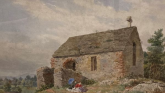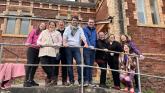
Volunteers and visitors at the old Paignton Monastery including (far left) Cllr Cat Johns (Image courtesy: Guy Henderson)
Search


07 Mar 2026

Please allow ads as they help fund our trusted local news content.
Kindly add us to your ad blocker whitelist.
If you want further access to Ireland's best local journalism, consider contributing and/or subscribing to our free daily Newsletter .
Support our mission and join our community now.
To continue reading this article, you can subscribe for as little as €0.50 per week which will also give you access to all of our premium content and archived articles!
Alternatively, you can pay €0.50 per article, capped at €1 per day.
Thank you for supporting Ireland's best local journalism!

Oliver Heaviside

Eminent world scientist who was so visionary his theories took decades to be proven and attributed. Oliver Heaviside - mathematician, physicist, electrical engineer would eventually even have craters on the Moon and on Mars named after him.
Throughout life forever hampered by deafness believed contracted through scarlet fever as a child Oliver finally left school at sixteen plagued by this, jaundice and gout. Yet it was deafness that being a lifelong bachelor eventually saw him turn into a recluse.
Born in the slums of London during May 1850 Oliver was an early publisher of papers on electricity having been inspired by James Maxwell - a specialist in the field of electric and magnetism. Having followed Olivers uncle Charles Wheatstone who in partnership with W F Cooke had patented the electrical telegraph system they also created a network which could measure resistance which would become known as "The Wheatstone Bridge". Oliver like Maxwell himself would follow a connection that virtually destined this mathematical genius into the world of studying science.
Oliver went to Camden House School until 1866 which saw him mastering morse code and studying electricity before taking a job as a telegraph operator in Denmark. Between 1870 and 1871 he published his first paper entitled "Comparing Electomotive Forces". On return to England he worked for the Great Northern Telegraph Company who were already operating telephonic traffic overseas. By 1873 a further paper was published which attracted the attention of Maxwell who then incorporated Oliver's results in his next edition of "The Treatise on Electricity and Magnetism". Oliver became obsessed with electromagnetism and the electromotive forces on Earth and being a renowned mathematician and electrical engineer he even predicted ionised particle layers in the Earth's upper atmosphere, being possibly able to bounce radio waves back to earth.
The theory was never officially accepted until a year before his death in Torquay yet way back in 1901 Guglielmo Marconi had proven the theory when sending radio signals across the Atlantic, though always at a loss to explain how this could occur bearing in mind they needed to cope with the curvature of the Earth. Marconi's name was permanently linked to the strange phenomenon though it was Oliver that was left to explain how wireless waves were "caught" by a magnetic layer in the atmosphere - a theory formally recorded in the tenth edition of Encyclopaedia Britannica in 1902.
Academics eventually called the " Kennelly-Heaviside Layer" through a joint recognition process as Arthur Kennelly of Harvard University USA had also issued papers on the ionised layer. Meanwhile Oliver simplified Maxwell's twenty equations into 20 variables by replacing them with two equations in two variables. But it was his increasing deafness that saw him leave the telegraph company to become self-employed working at home. The AC system had now been established some 15 years ago but it was Heaviside that created a symbolic method in 1874 when analysing AC circuits we still use today. Between 1880 and 1887 he also developed a new form of calculus and branches of "pure mathematics" enhancing our knowledge of the relationship between the Sun and the Earth's electromagnetism and gravitation pull.
Heaviside's third book on electromagnetism was now published although his fourth and final one would not appear until after his death. Having moved back to Devonshire in 1897 and Paignton he then moved to Newton Abbot where he remained eleven years. Yet ill health brought him back to Torbay in 1908 to live near his brother Charles, who owned a music shop in Torwood Street. Although Oliver was able to play the Aeolian Harp it was those mathematical and scientific skills that made him special.
Our recluse was eventually found unconscious at "Highfield" in Lower Warberry Road in 1925 and later died on February 3rd 1925 aged 74 in a Torquay Nursing home. Today Oliver lies buried in the family grave at Colley End Road Cemetery Paignton.

Subscribe or register today to discover more from DonegalLive.ie
Buy the e-paper of the Donegal Democrat, Donegal People's Press, Donegal Post and Inish Times here for instant access to Donegal's premier news titles.
Keep up with the latest news from Donegal with our daily newsletter featuring the most important stories of the day delivered to your inbox every evening at 5pm.