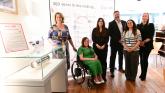
Kitson Boyce team members including (left) Kate Barton and third from right Rhodri Davey at the Torquay museum exhibition
Search


03 Apr 2026

Please allow ads as they help fund our trusted local news content.
Kindly add us to your ad blocker whitelist.
If you want further access to Ireland's best local journalism, consider contributing and/or subscribing to our free daily Newsletter .
Support our mission and join our community now.
To continue reading this article, you can subscribe for as little as €0.50 per week which will also give you access to all of our premium content and archived articles!
Alternatively, you can pay €0.50 per article, capped at €1 per day.
Thank you for supporting Ireland's best local journalism!

Many of us are familiar with the medieval St Michael’s Chapel opposite Torre Station. Less well known is another ruin next to the chapel.
However, this graffiti-covered arch deserves to be recognised as being essential to the success of Torquay’s early tourism industry.
The arch is all that remains of the Borough Meteorological Observatory. For a few short years between 1888 and 1902 it served to maintain Torquay’s hard fought-for place as the foremost amongst Britain’s 27 tourist resorts.
From the mid-nineteenth century instrument inventors and manufacturers had systematised weather observation and by 1880, pressure, temperature, wind, sky state, current weather, and visibility reports were being routinely disseminated across the nation.
Readings were being taken at specific times of the day and immediately transmitted by electric telegraph to central offices where they were plotted on maps. Responsibility for collating these observations and analysing charts lay with the organisation that became known as the Met Office.
Recognising the value of accurate weather reporting, in 1888 Torquay Town Council initiated the town’s Meteorological Observatory under the supervision of the Royal Meteorological Society.
It was decided that Torquay’s Observatory should be located on the 276-foot Chapel Hill taking advantage of its uninterrupted views and the solid limestone that prevented unwanted vibrations. Designed by J Hallwith, the Observatory was operated by Alfred Chandler with the sensitive instruments maintained by the Chapel Grounds Gardener.
It was built as one of a pair of stations, with another set of instruments on Cary Green. It was soon realised, however, that the harbourside station needed to be fenced off to prevent interference from enthusiastic and often inebriated Strand visitors.
The Chapel Hill facility included sunshine recorders, a Solar Thermometer by Negretti and a Snowdon Rain Gauge. In 1894 an Anemometer was installed which registered the velocity and direction of the wind. This invention by Dr. Robinson of Armagh consisted of four hemispherical cups of five inches diameter, fixed on twelve-inch arms, which revolved with the wind.
Each day, at 9.00 in the morning and 4.00 in the afternoon, Alfred and his associates would carefully enter the information provided by the equipment, check it again, make computations, and then distribute the data.
Across the nation observatories were taking these kinds of readings, though Torquay’s Observatory had a specific role to play.
Not all Victorian tourist resorts were the same. Each had its own personality and there was a definite hierarchy dictated by location, existing and hoped-for clientele, and the conscious decisions of its local elite.
Torquay knew exactly what it wanted to be. By 1850 the town was calling itself ‘the Montpellier of England’ and ‘the Queen of Watering Places’. In 1864 the Western Morning News described the town as “the most opulent, the handsomest and the most fashionable watering place in the British Isles”.
Competition for visitors, and for the right 'type' of visitors, was therefore intense and any natural advantages needed to be exploited to the full. As Torquay had good weather, it wanted to tell everybody as soon as it could.
Ever since local landowner Sir Lawrence Palk had built a new harbour in 1870 the Bay had been a favourite of aristocratic yacht owners who welcomed speedy weather reports; and so Torquay was one of the first Victorian resorts to record daily sunshine hours.
During the 1870s and 1880s, however, the nobility began to take their summer and winter holidays abroad. A new kind of elite visitor was then needed to maintain the town’s status and reputation and it was the newly prosperous upper middle classes of industrial Britain that now had the spending power. They were eager to display their wealth and wanted to visit the same places as other sophisticates. Especially glamorous were those resorts frequented by the continent’s royal families. In this rivalry of the resorts, Torquay claimed to have more European royal visitors than anywhere else in the world.
Queen Victoria reviewed the Royal Navy in the Bay and the Russian Romanoffs built the Villa Syracusa, now the Headland Hotel, where they entertained the Russian Royal Family. Over at the Imperial Hotel could be seen Emperor Napoleon III of France, the Queen of the Netherlands, and the Prince of Wales.
Torquay was the ideal resort for the Belle Époque, ‘the Beautiful Era’, a period characterised by the optimism of Empire, regional peace, economic prosperity, and technological, scientific and cultural innovations. The town consistently attracted Victorian notables, such as Elizabeth Barrett Browning, Robert Louis Stevenson, Oscar Wilde, Charles Dickens, Alfred Lord Tennyson, George Eliot, Arthur Conan Doyle, Rudyard Kipling, Wilkie Collins, Benjamin Disraeli, and Henry James.
In 1886 Worth’s Tourist Guide to Devonshire declared Torquay to be “the wealthiest town in England” and in 1892 the town was granted borough status by Royal Charter, adopting the motto Salus et Felicitas, ‘Health and Happiness’.
It was via the Observatory that Torquay presented its attributes to the nation and the world. In 1897 Plymouth’s Meteorologist H Prigg acknowledged Torquay’s promotional success. He wrote: “It is undoubtedly by the system for distributing by telegraph the daily weather that the Climate of Torquay is so widely known and so fully appreciated.”
Each year the Observatory issued two thousand five hundred ‘Afternoon Reports of the Weather’ by telegram which were published daily under the titles ‘Weather at the South, Torquay’ or ‘Weather at the Sea-side Resorts’.
These notices appeared in: the Newcastle Chronicle; Glasgow Mail; Sheffield Telegraph; Yorkshire Post; Liverpool Post; Liverpool and Manchester Journal of Commerce; Birmingham Post; Birmingham Gazette; Bradford Observer; the Bristol Times & Mirror; the London Standard; Daily Chronicle; Western Morning News; The Western Daily Mercury; and the Queen Newspaper.
The newspapers were a vital way of promoting Torquay to those with the means to holiday; the Birmingham Post had a daily circulation of 27,000, while the London Standard was selling more than 250,000 copies.
Weekly, monthly and annual reports on the Bay’s weather were also published by: the Royal Meteorological Society; the Meteorological Office; Symons’s Meteorological Magazine; British Rainfall; the Torquay Directory; the Times; the Standard; The Natural History Society; and the Transactions of the Devonshire Association.
Beyond our shores, a Special Report was prepared on ‘The Climate of Torquay’ and published in the ‘Health Resorts of Europe’.
When in town locals and visitors were kept informed by daily reports available at the Strand and the Museum and sent to all Torquay’s principal hotels and boarding houses. The Observatory even became a tourist attraction in its own right and many visitors came to view these new wonders of technology and to take away printed reports.
But technology moves on and requires more space. In 1902 the Observatory closed and the equipment was moved to the end of Princess Pier.
Though this was the end of the Chapel Hill Observatory, another phase in Torquay’s tourism offer was just beginning. In 1902 the town launched its first advertising campaign to promote a new kind of tourism offer, the objective being to reposition Torquay from being a winter destination towards a summer holiday resort for families.
As the Observatory closed, grand architectural adventures befitting this new image were already being designed. The following decade then saw the building of a Baroque Town Hall, the Pavilion, and even an opera house based on Milan’s neoclassical Scala.
The up-market clientele continued to arrive though we should never forget that for fourteen years a forgotten ruin in the woods was Torquay’s main way of promoting itself as the centre of the British Empire at leisure.
As the Western Times recognised in 1923, the contest between the resorts was still seeing a small town on the south west coast as something special, “Torquay is not Brighton, neither is it Blackpool. It stands upon a different plane to these watering places. A higher one”.

Subscribe or register today to discover more from DonegalLive.ie
Buy the e-paper of the Donegal Democrat, Donegal People's Press, Donegal Post and Inish Times here for instant access to Donegal's premier news titles.
Keep up with the latest news from Donegal with our daily newsletter featuring the most important stories of the day delivered to your inbox every evening at 5pm.