

Look up, Torbay! Asteroid missions, meteor showers and November’s night sky

This month, Torbay stargazers can witness a spectacular display of asteroid missions and meteor showers, with the European Space Agency's Hera probe set to take up orbit around the asteroid Didymos and three meteor showers expected to peak in the region.
Chasing the DART
On 20 October 2022 NASA’s Double Asteroid Redirection Test mission (DART) impacted on the asteroid, Dimorphos in the hope of changing its orbital period. NASA’s expectations were to alter the asteroids orbit by around 73 seconds, after analysis of the impact it seems that the orbit has been altered by 32 minutes and is deemed a successful demonstration of potential asteroid deflection technology.
A double asteroid was chosen as the target as it would be relatively easy to compare the orbit of one of the pair around the other in a short time. In fact, Dimorphos is a 151 metre diameter moonlet, companion to another asteroid known as Didymos (Greek for “Twin”) which, itself, is less than a kilometre in diameter. Didymos is a member of the Apollo group of asteroids which are classified as potential threats to the Earth although there is no immediate threat from this pair.
It seems that the 32 minutes change was enhanced by the ejected material caused by the impact in accordance with Newton’s Third Law, “For every action there is an equal and opposite reaction”. So the force of the ejection “pushed” the asteroid further off course (like letting a partially inflated balloon go and the air “pushing” the balloon, itself, along).
This month, the European Space Agency’s Hera probe is due to take up orbit around Didymos in a follow-up mission to DART.
Hera will measure the size and shape of the crater caused by the impact of DART, as well as measuring the energy imparted to the asteroid, which will provide evidence of the efficiency of that mission to deflect the asteroid. Hera will also analyse the expanding cloud of debris thrown up by the impact, and make a thorough examination of the sub-surface and internal structure for the first time.
Hera is the first mission in ESA’s Space Safety Programme, which has been set up to monitor potential threats from meteor impact. However some scientists think that if the asteroid is already heading directly towards the Earth, then it is already too late as its momentum would be too great to overcome. The plan is, therefore, To nudge the asteroid into a different orbit before it begins its final trajectory.
The Star Chart
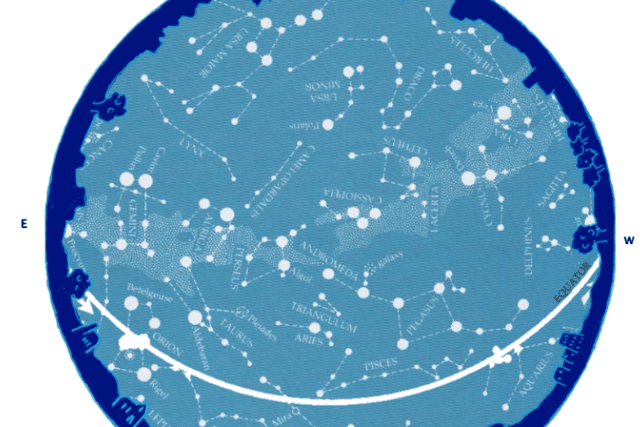
The sky will look like the chart on November 7 at 9pm and again on November 22 at 8pm. And four minutes earlier on each successive night e.g. 8.56 on November 8.
Skynotes
Please note all times given in this article are in GMT and as the clocks have changed that is the current time.
Sun: From the beginning to the end of the month the period of dark sky increases by an hour. At the beginning of the month the Sun sets before 5pm and by the end of the month by 4:15 pm after which there is the twilight period. The nights are really drawing in now and there are less than ten hours of daylight, making November a good time to observe fainter deep sky objects such as M42, The Great Orion Nebula, which is actually visible to the naked eye from a dark site. This cloud of gas is a star forming region in space and can be seen easily in binoculars or a small telescope. Find the three stars that form the asterism of The Belt of Orion and then drop vertically down from the middle star of these three. You will come to three much fainter stars forming the “sword”. The bottom one of these should seem rather fuzzy. This is the nebula, a cloud of glowing gas and not a star at all (although it contains newly formed, hot, young stars).
Mercury and Venus: Mercury rises just before the Sun in the already lightening sky. And is seen against the background stars of Virgo low in the Eastern sky. Venus shines brilliantly, also in Virgo, and lies very close to the bright star Spica. Venus rises a little before dawn and, in any case, can be seen in daylight if you know where to look.
Mars: Mars rises a little before midnight in the constellation of Leo, close to the asterism (a recognised shape within the constellation) of the back-to-front question mark. Mars lies very close to the much brighter Jupiter by mid-month.
Jupiter: The largest planet rises just before midnight and is also seen against the background stars of Leo. In the darker skies, the contrast allows the coloured bands and zones on the surface of the planet to be distinguished more easily with small telescopes, as can the Great Red Spot, a colossal hurricane, greater in diameter than the planet Earth. The Galilean moons can be seen with a good pair of binoculars or a small (bird-spotting) telescope. DSLR and smartphone images of the planet will also pick up the moons. These moons orbit Jupiter such that we sometimes see them pass between the Earth and the giant planet along our line of sight.
Saturn: The ringed planet can be found against the stars of Cetus, in the South-Eastern sky. Because Saturn’s orbit takes it further from the ecliptic than other planets, it can sometimes be seen against the background stars of non-Zodiac constellations. Cetus is “The Whale” and represents the mythical sea-monster sent to devour Andromeda. The rings are now edge-on to us but are beginning to open out again, making them more easily visible in a medium-sized telescope. Saturn’s largest moon, Titan, can be seen near the planet with a good pair of binoculars or a small telescope but, whilst the rings are edge-on it is worth looking out for 3 or 4 other moons, visible because of the lack of glare from the rings.
Uranus and Neptune: Uranus is visible just about all night long throughout November and is seen against the background stars of Taurus, lying between the Pleiades star cluster and the more open Hyades cluster that forms the “V” shaped head of the bull. Look for a tiny greenish disc compared to the pinpoints which are the stars. Neptune is seen against the background stars of Cetus a little way from Saturn. At magnitude 7.7 it will require large binoculars or a moderate telescope to find it. Neptune displays a smaller and truly blue disc compared to that of Uranus although it will appear only as a bluish star to most small instruments
We are fast approaching the season of meteors. This month sees not one, not two, but three meteor showers. The last in the month, the Leonids, is prone to outbursts called “meteor storms” once every 33 years, as its parent comet returns near the Sun (unfortunately this is not expected until, between 2032- 2035. Nevertheless this shower often produced some bright meteors. The second in the month, The Northern Taurids is a shower that generally produces few but bright meteors and extends over a period of about 20 days.
The first shower in the month is the most problematic of all. The Guyfawkid meteor shower has its peak on November 5th and can produce reports of very bright, even exploding meteors. All joking aside, you would not believe how many spurious reports of unusual shooting stars are made on and around this date. And it is not just meteors.
The British UFO Society still asks its members to be especially aware of sightings of unusual phenomenon on November 5th along with November 17th (maximum of the Leonids) and August 12th (maximum of the Perseids)!
The Taurids occur from 20th and all the way through to 10th December. This shower seems to emanate from a point near the Pleiades. These meteors are particularly bright and are not affected by strong moonlight. In fact this shower contains large meteors that can produce fireballs – defined as bright enough to cast shadows. However, the Zenith Hourly Rate is only 12 (the ZHR is always quoted as if the radiant point was overhead, so is often greater than that actually observed when the radiant point is lower in the sky). The Taurids are associated with a comet called Encke, which has one of the shortest orbital periods of any comet; just 3.3 years.
The Leonid shower reaching its maximum on 17th is associated with a comet called Temple-Tuttle which has a 33-year orbit around the Sun. This is the shower which, once every 33 years, produces a meteor storm with thousands of meteors seen in a night. The last such storm was expected in 1999 but did not occur until 2001, so the next storm is expected sometime between 2032 and 2035.
Meteor Showers:
The Last Quarter Moon occurs on November 1st with New Moon on November 9th . First Quarter then follows on 17th and Full Moon is on 24th.
Sky Notes by Dale Giles, Observation Secretary, Torbay Astronomical Society
Diary Dates
The next meetings of the Torbay Astronomical Society will be held at Torquay Boys Grammar School, Shiphay Manor Drive, TQ2 7EL. On November 5th our regular observational evening will be held at the Observatory (weather permitting) when members will be delighted to provide views of the objects discussed in this article. In the event of bad weather, short talks and videos will be presented alongside informal discussion and an opportunity to get to know the Society. Then on November 19th Karen Williams, an archive researcher for the Norman Lockyer Observatory, will give a talk entitled “The Moon and Sir Norman”. For details contact the Secretary TAS on [email protected] . Visitors and prospective members especially welcome.