Search


03 Apr 2026
Search
03 Apr 2026

Please allow ads as they help fund our trusted local news content.
Kindly add us to your ad blocker whitelist.
If you want further access to Ireland's best local journalism, consider contributing and/or subscribing to our free daily Newsletter .
Support our mission and join our community now.
To continue reading this article, you can subscribe for as little as €0.50 per week which will also give you access to all of our premium content and archived articles!
Alternatively, you can pay €0.50 per article, capped at €1 per day.
Thank you for supporting Ireland's best local journalism!


Europa: Jupiter’s Very Icy Moon
In the last few years, NASA has had a very successful mission with its “Juno” probe orbiting Jupiter and making close passes of its larger moons.
Some of these moons, Europa and Ganymede in particular, are thought to have oceans of briny water beneath their icy surfaces. Such conditions are believed to be conducive to the formation of life, if these planetoids exhibit thermal vents such as those found in the deep oceans pf the Earth. These thermal vents would provide the energy for life to form in the darkness of the deep waters, much as it does on Earth.
However, this depends on a number of factors. The icy surface layers of both moons exhibit cracks and movement, so it has been estimated that the solid surface is only about one or two miles thick.
The ocean, in order to contain salts, must also be interacting with a solid surface below it. We now know that not all icy moon candidates have this. Some have oceans that are “sandwiched” between two icy layers so that there is no internal erosion of a crustal surface to produce the necessary salts.
Now, after much more data from the “Juno” probe has been analysed, it seems that the icy surface of Europa is, in fact, something like 18 miles thick. This suggests that the ocean is far colder than first thought and would not allow the transpiration of gases between the liquid layer and the surface so readily. It would simply take much longer for the gases to work through the ice. This is a severe setback for the search for life in our Solar System as Europa had been the most favoured place to look.
Two further missions, NASA’s “Europa Clipper” and the European Space Agency’s “JUICE” (Jupiter Icy moon Explorer) are already on their way to the giant planet and are due to arrive in 2030. Both of these missions are equipped with experiments to investigate the ocean below the icy surface. A “drilling” probe has been included in order to bore its way through the ice (believed to be only 1 mile thick at the time of launch) but it will almost certainly be unable to pierce an 18 mile thick layer of frozen water.
Both agencies still expect to learn a lot more about Europa but whether it remains a potential haven for non-terrestrial life we will have to wait and see
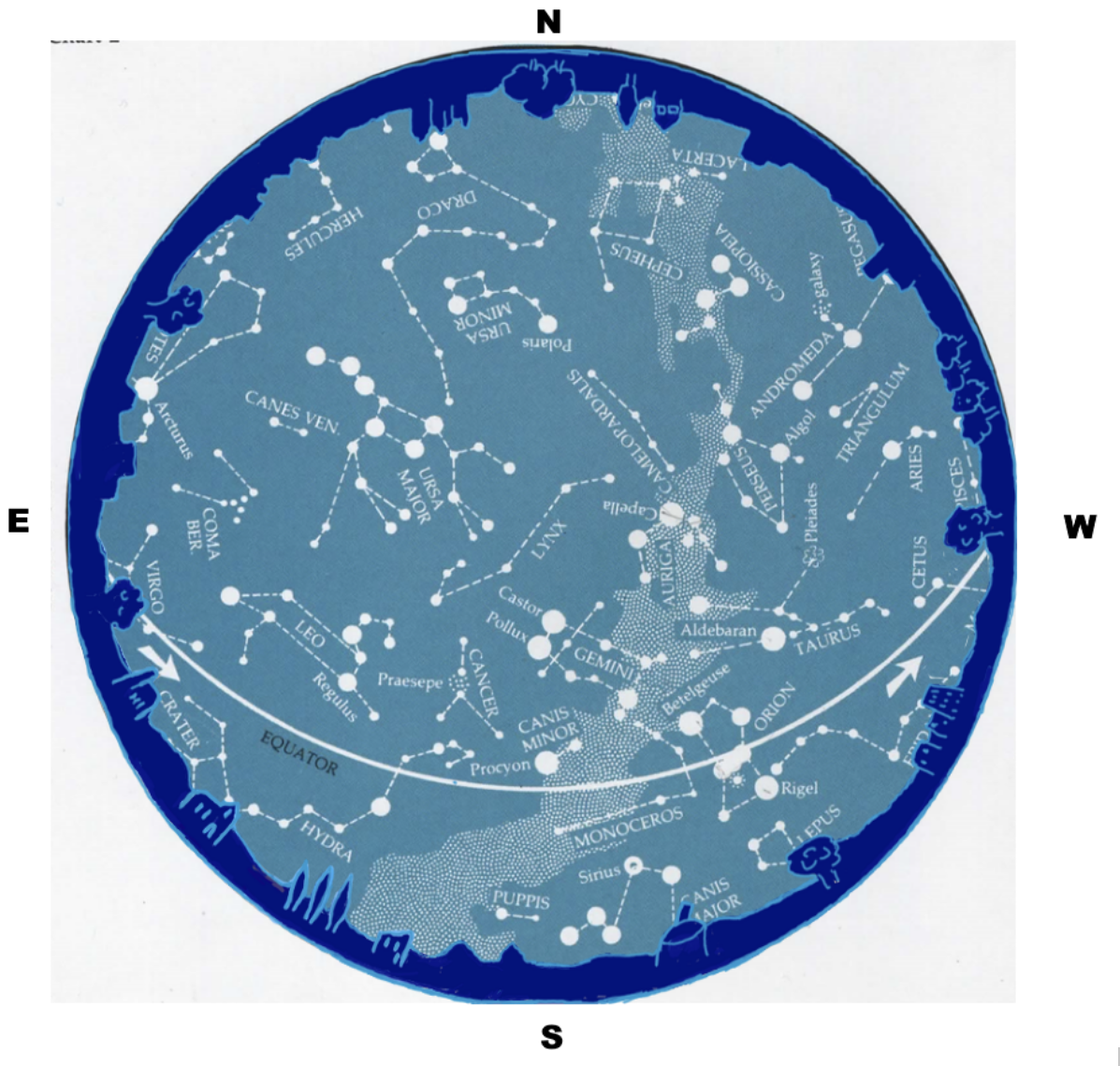
The sky will look like the chart on February 7 at 9pm and again on February 21 at 8pm. And four minutes earlier on each successive night e.g. 8.56 on February 8.
To use the chart hold it above your head whilst facing South so that you can look directly from the chart to the sky.
Please note all times given in this article are in GMT.
Sun: At the start of the month there are just 9 hours of daylight but as February progresses, the length of day will increase to almost 11 hours.
Mercury: Mercury will be visible on the Western horizon by mid-month. Despite reaching its maximum altitude on 20th it still hugs the horizon and will be difficult to see. The planet reaches its greatest eastern elongation (farthest distance East of the Sun) on 19th and this would be the best time to try and spot Mercury immediately after sunset. This date is, however, also when the planet reaches perihelion (closest point to the Sun) in its orbit. Take care never to look directly at the Sun when trying to see Mercury. The safest thing to do is to position oneself so that a wall obstructs the direct line of sight towards the Sun.
Venus: Venus is very close to the Sun and will be difficult to see this month.
Mars: Mars is not visible this month.
Jupiter: Jupiter is visible all night long and is seen high in the south-eastern sky, amongst the stars of Gemini. The four, large Galilean moons; Io, Europa, Ganymede and Callisto, can be seen with a good pair of binoculars or a small (bird-spotting) telescope. DSLR images of the planet will also pick up the moons. The cold winter skies (if they are clear) give a much clearer and steadier image in a telescope or binoculars making observations much more satisfying.
Saturn: Saturn starts the month low in the Western evening sky, against the background stars of Pisces, and sets shortly after darkness falls.
Uranus and Neptune: Uranus is seen against the background stars of Taurus and close to the Pleiades star cluster. It is visible, although small and difficult to find, throughout most of the month. At magnitude 5.8 it is visible in binoculars. Look for a tiny greenish disc compared to the pinpoints which are the stars. Neptune is much lower in the sky, in the constellation of Pisces and close to Saturn. It, too sets shortly after darkness falls. At magnitude 7.8 it will require large binoculars or a small telescope to find it. Neptune displays a smaller and truly blue disc compared to that of Uranus although it will appear only as a bluish star to most small instruments.
Meteor Shower: There are no regular meteor showers this month. However stray or sporadic meteors can still be seen at any time. Some of these can be very bright.
Comet: Comet 24/P Schaumasse lies in the constellation of Leo. Although this comet is given as magnitude 7.5 and therefore should be visible in binoculars, it is a rather diffuse object and proves difficult to spot.
The Full Moon occurs on February 1st with Last Quarter on 9th, New Moon then follows on 17th February and First Quarter on 24th.
Data supplied by Dale Giles, Torbay Astronomical Society
The next meetings of the Torbay Astronomical Society will be held at Torquay Boys Grammar School, Shiphay Manor Drive, TQ2 7EL.
On February 12th well known blogger and contributor to the Sky at Night, Mary McIntyre FRAS will give a talk, via Zoom, entitled “The History of Women in Astronomy”. This talk follows on from her previous talk earlier in the season but is also readily accessible as a stand-alone presentation in its own right.
Then on February 26th, the society will hold its regular monthly observing evening in the Sixth Form Suite and the observatory (weather permitting) when members will be delighted to provide views of the objects discussed in this article.
In the event of bad weather, short talks and videos will be presented alongside informal discussion and an opportunity to get to know the Society. For details contact the Secretary TAS on astrosecretary@gmail.com .
Visitors and prospective members especially welcome.

Subscribe or register today to discover more from DonegalLive.ie
Buy the e-paper of the Donegal Democrat, Donegal People's Press, Donegal Post and Inish Times here for instant access to Donegal's premier news titles.
Keep up with the latest news from Donegal with our daily newsletter featuring the most important stories of the day delivered to your inbox every evening at 5pm.