Search


03 Apr 2026
Search
03 Apr 2026

Please allow ads as they help fund our trusted local news content.
Kindly add us to your ad blocker whitelist.
If you want further access to Ireland's best local journalism, consider contributing and/or subscribing to our free daily Newsletter .
Support our mission and join our community now.
To continue reading this article, you can subscribe for as little as €0.50 per week which will also give you access to all of our premium content and archived articles!
Alternatively, you can pay €0.50 per article, capped at €1 per day.
Thank you for supporting Ireland's best local journalism!

Vickery medals (Picture courtesy of: Noonans)

A South Devon war hero’s special medal for bravery during the Crimean War is to be auctioned.
Private Samuel Vickery was also renowned for keeping Florence Nightingale safe as one of her ‘bodyguards’ during the war.
Samuel Vickery, the son of an illiterate labourer, was born in Kenton in August 1826.
Private Vickery, of the Coldstream Guards, was awarded the Distinguished Conduct Medal which is being offered in an auction of ‘Orders, Decorations, Medals and Militaria'at Noonan in London’s Mayfair on Wednesday, January 14 where it is expected to fetch between £7,000 and £9,000 and is being sold by a private collector.
Oliver Pepys, associate director and medal specialist at Noonans, said: “Devon-born Vickery was struck down by frostbite after the battle of Inkermann and found himself facing an uncertain future. That was until Florence Nightingale, a close colleague, came to his aid.
“The heroine of the Crimea intervened to ask that Vickery be appointed her orderly and an effective bodyguard. It was an appointment that was to prove crucial to the success of her role in treating the wounded and introducing new health practices that have echoed down the years.”
He added: “The auction brings to life once more the fascinating tale of how an army private became Florence Nightingale’s indispensable and trusted bodyguard, about whom she wrote ‘I cannot speak too highly of Vickery’s honesty and trustworthiness.’”
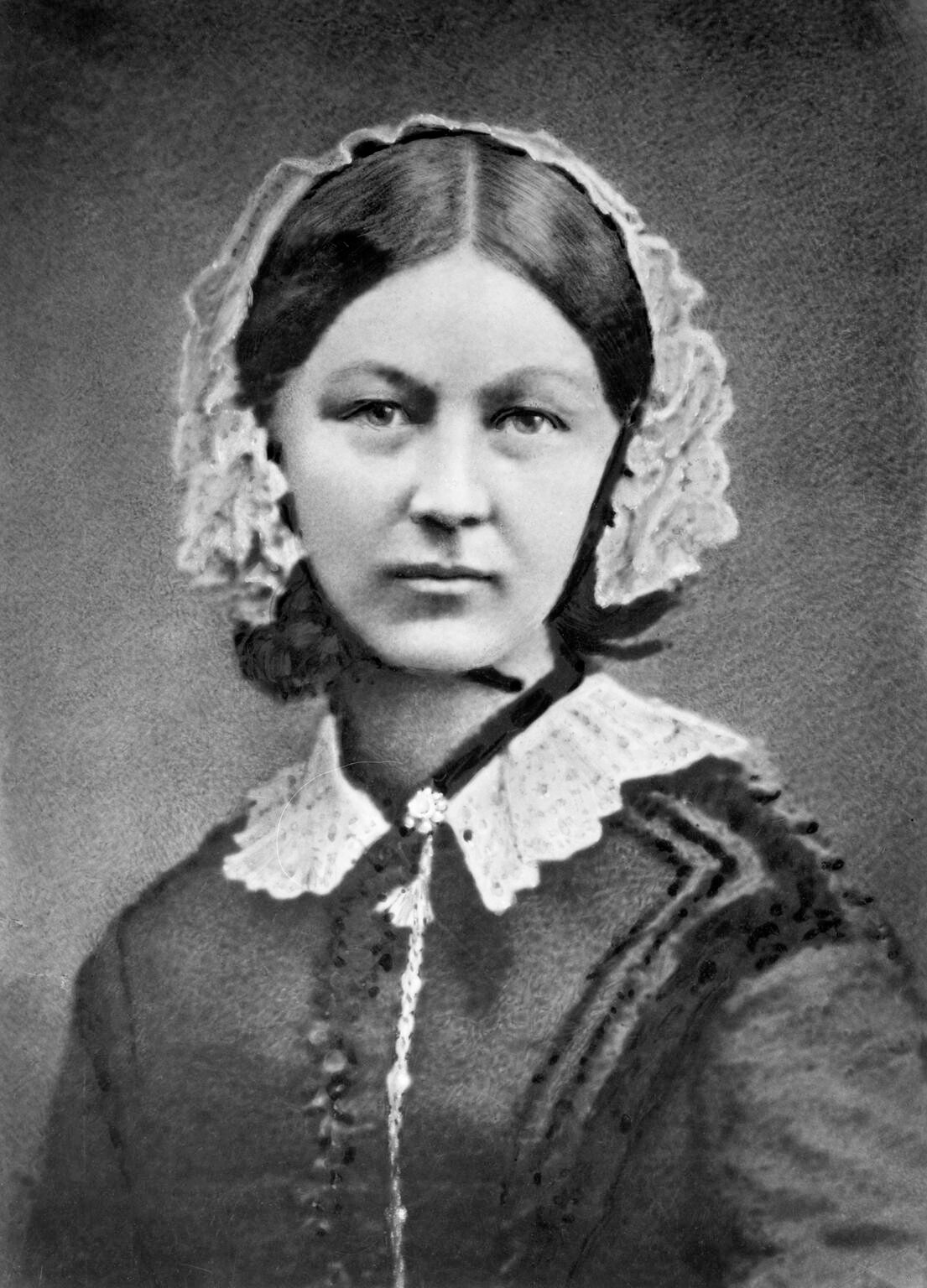 Florence Nightingale (Picture courtesy of: Wikimedia Commons)
Private Vickery had won his DCM during hand-to-hand fighting at Inkermann on November 5, 1854, when he was part of a force that held the Russian enemy at the point of a bayonet and helped recapture a vital battery.
The Coldstream Guards lost eight of their 16 officers and upwards of 200 rank-and-file of the 400 men that had advanced.
Vickery’s frostbite was almost certainly mostly in his feet, and he probably lost several toes, which may have permanently affected his balance.
He was certainly too serious a case to stay in the regimental hospital camp and was evacuated, first to the British Army Hospital at Balaklava and then to the Base Hospital at Scutari, on the Asian side of the Bosphorus, opposite Constantinople.
At Scutari, he found himself in the care of the 34-year-old Florence Nightingale, who had arrived from England only a few weeks before.
She oversaw what was still at that time a filthy Barrack Hospital where infection was rife and such care as existed was provided by male army orderlies who lacked any nursing skills and were usually drunk and frequently ill disciplined. Submitting a written damning indictment about the conditions and lack of cleanliness, she also railed at the vermin and disgusting condition of the food supplies.
Private Vickery always waited for Miss Nightingale to finish her rounds at night and accompanied her on her daily journeys between the hospital and her house, where he had a room on the lower floor, close to the entrance.
It was Vickery who ensured Nightingale’s safety and protection from unwanted advances from drunken and licentious convalescents.
As the only woman allowed to enter the wards after eight at night, she soon acquired the admiring title, the Lady of the Lamp.
The significance of Vickery to the success of the Nightingale regime is reflected in an important letter she wrote to Colonel Gordon Drummond of the Coldstream Guards, General Hospital, Balaclava, on April 15, 1856.
It sold at Christie’s in November 2011. In it, Florence asks permission to retain Vickery as an orderly in the case of the regiment being ordered home: “Vickery was frostbitten soon after Inkermann and sent down to Hospital in Scutari. He recovered sufficiently to become one of my Orderlies and has since become indispensable. I cannot speak too highly of Vickery’s honesty and trustworthiness. On one occasion, he was the principal means of discovering a robbery, of a large amount, of stores.”
Vickery soon became indispensable to Miss Nightingale. Tall, an accomplished soldier, with over ten years of experience as a Guardsman, Vickery principally served as Miss Nightingale’s sounding board, personal protection expert and bodyguard, both in the dirty and dangerous environment of Scutari and during her visits to the two main hospitals in the Crimea.
Vickerye was discharged at the age of just 30. Little is known about him after that time, except that he married Sarah, a woman four years older than himself (possibly a widow).
By the census of 1871 he was listed as an ‘unemployed servant’, living with his wife in Broadclyst, East Devon, near to his sister.
No children are recorded as living in the house. Tragedy struck later that year when Vickery was killed in an accident while working as an agricultural labourer at Thorverton Mills on December 9. His leg became trapped in a water-powered chaff-cutting machine, pulling him into its mechanism. He died in the Devon and Exeter Hospital of a fractured leg and concussion of the brain, aged 45.

Subscribe or register today to discover more from DonegalLive.ie
Buy the e-paper of the Donegal Democrat, Donegal People's Press, Donegal Post and Inish Times here for instant access to Donegal's premier news titles.
Keep up with the latest news from Donegal with our daily newsletter featuring the most important stories of the day delivered to your inbox every evening at 5pm.