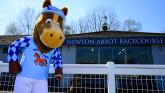
Left - Rob Murray, Chair of Trustees for Vigilance of Brixham and Richard Speckley, Commodore of Brixham Yacht Club, mark the signing of the lease
Search


01 Apr 2026

Please allow ads as they help fund our trusted local news content.
Kindly add us to your ad blocker whitelist.
If you want further access to Ireland's best local journalism, consider contributing and/or subscribing to our free daily Newsletter .
Support our mission and join our community now.
To continue reading this article, you can subscribe for as little as €0.50 per week which will also give you access to all of our premium content and archived articles!
Alternatively, you can pay €0.50 per article, capped at €1 per day.
Thank you for supporting Ireland's best local journalism!

September sees the start of the new season of meetings of the Torbay Astronomical Society at the Torquay Boys Grammar School. This season we are kicking off with an observational evening when there will be opportunities to come and meet us and, weather permitting, to take a guided tour around the Autumn constellations, view the planet Saturn and some deep sky objects such as M 12, a globular cluster and M 51, a pair of interacting galaxies known as “The Whirlpool”. (see Diary Dates).
After being lost in the light of the long summer evenings, the autumn sees the welcome return of all seven of the visible planets to our night skies. Albeit some of them are low in altitude and others begin rising towards midnight and beyond. These nights offer us the last views of Mars and Neptune before they become too faint for any serious observation, and our last view of the rings of Saturn before they fall edge-on to us and (almost) disappear from view for a time.
The darker evenings will make fainter, interesting objects such as nebulae, star clusters and galaxies more easily visible, and the potential nova, T Corona Borealis, is still, yet to explode into view.
With its 70th anniversary season just twelve months away, the society has lined up an impressive season of speakers, many of whom are leaders in their field.
September also begins a new round of outreach sessions. At the moment the diary is mostly free. Anyone who is interested in booking an outreach session for their group, school or club should contact me, John Stapleton at torbayastrochairperson@gmail.com with the word “outreach” in the subject bar.
by John Stapleton, Chairman, Torbay Astronomical Society
The Star Chart
The sky will look like the chart on September 8 at 9pm and again on September 23 at 8pm. And four minutes earlier on each successive night e.g. 8.56 on September 9.
To use the chart hold it above your head whilst facing South so that you can look directly from the chart to the sky.
Skynotes
Please note all times given in this article are in GMT so remember to add an hour to get the time in BST.
Sun: From the beginning to the end of the month the period of dark sky increases from 6.5 to 8.5 hours. The Autumnal Equinox, when night and day are of equal length, occurs on 27th. The longer period of darkness provides a good opportunity to view the summer constellations and the Milky Way that runs through them. The Milky Way is actually our view through the spiral arms of our Galaxy which we see as a faint band of light caused by millions of distant stars.
Mercury: Mercury is an early morning object seen low in the East before dawn during the first week of September. It is located against the background stars of Leo but is not well placed for observation.
Venus: Venus is also seen very low, this time in the western sky, rising around 7:00pm. It is a brilliant object which can be seen in the light evening sky and lies against the background stars of Virgo
Mars: Mars rises after 10:30 and is moving from Taurus into Gemini. The red planet is both small and faint at this time but still easily distinguished in a small telescope.
Jupiter: The largest planet precedes Mars into the Eastern sky and is seen against the background stars of Taurus. Jupiter is much brighter than Mars and so can be used as a guide to the red planet, and to Uranus which lies about the same distance on the other side of Jupiter. The coloured bands and zones on the surface of the planet can be distinguished with small telescopes as can the Great Red Spot, a colossal hurricane, greater in diameter than the planet Earth. The Galilean moons can be seen with a good pair of binoculars or a small (bird-spotting) telescope. DSLR images of the planet will also pick up the moons.
Saturn: The ringed planet can be found further South, against the stars of Aquarius. Saturn reaches opposition (closest point to the Earth and opposite the Sun in the sky) on 8th, The rings are now nearly edge-on from our point of view and the planet consequently appears fainter. Saturn’s largest moon, Titan, can usually be seen and because of the lack of glare from the rings, up to 5 other moons can be picked out using a moderate-sized telescope.
Uranus and Neptune: Uranus rises before Jupiter and is on the boundary between Taurus and Aries, close to the Pleiades star cluster. Neptune reaches opposition (due South in the sky and at its highest elevation) on 20th. At magnitude 7.7 it will require large binoculars or a small telescope to find it. Neptune displays a smaller and truly blue disc compared to that of Uranus although it will appear only as a bluish star to most small instruments.
Meteor Shower: There are no bright meteor showers due in September
Comet: There are no bright comets expected this month.
The New Moon occurs on September 3rd with First Quarter on 11th, Full Moon then follows on 18th September when there will be a Partial Lunar Eclipse. A thin shadow will fall across part of the Moon at about 02:45am. and Full Moon on 29th. Third Quarter then follows on 24th..
Diary Dates
The next meetings of the Torbay Astronomical Society will be held at Torquay Boys Grammar School, Shiphay Manor Drive, TQ2 7EL. On September 5th an observational evening will be held in Room PL4 and the Observatory (weather permitting) when members will be delighted to provide views of the objects discussed in this article. In the event of bad weather, short talks and videos will be presented alongside informal discussion and an opportunity to get to know the Society. Then, on September 19th, when Dr Benjamin Drummond of the Met Office will give a talk about “Mars”. Talks will be held in The Forum Lecture Theatre at the front of the school, unless otherwise advertised. For details contact the Secretary TAS on astrosecretary@gmail.com . Visitors and prospective members especially welcome.

Subscribe or register today to discover more from DonegalLive.ie
Buy the e-paper of the Donegal Democrat, Donegal People's Press, Donegal Post and Inish Times here for instant access to Donegal's premier news titles.
Keep up with the latest news from Donegal with our daily newsletter featuring the most important stories of the day delivered to your inbox every evening at 5pm.