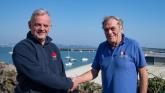
Left - Rob Murray, Chair of Trustees for Vigilance of Brixham and Richard Speckley, Commodore of Brixham Yacht Club, mark the signing of the lease
Search


01 Apr 2026

Please allow ads as they help fund our trusted local news content.
Kindly add us to your ad blocker whitelist.
If you want further access to Ireland's best local journalism, consider contributing and/or subscribing to our free daily Newsletter .
Support our mission and join our community now.
To continue reading this article, you can subscribe for as little as €0.50 per week which will also give you access to all of our premium content and archived articles!
Alternatively, you can pay €0.50 per article, capped at €1 per day.
Thank you for supporting Ireland's best local journalism!

With a new race to the Moon imminent, the legal rights of those involved have come into question.
Way back in 1969, even before the first Moon landings by US astronauts, a United Nations agreement reserving the lunar surface and its resources for the benefit of all humankind was signed by 100 countries. Then, in 1979 a further international agreement along these lines was proposed, stating that no single country, organisation or individual could own areas of the Moon.
This treaty also tried to ban nuclear weapons from space, but only 14 countries signed up to it. Not one of the countries that have actually successfully placed a lander on the Moon, China, India, Japan, Russia and the United States, not to mention the private companies that are involved with these missions or missions of their own, has signed. Rather the US has proposed a non-binding code of conduct of its own, to which 40 countries, but not China, have already signed up. The US has also passed a domestic law that essentially invites national agencies or private companies to “come and get it”.
Such short-sighted and selfish policies, whilst typical of today’s big business and governments, could involve the Moon, at best, as a new Antarctica, where international agreement has a tentative control, or, at worst, in a new Cold War in space. Would the eventual theoretical owners ban us from, or, more likely, charge us for looking at the Moon from the Earth, even though we have always been able to see it on most clear nights?
Some years ago companies “sold” plots of land on the Moon to individual speculators. This, rather like the “Buy a Star” craze which I have talked about before in this article, actually has no legal value. Both of these ventures could only guarantee to supply a certificate connecting your name to a star or piece of the Moon which recorded the fact that on a star map or moon map, or on a database in the companies’ head office, your name was recorded against the star or piece of the Moon you think you purchased. This registration on the map or data base is the only legal requirement.
Skynotes
Please note all times given in this article are in GMT so remember to add an hour to get the time in BST.
Sun: The Sun is never very far below the horizon at night until the latter half of July, so it never gets astronomically dark, and this is not the best time for the observation of faint objects. If you are able to safely observe the Sun, there are plenty of sunspots to be seen as our star is reaching the peak of its cycle of activity.
Mercury and Venus: Both of these inner planets are closer to the Sun than the Earth so are never very far from the Sun (especially Mercury). The innermost planet is best seen early in the month but will be very low in the west-northwest, so a low horizon is essential. Venus is not visible this month.
Mars: The red planet can be seen low in the east shortly after midnight. At this time it lies close to Uranus, which is also very faint. As the month progresses the red planet moves from the background stars of Aries to those of Taurus.
Jupiter: Rises half-an-hour, or so, after Mars and is also seen against the background stars of Taurus.
Saturn: The ringed planet can also be found rising in the south-eastern sky a bit earlier at about 11pm. It lies in the constellation of Aquarius.
Uranus and Neptune: Uranus is visible in the morning sky and is seen against the background stars of Taurus, quite close to Mars. Just visible to the naked eye, the planet can be seen in binoculars or a small telescope. Look for a tiny, distinctly greenish disc. Neptune rises shortly after Saturn but is now much fainter, Its blue disc can still be seen in good binoculars or a small telescope against the background stars of Pisces.
Meteor shower: The Delta Aquarid meteor shower peaks on 29 this month. This is not a very active shower but around 16 meteors an hour can be expected. The Alpha Capricornid shower is active for most of the month but the radiant never rises very high in our skies so only a small number of meteors are usually seen.
The New Moon was on July 5 with the First Quarter on July 13. Full Moon follows on July 21 with Last Quarter towards the end of the month on July 28.
Noctilucent clouds: It may seem anachronistic for astronomers to be interested in clouds, but these rare apparitions are best seen at this time of year. Noctilucent clouds are so high (over 80 km) in the atmosphere that they are able to reflect sunlight even when the Sun is well below the horizon.
The tiny ice crystals that make up the clouds reflect bluish-white light that stands out against the gloaming sky. They are typically seen 1 ½ to 2 hours after sunset low in the Northwest or before sunrise low in the Northeast.
Diary dates
The next meeting of the Torbay Astronomical Society will be the first in our new season in September. For details contact the secretary TAS on astrosecretary@gmail.com Visitors and prospective members are especially welcome.

Subscribe or register today to discover more from DonegalLive.ie
Buy the e-paper of the Donegal Democrat, Donegal People's Press, Donegal Post and Inish Times here for instant access to Donegal's premier news titles.
Keep up with the latest news from Donegal with our daily newsletter featuring the most important stories of the day delivered to your inbox every evening at 5pm.