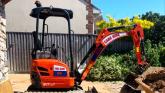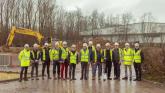
Gathering for a picture after breaking ground on the new Turnstyle Designs factory being built at Roundswell as the company expands into a new home.
Search


05 Apr 2026

Please allow ads as they help fund our trusted local news content.
Kindly add us to your ad blocker whitelist.
If you want further access to Ireland's best local journalism, consider contributing and/or subscribing to our free daily Newsletter .
Support our mission and join our community now.
To continue reading this article, you can subscribe for as little as €0.50 per week which will also give you access to all of our premium content and archived articles!
Alternatively, you can pay €0.50 per article, capped at €1 per day.
Thank you for supporting Ireland's best local journalism!


The Earls Court Motor Show always featured a spectacular display of Triumph motor cars, often all in one colour such as white, or red, for maximum effect.
In 1970, Triumph produced no less than 11 very different models – Spitfire, GT6, TR6, Stag, Herald, Vitesse, 1300, 1500, Toledo, 2000 and 2.5 PI – a mix of saloon, convertible, estate, sports car and coupe.
Some were front wheel drive but most were rear wheel drive.
The complexities of production were enormous with such a wide range including 4, 6, and 8 cylinder engines, fuel injection or carbs and a mix of separate chassis and monocoque design.
But the brand had great loyalty and was a leading example of the best of British.
We all love Triumph sports cars and I have just acquired a TR6 myself.
But this vast offering came with a price. They simply could not keep up with the tooling and multiple production line costs, spread over various locations across the country.
No one could ever claim they made dull cars. Far from it. Great then and still great now.
The last Triumph model was the Acclaim, introduced in 1981 and essentially a rebadged Honda Ballade built under licence from the Japanese company at the former Morris Motors works in Cowley, Oxford.
The Triumph name disappeared in 1984, when the Acclaim was replaced by the Rover 200, a rebadged version of Honda’s Civic.
The BL car division had by then been named the Austin Rover Group, which also ended the Morris marque as well as Triumph.
Had there been more creative imagination at British Leyland, some of these marques might have prospered past the strife ridden days of the 1970s.
Merging our collective motoring legacy into one brand was never a recipe for success.
BL was responsible for the loss of Riley, Wolseley, MG, Vanden Plas, Morris, and Austin.
As an example of how lacklustre the management was, they produced no less than six variants of the little 1100 family saloon with those aforementioned brands.
Multiple badge engineering at its worst. The public deserved better than that.

Subscribe or register today to discover more from DonegalLive.ie
Buy the e-paper of the Donegal Democrat, Donegal People's Press, Donegal Post and Inish Times here for instant access to Donegal's premier news titles.
Keep up with the latest news from Donegal with our daily newsletter featuring the most important stories of the day delivered to your inbox every evening at 5pm.