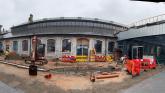
Historic Newton Abbot building restored with modern features and improved access (Image- Teignbridge Council)
Search


01 Apr 2026

Please allow ads as they help fund our trusted local news content.
Kindly add us to your ad blocker whitelist.
If you want further access to Ireland's best local journalism, consider contributing and/or subscribing to our free daily Newsletter .
Support our mission and join our community now.
To continue reading this article, you can subscribe for as little as €0.50 per week which will also give you access to all of our premium content and archived articles!
Alternatively, you can pay €0.50 per article, capped at €1 per day.
Thank you for supporting Ireland's best local journalism!

Torbay Astronomical Society
Many people either look forward to or dread the changing of the clocks at this time of year
Many people either look forward to or dread the changing of the clocks at this time of year. It may be that they look forward to longer hours of daylight or that they worry about remembering to change the clocks at all.
The original reasons for this change are rather mundane and are based on, at least someone’s idea that useful daylight was being wasted. The first person to suggest that people should arise earlier in the Summer was the American founding father, Benjamin Franklin.
When on a visit to Paris, in 1784 he suggested that the Parisians should be woken earlier by church bells ringing or cannons being fired in the streets.
The idea didn’t catch on but was revived in 1895 when a New Zealand scientist tried to convince his Government to move the clocks forward in the Summer by two hours. This suggestion also failed to find support.
The idea really caught on in Britain when a builder by the name of William Willett campaigned to get the clocks changed. It is thought that he was becoming frustrated at having his game of golf interrupted by “bad light” as the Sun began to set in the evenings.
He campaigned for the change all of his life, until he died in 1915.
What made Parliament finally adopt the change was the fact that in 1916 the Germans changed their clocks as a means of saving energy, and most of Europe, including Britain followed suit.
Since then, wartime measures have seen the changing of the clocks become a permanent fixture of our calendar, even adopting “double daylight saving” during WWII, when two hours were added.
There is much debate about the safety of dark Winter mornings or that the interruption to our natural rhythms of sleep are detrimental to our health.
One argument that does not hold water is that Farmers rely on there being enough sunlight for their crops to grow. The crops grow in the sunlight when the sunlight is there, whatever time of day it is.
Before the Industrial Revolution, when the agrarian population was larger, and certainly before the widespread use of accurate clocks, our ancestors were in tune with getting up when the Sun rose and going to bed when the Sun set and the time of day was irrelevant.
In 2019 the European Parliament voted to end the practice of changing the clocks altogether, but would allow individual countries to make their own decisions on whether they fixed on Summer or Winter Time.
This issue has still not been resolved. The British Government favoured Summer Time, even though Winter Time is measured in the only International Standard (Greenwich Mean Time or Universal Time) that British science can still claim to be the founders of.
The Star Chart
The sky will look like the chart on April 7 at 9pm and again on April 22 at 8pm. And four minutes earlier on each successive night e.g. 8.56 on April 8.
To use the chart hold it above your head whilst facing South so that you can look directly from the chart to the sky.
Skynotes
Please note all times given in this article are in GMT so remember to add an hour to get the time in BST which started on Sunday March 29.
Sun: On April 1, the sun rises at 06:47 and remains in the sky for 13 hours. This means that it does not get truly, astronomically, dark until about a quarter to ten. By the end of the month, the sun rises at 05:48 and remains in the sky for 14 ½ hours so that astronomical darkness does not fall until around 11 o’clock.
Mercury: Mercury is too close to the Sun to be visible this month.
Venus: Venus can be seen close to the horizon in the West, just after sunset It will gradually increase in altitude over the course of the month.
Mars: Mars is too close to the Sun to be visible this month.
Jupiter: The largest planet is a bright object seen high in the sky, in the constellation of Gemini. The giant planet is visible all evening, although it will set before the end of the night. The four “Galilean Moons”, two of which are as large or larger than the planet Mercury, are visible even in small telescopes or large binoculars.
Saturn: The ringed planet lies too close to the Sun to be visible, this month.
Uranus and Neptune: Uranus is still visible in the constellation of Taurus, below the Pleiades star cluster, but sets soon after the Sun and will be too close to our star to observe, by the end of the month.
Neptune is too close to the Sun to be seen this month.
Meteor Shower: April is our first chance of the year to see shooting stars, or more formally meteors.
The Lyrid meteor shower falls in April. It appears to come from a point in the sky lying in the direction of the background constellation of Lyra and so is known as the April Lyrids. Look out for these meteors between April 16 and 25 . The peak time falls on the night of 22 to 23.
Meteors are the remnants left in the path of comets as they orbit the Sun. We see them when the Earth passes through a cloud of these remnants. The April Lyrids are the remnants of Comet Thatcher.
This year the Moon is nearing Full and so its light will drown out all but the brightest meteors. The Lyrid meteors are relatively slow-moving and can include some bright shooting stars.
Comets: There is the possibility of two comets being visible during April. Comet C/2026 A1 MAPS, named after the initials of the survey team that discovered it is a “Kreuz Group” comet. This group of comets are also known as “Sungrazers” because their closest approach to the Sun is near enough that the gravitational forces could rip it apart and the material swallowed by the Sun.
If the comet survives this it may, as previous “Sungrazers” have, become exceedingly bright as it passes by the Earth. In some historic cases, bright enough to be seen in daylight. April 5 to 10 will provide the best viewing opportunities, although the comet will lie close to the Western horizon and will best be seen in the Southern Hemisphere. Ensure you are unable to look directly at the Sun by positioning yourself at the corner of a wall so that the line of sight to the Sun is obscured.
The second comet is C/2025 R3 PanSTARRS, similarly named. This is a more normal comet that reaches its closest to the Sun on April 20 th and closest to the Earth a week later. It is expected to reach binocular, or possibly naked-eye visibility and can be found near the Square of Pegasus in the pre-dawn sky.
The Full Moon occurs on April 2, with the Third Quarter following on April 10 . The New Moon is then on April 17 with the First Quarter occurring on April 24.
The next meetings of the Torbay Astronomical Society will be held at Torquay Boys Grammar School, Shiphay Manor Drive, TQ2 7EL. On April 9 the speaker will be John Stapleton who will give his “Chairman’s Address” entitled “Around the Ecliptic in 80 Frames” in the Sixth Form Centre. And on April 23 an observational evening will be held in the same rooms and the Observatory (weather and dark skies permitting) when members will be delighted to provide views of the objects discussed in this article.
In the event of bad weather, short talks and videos will be presented alongside informal discussion and an opportunity to get to know the Society.
Both meetings commence informally at 7pm. For details contact the Secretary TAS on astrosecretary@gmail.com . Visitors and prospective members especially welcome.

Subscribe or register today to discover more from DonegalLive.ie
Buy the e-paper of the Donegal Democrat, Donegal People's Press, Donegal Post and Inish Times here for instant access to Donegal's premier news titles.
Keep up with the latest news from Donegal with our daily newsletter featuring the most important stories of the day delivered to your inbox every evening at 5pm.