It wasn’t until 1928 that women achieved the right to vote, and Torquay’s campaigners were at the forefront of that struggle.
Our earliest local glimpse of the issue that was to divide the nation was in 1866 when Mary Caroline Cockrem of 10 Strand Torquay was among 1,499 women who signed a petition to extend the vote to all householders, not just men.
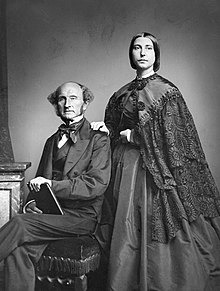
This petition was the start of the women’s suffrage movement, the first version being drafted by the feminist Helen Taylor (1831-1907), stepdaughter of John Stuart Mill. Together they promoted women’s rights.
A lifelong campaigner, the stress of work took its toll, and in 1904 an exhausted Helen retired to Torquay.
Above: Torquay resident early feminist Helen Taylor with her stepfather John Stuart Mill
During the campaign for voting rights, Torquay had two organisations with differing tactics. These were the National Union of Women’s Suffrage Societies (NUWSS) and the Women’s Social and Political Union (WSPU). They were to become known as the Suffragists & the Suffragettes.
In 1897 the various suffrage organisations had united into the 100,000-member National Union of Women’s Suffrage Societies.
The NUWSS attempted to convert the public by reasoned argument and through peaceful change. Accordingly, they lobbied, petitioned, and held public meetings. In January 1914, for instance, a rally with speakers from all three political parties, titled ‘Why not give women the vote?’, was held at St. Marychurch Town Hall.
To convert men to their cause, the NUWSS welcomed male members. Hence, in July 1913, we have Admiral Sir William Acland motoring a Torquay contingent to a demonstration in Exeter. The town’s Society also organised ‘pilgrimages’ to Totnes, Newton Abbot, Teignmouth, and Dawlish.
As the NUWSS was supported by prominent members of society, Lady Acland being their Torquay president, it was well-funded and able to open offices at 19 Abbey Road.
However, parliamentary bills for female suffrage were each defeated. One suffragist, Emmeline Pankhurst, was so frustrated that in 1903 she founded the breakaway Women’s Social and Political Union. Their motto was ‘Deeds not Words,’ and their tactics became increasingly confrontational. The Daily Mail coined the term ‘suffragette’ to distinguish these militants from the moderate suffragists.
The WSPU were very active in the Bay and in March 1911 organised a Torquay Theatre meeting titled ‘Votes for Women’. The main speaker was militant working-class suffragette Annie Kenney who commended “the splendid fishermen of Brixham who were keen supporters of the women’s cause”.
She told her audience: “Some people are inclined to think that an MP is a wonderful man, and that they just bow down to him. Women are not afraid of MPs. I am here to tell you that we women are going to have the vote, and that quickly.”
In July 1912, Christabel Pankhurst launched an arson campaign which targeted the houses of MPs and public buildings. In response, the Government banned the WSPU’s demonstrations and jailed activists, causing a rapid decline in the suffragettes’ membership. At a local level, Torquay’s police warned that suffragettes were planning to burn down holiday accommodation, something that was designed to touch a raw nerve in the resort.
In May 1913 another Torquay WSPU meeting was held. The hostile local paper reported that “only a score of women were present to hear Miss Mary Phillips, the Devonshire organiser, who does not mince words in her advocacy of militancy”.
Mary announced that there would have to be “more secret work and they would be more in the position of outlaws”.
Also present was the Women’s Tax Resistance League, who refused to pay tax until women received the vote. 220 British women participated in tax resistance; one being a Miss Baker who had her goods seized by the Torquay courts.
In June 1914 local Suffragettes took action. Leaflets inscribed, “Votes for women or ceaseless militancy” were dropped into Torquay’s pillar boxes along with ink cartridges designed to damage letters. The resort’s police then began to keep an even closer watch on activists.
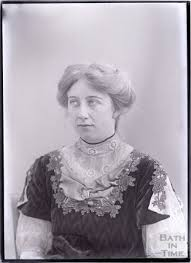
Between 1909 and 1914 Torquay’s Suffragette Organiser Elsie Howey (1884-1963) was “in the vanguard’ of militancy”.
Elsie’s commitment to the cause began in her early years when she lived in Germany and “she had first occasion to realise women’s position”. She later joined the WSPU and in February 1908 was arrested for taking part in a demonstration outside the House of Commons. She was sentenced to six weeks’ imprisonment and, on release, immediately went to help at a by-election in Shropshire.
Above: Jailed six times - Torquay’s ‘hooligan' suffragette Elsie Howey
Elsie was detained for the second time demonstrating outside the home of Herbert Asquith and sentenced to three months’ imprisonment. On her release she was met at the gates of Holloway Prison and drawn by fifty women on a carriage to Queen’s Hall. On arrival she was presented with bouquets in the suffragette colours and with illuminated scrolls, designed by Sylvia Pankhurst, to commemorate her imprisonment.
Elsie had responded to a call for “young women with private means” to work as honorary WSPU organisers. Supported by her mother, she spent the year working to establish a Suffragette presence in Devon and in March 1909 was appointed organiser in Torquay and Paignton, later opening a WSPU shop in Torquay.
An article in ’Votes for Women’ used Elsie’s commitment to recruit more activists: “I say to you young women… come and give one year of your life to bringing the message of deliverance to thousands of your sisters… this noble girl is one of our most able and successful organisers.”
On 16 April 1909 Elsie achieved national recognition when she headed a WSPU demonstration, dressed as Joan of Arc, in a full set of armour, “astride a great white charger”, to welcome Emmeline Pethick-Lawrence on her release from Holloway Prison.
On 30 July she was again arrested for demonstrating at a Penzance meeting held by Lord Carrington and sentenced to seven days’ imprisonment. Elsie promptly went on hunger strike for 144 hours. On her release she was presented with a travelling clock by Torquay’s Suffragettes.
On 5 September she was involved in an assault on Herbert Asquith and Herbert Gladstone while they were out playing golf. Elsie and her friends also climbed into Lympne Castle in Kent where the prime minister was staying. They demanded “votes for women” through the window while the Asquiths dined, escaping via an adjacent canal.
Elsie was once more arrested on 14 January 1910 and sentenced to six weeks hard labour. It happened again in March 1912 when she took part in the WSPU window-smashing campaign. This time it was four months imprisonment.
At the end of 1912 she was back in Holloway for setting-off a fire-alarm. Her final jailing was in December 1912, though she was released early following a hunger strike which prompted questions in parliament.
More moderate suffragettes condemned the violence: “We hear of terrible things by the two Hooligans we know, Vera and Elsie… They made a regular raid on Mr. Asquith breaking a window and using personal violence. Then missiles have been thrown lately through windows during Cabinet Members meetings which might injure or kill innocent persons.”
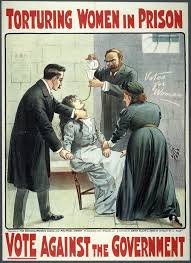
During her terms of imprisonment, Elsie faced forced feeding which broke most of her teeth; “her beautiful voice was quite ruined”.
Elsie left public life when militancy ended in 1914. She followed no career, and never fully recovered from the sacrifices she made. She was “tired and ill” for much of her life, her health “almost certainly connected to her numerous forcible feedings”.
Elsie died in 1963.
Women were partly enfranchised in 1918, but it wasn’t until 1928 that the female voting age was lowered to 21 in line with men. Both the Torquay NUWSS and the WSPU had, in their own ways, played their part in campaigning for change.
In the 2024 general election voter turnout was 60 per cent.