

Scylla and Charybdis: Working Between Craft and Industry
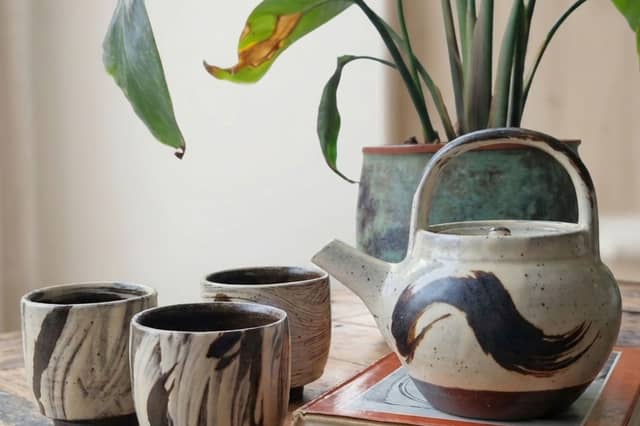

M.J. Holmes is a pottery-maker based in Torre whose work draws on the Leach tradition, English slipware, Oriental stoneware, and philosophy rooted in literature and science. Having spent over thirty years working across craft, industry, education and back to the wheel, he’s having his first exhibition now at Sienna Editions. We talked with him about his journey, his influences, and what this moment means.
You stumbled into pottery quite by accident, watching a friend throw at Ripon College. Can you take us back to that moment?
“Having studied it at school, my friend Mark was already a pretty good thrower at the age of nineteen. It was the magic of seeing him pull a tall form up and out from this amorphous lump of grey clay. Of course, I’d seen the famous interlude piece, but to watch it happen before my eyes, well, I had to have a go myself. It was the whole ‘head, hand and heart’ thing, you know? I was searching for a meaning to my life and at that time, teaching didn’t sit right with me; I hadn’t the experience to pass on to youngsters. Pottery came to me in my hour of need, really.”
Your practice draws on so much - the Leach tradition, English slipware, Oriental stoneware, and philosophy from Coomaraswamy and Yanagi. Why this particular combination of influences?
“It’s the search for unity, for beauty. Coomaraswamy said, ‘Art is religion, religion art, not related, but the same’. From this, Keats’ Grecian Urn comes to mind. Then there’s T.S. Eliot’s Chinese jar in Burnt Norton; both poets use that same word, ‘still’. Then Bernard Leach talks about ‘frozen music’. You see, my first love really was literature. Wordsworth and Coleridge. The scientists of today are searching for unity. Wordsworth in the first few lines of The Prelude seems to allude to at least its earthly aspect. The Fibonacci Sequence; the 1,1,2,3,5: that is unity, emanation.
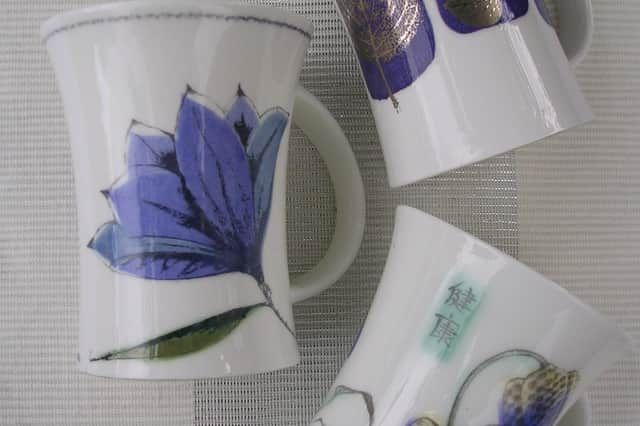
I’m constantly looking for motifs to express what I understand by the principles of emanationism. I think it was Andrew Holden who talked about looking ‘through’ a pot and therefore beyond it to a deeper meaning, as the Taoists pointed out. So if there’s a suggestion of landscape in some of the finished pieces, I’m usually happy with that, even if it occurs by accident, as it draws the eye beyond the form. When I’m decorating, I try to let Nature take over the brush and not force it. I can ruin seven out of ten pieces like this, but it’s worth it for the two okayers and the one good piece.”
You’ve worked all over - South Devon as an apprentice, Dunoon in Scotland, Finland for five years as a lecturer. How have all these places shaped your work?
“Well, I was learning all the time. I’ve endured possibly the longest, self-imposed apprenticeship in pottery history; through craft, industry, education, and back now to where I started, on the wheel. I had great teachers from the start: Pete Clough inherited the department at Ripon College from Victor Preim and developed it so you could do slip-casting, salt-firing, ash glazes. There was always something interesting going on, and he fostered that curiosity, taking us all over the north to demonstrations by Takeshi Yasuda, John Maltby, Phil Rogers, on and on. I learned model and mould-making with John Gregory at Ripon Pottery, cycled to Littlethorpe just outside the city to watch Rolly Curtis throw huge planters. It was a wonderful time.
By the time I got to Finland, I finally felt I had the experience needed in order to teach and yet found myself learning again, from the students and the all-pervading Finnish aesthetic. When you walk through those frozen landscapes, you see the very elements that imbue Scandinavian design with its natural spirit. It helped me to strip things down a bit; getting back to the essential over the novel, the trivial, the egoic. It informs the way I tackle shape and surface alike: the various ways ice forms in Finland had a profound effect on how I see glazing. You see? I’m back to stillness and ‘frozen music’. It’s all related.
I’ve allowed all those experiences to influence me one way or another. For example, I make pots as if they were prototypes. It comes from my days at Dunoon factory, trying out variations of form on the lathe. Industry is an exacting master; shaving microns of plaster away to get the model just right for mass production. Nowadays I have trouble even wanting to repeat a shape on the wheel. The next pot always morphs slightly, away from the previous one. I’m caught between the Scylla of free throwing and the Charybdis of turning plaster. That tension forms the centre of my form-making. I design from the wheel-head up, on the go.”
You prefer “pottery-maker” to “potter.” Why does that distinction matter?
“Well, I make pots, but I’m not really a potter in the traditional sense. There’s a film about George Curtis at Littlethorpe Pottery; he could make eight plant pots a minute. I’d be lucky to make one in two. And I don’t like titles anyhow. It all comes from reading D.H. Lawrence’s poem, ‘What is he?’ back when I was a teenager. It lodged in there somewhere and is still with me.”
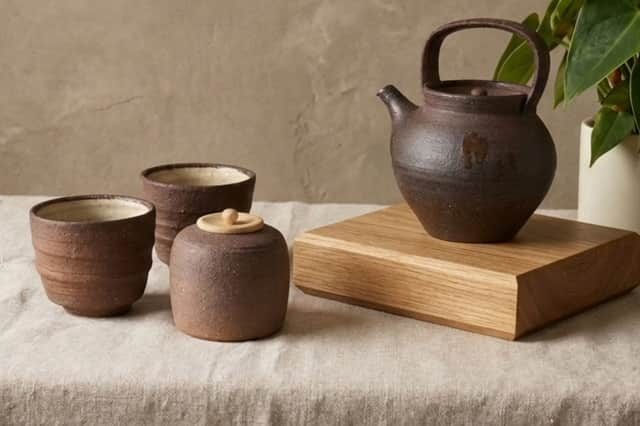
Why do you particularly like making teapots?
“It’s the challenge. Again, I come back to literature. I hear Yeats’ ‘kettle on the hob, Sing peace into his breast’, when I’m making teapots. And the battered, scorched old enamelled things we used to rig above a fire in the Finnish forest at minus fifteen. That coffee tasted so good! It’s the vernacular. It’s closer to Nature. And Nature is our branch of the aether, which is the source. Teapots are the most difficult pieces of tableware to compose; they help me to synthesise these ideas.”
The South Devon landscape clearly feeds into what you make. Can you talk about how that works?
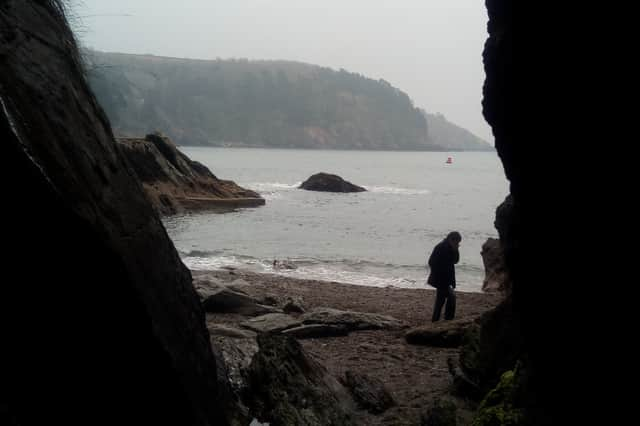
“I have a fondness for Torquay motto ware. Most of it is fairly bog-standard, but occasionally you get a real beauty, often when it’s a bit over-fired and well used. Leach and Cardew used to make inscribed pieces in the early days at St Ives, often using quotations from Blake or old Cornish sayings. Potters often talk about how pottery should reflect the place it was made and Torquay ware certainly does that, being of the local clay.
I’m using Etruria Marl at the moment, and it’s a wonderful material in itself and allows me to emulate some of the colours I see around the cliffs and beaches. Go down to Anstey’s Cove; it’s like a cluttered geological museum. I can spend hours just picking over pebbles down there, and they seem to find their way into my work. I made a series with heavy grits mixed into the clay; the results reminded me of the rock you see at Oddicombe and the sea wall at Torre Abbey Sands. I find peace in those places, and I want that to emanate from the work I make. It’s what Michael Cardew said about the hand-made pot ‘ministering’ to the user. That particular tenet stays with me always.”
This is your first exhibition. How are you feeling about it?
“Well, I would have continued ruminating for God knows how long if you hadn’t put on this exhibition. I’m never satisfied with my work; I have to keep pushing, but this puts a bookmark in the process so far and gives me the space to think again. And the pieces themselves seem to have come to life a bit, having been removed from the workshop environment; you’ve given them a calm, pleasant setting, the chance to breathe a bit. For that, I’m very grateful. Thank you!”
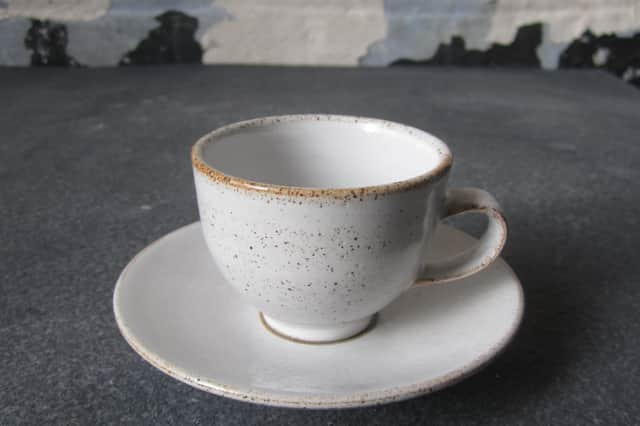
What strikes me most about M.J.’s practice is the depth of philosophy woven through every piece. He’s not just making pots, he’s exploring emanation, unity, and the frozen music of form. There’s a real generosity in how he talks about his work, and you can feel the respect he has for every influence that’s shaped him. His first exhibition is long overdue, and Sienna Editions is the perfect setting for work this thoughtfully conceived.
You can see M.J.’s work at Sienna Editions, 90 Belgrave Road, Torquay, TQ2 5HZ. At Print2Wall, we offer museum-quality fine art printing and bespoke framing services to help artists and photographers bring their vision to life. Visit us at www.print2wall.co.uk or drop me a line at [email protected].
Hannah
Artist Consultant
Print2Wall Ltd
WhatsApp: 07792285380
Telephone: 01803 214 222
"Love what we do? Refer a fellow creative and you'll both get 10% off your next order - because great art deserves great friends."