

Three chords, a guitar and a surprising history of musical politicians
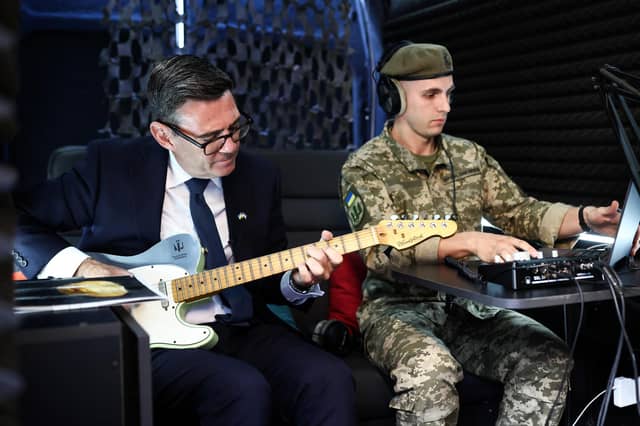

Andy Burnham’s guitar playing prompts a look at the politicians, presidents and historical figures who have turned their hands to music – with varying degrees of success
I was pleased to see Andy Burnham strum a guitar when he was in Ukraine. He may not be Brian May, Eric Clapton or Hank Marvin but he appeared to know some basic chords. To play most of the 60s music we only needed three chords and did not need to understand demi-semiquavers. I thought quavers were a type of crisps.
Like Andy Burnham I can play a few chords on my guitar. When I was at school I played rhythm guitar in a group. (We were a group not a band in the 1960s.) I loved the three chords of the basic rock and roll. As my singing lacks a certain finesse such as vaguely being in tune, I never pursued a career in music. It may be that spending too many hours practising my strumming was responsible for failing my A levels first time around.
There are some careers where people are expected to sing. Luckily for me medicine is not one of them. Although this applies to anyone in the Church, God has not given all priests this talent. When Arthur Sullivan was auditioning for someone to play a vicar in a Gilbert and Sullivan opera he said this singer was perfect. “He is a semitone flat. That’s ideal for playing a vicar”.
Andy Burnham is not the only politician to play music. Tony Blair has also been captured on camera playing the guitar. Boris Johnson was photographed holding a guitar which he clearly could not play. Keir Starmer played the flute, piano, recorder and violin in his youth and joined a youth orchestra. He even won a scholarship to the Guildhall School of Music.
Condoleezza Rice, the former US Secretary of State, once played Brahms for Queen Elizabeth II on the piano with four members of the London Symphony Orchestra.
Bill Clinton played the saxophone and the British Prime Minister Edward Heath was an organ scholar as well as conducting professional orchestras.
Nixon played the piano, violin, saxophone, clarinet and accordion. He even composed his own music although he is now more famous for being on the fiddle.
Donald Trump played the flute as a child and claims he was, of course, brilliant. He could have had a career as a flutist but instead spent the rest of his career blowing his own trumpet.
Some historians have suggested that Henry VIII was a good musician and possibly wrote Greensleeves. If I had been around Henry’s court I would not have told him he was rubbish. I value my head too much. He could have written Head Shoulders Knees and Toes and then missed the word head.
Does any of this matter? Do I regret spending time learning a few basic chords when I had no natural talent? I have an acoustic guitar and whenever I have felt stressed over the years I pick it up and play. I am really good, especially when no one can hear me. It is better than Valium although may be equally addictive.
Depending on your politics not all these musical politicians were successful but I like to think that having an artistic interest helped them to be more rounded. A basic understanding of music is a useful skill even if it does not translate into any musical talent. Churchill may not have been a rock guitarist but wrote books, studied history and painted. Surely this must have helped his caring side.
My theory about artistic skills helping politicians to be more sensitive fell down when I realised that the only political leader I can think of who was also an artist was Adolf Hitler. Maybe he was not a very good artist as he was rejected by the Academy of Fine Arts in Vienna twice. Had he been accepted he might have spent his life as an artist which would have saved the World quite a few problems. We should not blame the interview board. He may not have answered the question “where do you see yourself in ten years time” with “becoming a megalomaniac”.
Hitler was fond of Wagner and refused to allow anyone to play anything by Mendelssohn, who was Jewish. On May 26th, 1945, 18 days after the end of the war, the Berlin Philharmonic Orchestra performed a concert when they included music by Mendelssohn, a deliberate rejection of the Nazi culture. That was a rather larger political statement than today’s politicians strumming three chords.