

The rise and fall of the Torquay Beach Photographer

Long before Instagram and camera phones, photographers were capturing the sights, characters and changing fortunes of Torquay. Their images now provide an invaluable record of nearly 200 years of life by the sea
For almost 200 years, photography and Torquay tourism have evolved hand in hand.
In many thousands of images held online, in the Library and the Museum, we see modern Torquay emerge, grow and adapt. These photographs record changes across our town in a chronicle of local transport, architecture and the landscape itself, but also give us access to the lives and experiences of locals and holidaymakers.
Advances in image-making technology travelled alongside Torquay’s ever-more sophisticated offer to tourists. Our earliest known seaside photographs were landscapes taken in the 1850s, a sensible choice for photographers, as working outdoors provided the light required. Additionally, as long exposures were part of the process, this avoided any movements which would leave the image blurred.
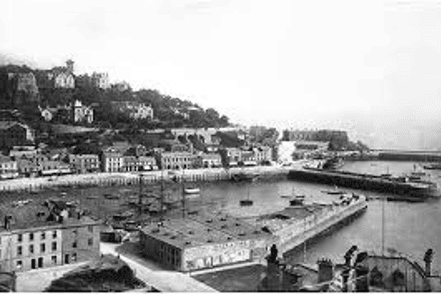
Torquay changed forever on 18 December 1848 when the South Devon Railway opened a branch line from Newton Abbot to Torquay, now Torre Station. The railway companies immediately recognised the value of promoting the places that could be reached by their trains, and the novel art of photography was fully employed. In particular, we have Francis Frith to thank for his photographic records of the Bay. His pioneering photographic publishing firm began in 1860 with the mission to capture views of tourist destinations, and a number are of Torquay’s early years.
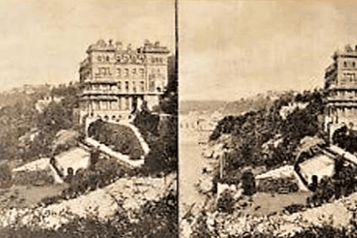
Technical advances were always seized on at the seaside. An instant success with visitors were stereo-viewers that gave two slightly differing images to the left and right eye, offering a three-dimensional effect. Hundreds of thousands of stereoscopic images were then to be found in middle-class Victorian drawing rooms; many featured our dramatic South Devon coast.
From the beginning of popular photography, people could purchase an image of themselves or their families. But these needed to be taken in photographic portrait studios, as the first medium, the daguerreotype, still required an exposure time of several minutes. Hence, sitters had to remain motionless in bright light, and so they often appear rigid and without expression.
The first portrait studio opened in 1841 in London’s Regent Street, and soon after others appeared in major cities, including Liverpool, Birmingham and Manchester. By the late 1860s, almost every town had at least one photographic studio. These were respectable businesses and, unusually for the time, managing a portrait studio wasn’t an exclusively male profession, with women well represented as owners and operators.
The rapidly expanding tourist resorts offered an obvious clientele, and visitors came to a studio to acquire a visual memento of their visit. But even while the sitter may actually have been in Torquay on holiday, the pictures were still taken indoors, perhaps against a painted backdrop of the seaside.
The cost of a portrait was around one guinea, equivalent to about £140 today, and so well beyond the means of most people. A cheaper alternative were the itinerant commercial photographers who were a familiar sight across Victorian Torbay.
Photographers set up their camera and a mobile dark tent or darkroom on wheels on the beach and the promenade. A good income could then be made taking photographs using wet-plate processes and then selling these inexpensive souvenirs to holidaymakers. These ‘while-you-wait’ merchants could produce a finished photograph in just a few minutes, and their trade rapidly became part of the seaside experience.
The beach photographers were at the opposite end of the social spectrum to the reputable portrait studios, and they were seen by the photographic establishment as vulgar showmen. Yet, their images of people and their seaside surroundings are now recognised as historically and culturally invaluable.
By the 1880s, advances in processes and equipment made taking photographs much easier and less expensive. So was born the amateur photographer, and we see from their images a move away from static poses to a narration of life as it was happening in our resort.
Not all these images were necessarily wholesome, however. Illustrating that there is always someone waiting to take advantage of a technology, sold under the metaphorical counter were risqué and pornographic photographs. We know that these pictures were circulating locally as Canon Hicks of Torquay’s Young Men’s Christian Association felt it necessary in 1914 to warn local young men of, “Filthy picture postcards that often led to a loose and unclean life”. It was said these visual temptations were tolerated more in Paignton than Torquay, reflecting the contrasting social expectations and clientele of the neighbouring resorts.
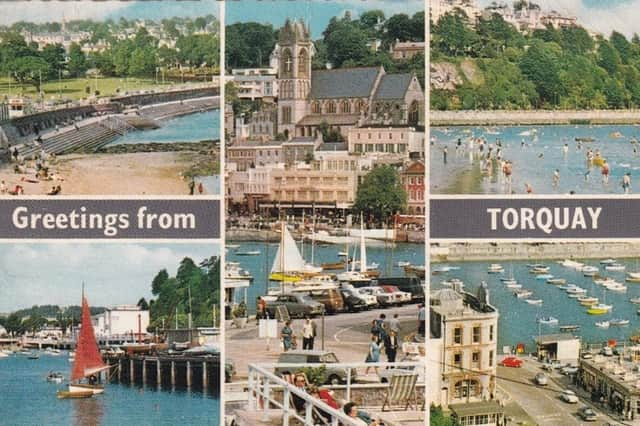
The more mainstream and socially acceptable postcards had been introduced in 1894 but became hugely popular after 1902 when the cards featured a divided back for messages. This innovation created a mass market for coastal views that remained for most of the twentieth century. Giving us an especially valuable record of change in the Bay are those postcards taken from fixed-wing aircraft, which offer bird’s-eye perspectives of Torquay, Paignton and Brixham.
The inter-war period saw the rise of a new form of commercial opportunity as street photographers adopted reflex cameras. These allowed the image to be seen exactly as it would appear on the film, enabling precise focusing and composition. These lensmen patrolled Abbey Sands and the prom in search of paying customers in a form of guerrilla photography, images being quickly taken and the prints sold later from stalls. As many of the photographs were of unsuspecting pedestrians, these became known as ‘walking pictures’ or ‘walkies’. The photos they took were consequently very different to the stiff and formal portraits of earlier years, and these street scenes give us a great deal of information on each decade’s leisure and fashion.
This wasn’t an easy life for the ‘snapper’. The season was short, early June through to late September, and the hours long, 8am until most holidaymakers had returned to their hotels and guesthouses in the evening. Then the day’s negatives had to be developed and printed, ready for display and sale the next day.
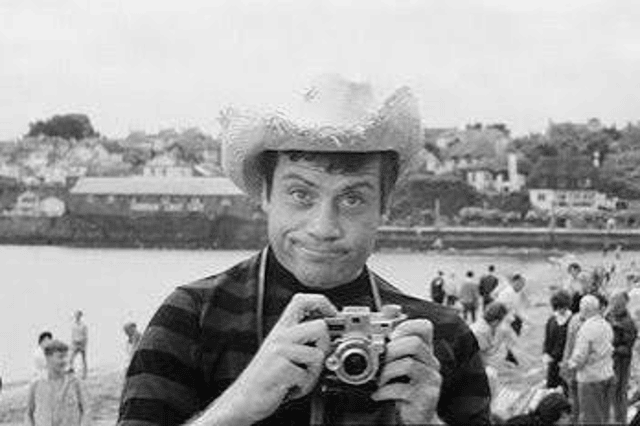
A glimpse of this long-gone profession can be seen in the 1964 Torbay-set ‘The System’. The movie has Tinker, played by Oliver Reed, as a beach photographer and serial seducer of young women. It shows the tricks of the trade, the competition between photographers, and payment by results; all against a brief season that inevitably must come to a melancholy end.
‘The System’ also hints that the seaside world was changing as commercial beach photography struggled to compete with mass camera ownership and 24-hour developing and printing services.
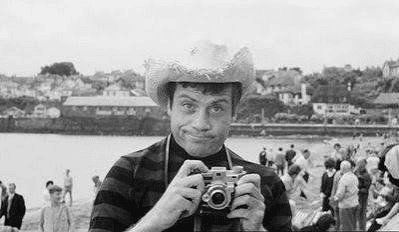
From the 1960s, individuals and families could take their own increasingly high-quality photos as souvenirs of day trips and annual seaside holidays. Millions of images of Torquay were taken and retained in family albums, literal snapshots of economic and social change; of guest house dining rooms, café menus, street entertainers, transport and much-loved buildings later lost to the bulldozers and the fireraisers. During the later decades of the twentieth century, those images also record a gradual lessening in the numbers of tourists due to the rise of the Mediterranean vacation.

Photography remains part of the Torquay experience but today there is little need for the beach photographer and his darkroom. The first widely commercially available digital camera was released in 1990, and around half the world’s adult population now carry the technology in their pocket. Every two minutes, we take as many photos as were taken during the whole nineteenth century. But, while the technology has improved immensely, the desire to create pictures remains essentially the same.
Letting the world know what the Bay has to offer has now been democratised.
Back in 1923, the Western Times acknowledged Torquay’s claims to be foremost amongst the nation’s tourist towns: “Torquay is not Brighton, neither is it Blackpool. It stands upon a different plane to these watering places. A higher one”. Photographers - professional, amateur, resident or visitor - were always there providing supporting evidence for that two-century-long campaign. And their mission continues.