

The mundane and the majestic: Torquay’s iron survivals


From decorative balconies to cast-iron fountains, the ironwork of Victorian Torquay remains an often-overlooked part of the town’s seaside heritage
Torquay is a palimpsest, a landscape used time and again with glimpses of previous lives surviving in its architecture.
Many of these remaining features are made of iron, a material that became widely used for both practical and decorative purposes in the Victorian resort. Indeed, ironwork became a part of Torquay’s identity, its intricate curves, patterns and decorative touches turning the everyday into lasting art and design.
Two types of nineteenth-century ironwork can still be seen across town.
The first is the kind of traditional wrought iron that continues to be produced at Cockington.
When iron is heated and worked by hand it becomes strong, durable and easy to shape. This is highly skilled work, needing patience, precision and expertise. Architects and artisans are then able to craft pieces reflecting contemporary styles and tastes, each piece individually made with its own unique character.
Then there is cast iron. In the mid-eighteenth century, Abraham Darby pioneered a new method of using coke to fuel huge blast furnaces where iron was smelted and poured into moulds to create a finished form. This could mass-produce both ornamentation and practical items such as fireplaces and stoves in large quantities and at low cost.
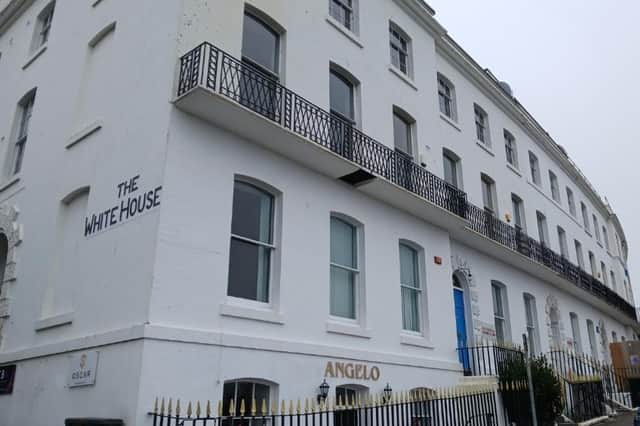
During the Georgian period houses used railings to mark property boundaries, provide security, and to prevent people from tumbling into the basement light well. But ironwork increasingly took on more decorative uses; the uniformity of terraces, for instance, being relieved by decorative balconies at the first-floor level which doubled as fire escape routes.
This fashion was taken up in Torquay with bay windows and balconies becoming a way to promote access to health-giving sunshine and sea air. In 1892 Torquay officially recognised its origins and reputation by adopting the Latin motto ‘Salus et Felicitas’, meaning Health and Happiness. Part of that offer to those with money to rent or buy was the ability to gaze at the sea at any time of the day. This became a particular mark of high social standing for both residents and visitors; a social division between view and non-view that survives to the present day.
The Terrace is a good surviving example of railings and balconies proclaiming seaside sophistication and status. Originally built in 1811 as the town's first row of grand townhouses, it marks Torquay's transition from a fishing village into a fashionable resort.
As Torquay rapidly expanded, it became an ideal place to try out new ideas. Indeed, the architectural profession is primarily a Victorian creation of a time when opulence and extravagance allowed a focus on style and design rather than the production of the purely functional.
The new town was certainly affluent and quickly seized any opportunity to showcase wealth with wrought and cast ironwork obvious choices for adding character and craftsmanship to homes and hotels; from railings, gates and balconies, to boot scrapers, bird baths and garden furniture.
In Torquay’s early years wrought iron was commonly used but increasingly substituted after 1850 for the cheaper cast iron; and by the last decades of the century there were catalogues of mass-produced cast-iron railings and gates for the householder to choose from.
Not only did ironwork styles and tastes change over the decades, so did its colour. In the early eighteenth century, external ironwork was mostly painted from a limited variety of available colours. The finer houses favoured blue, while the majority had blue, grey or stone colour. Green, resembling patinated bronze, and Venetian red, then became popular at the beginning of the nineteenth century, while the conclusion of the century saw the widespread use of a purple-brown colour.
The landscape gardener Humphry Repton recommended using ‘Invisible Green’. This was to make fences and railings blend into the background vegetation of an English garden.
The idea that Queen Victoria ordered all doors and iron railings to be painted black after Prince Albert died in 1861 is, however, an urban myth. Black did not become the standard default colour for outdoor iron railings until the late 1950s, driven by the invention and availability of fast-drying gloss paints.
When the South Devon Railway opened a branch line from Newton Abbot in 1848, Torquay was rapidly reconfigured into a new kind of community. Alongside transporting holidaymakers, the railways also gave faster and cheaper access to iron products. Appropriately, Torquay railway station and nearby Torre station feature cast iron elements, including decorative platform canopies, footbridges, and a vintage cast iron coal stove in Torre's historic signal box.
Another local Victorian survival is our parks as enclosed spaces with perimeter railings. There were no public parks in Britain before the 1840s but then these ‘urban lungs’ were introduced to improve public health and provide wholesome recreation. Parks offered a quiet alternative to pubs and street corners and so their gates were locked at night by park keepers in order to maintain moral order, protect plants, and prevent overnight sleeping. The park in Higher Union Street, there to offer fresh air to the patients of the 1853 hospital opposite, is worth a visit.
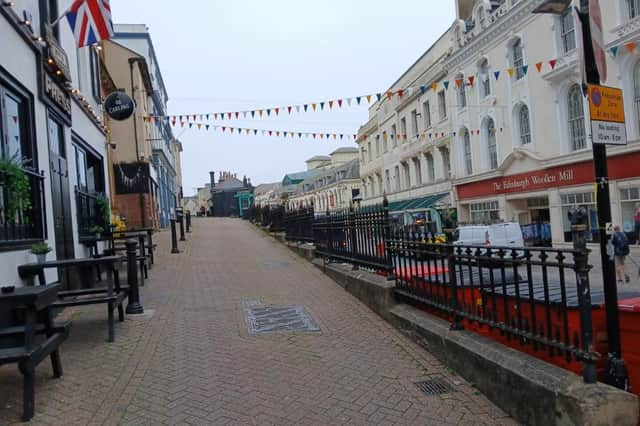
Cast iron’s strength and resistance to coastal weather was particularly useful at the seaside. Note the still extant iron and wooden benches installed across town, democratic fixtures of civic life intended as social spaces to ‘see and be seen’.
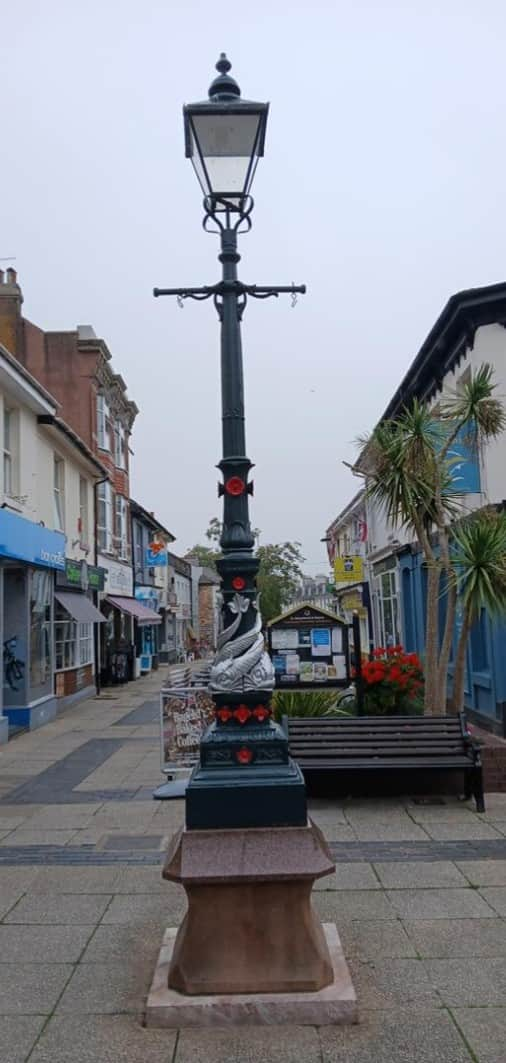
Some examples of street furniture are specifically designed for our resort and have marine-themed décor motifs like dolphins, ropes, and anchors. The St Marychurch cast-iron Dolphin Street Lamp, for example, was originally erected on the Strand in Torquay in 1887 to celebrate Queen Victoria's Golden Jubilee. It was renovated and re-sited in 1978.
Another impressive example of Victorian cast iron is the 1894 Princess Gardens three-tier fountain with its spouting dolphins ridden by children, and storks supporting the upper basin. The same mould patterns were used to cast a sister fountain currently standing in the Palm Garden at Singapore’s Raffles Hotel.
The high point of our fascination with iron came in 1881 with the construction of the original Torquay Winter Gardens. The inspiration was the purpose-built iron and glass Crystal Palace of 1851, a feature of the Great Exhibition in London’s Hyde Park. It was, however, unsuccessful in Torquay and in 1903 was dismantled and shipped by barge to Great Yarmouth. It’s still there and now the only remaining iron and glass seaside winter garden in the nation.
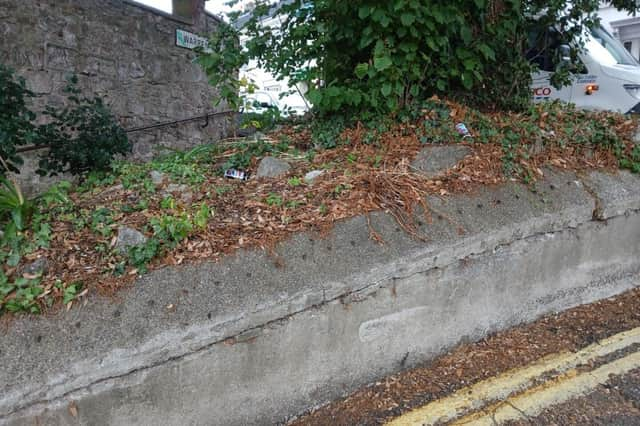
Across Torquay there are many metal stubs in walls, all that remains of long-seized iron railings. These date to the Second World War when councils requisitioned metal for recycling into weapons, tanks, and munitions.
Over one million tons were finally gathered as part of this patriotic scrap metal drive, a tangible way ordinary citizens could contribute to the war effort. However, far more was collected than was needed while much consisted of unusable low-grade iron. Large quantities were consequently hidden away and quietly disposed of.
Over time, wrought iron was used less as the production of steel became easier to produce and shape. Nevertheless, Victorian and Edwardian ironwork remains everywhere you look in Torquay. From front gardens to our greatest buildings and street furniture, ironwork is an intrinsic element in our layering of architectural styles. So do keep an eye out for these often-forgotten components of our urban and seaside heritage. We made it, and it made us.