

Searching for Agatha Christie and Torquay’s Seaside Mystery Men

“What is this excitement in a paper we have read, for a man they're hunting with a price upon his head?”
For generations, summer visitors to Torquay searched for a mystery man hidden in the crowds. If they suspected they had identified their target, they would exclaim something like, "You are Lobby Lud and I claim my fifty pounds". Indeed, the phrase became so familiar it would be taken up by books, movies, magazines, and television.
This was a competition created to maintain newspaper sales, particularly during the holiday season. People on vacation were less interested in reading the news and so newspaper circulations fell sharply in the summer months. A heightened challenge came when some towns and large factories had holiday fortnights (called ‘wakes weeks’) when a significant part of the population would all decamp to the seaside at the same time.
Accordingly, the newspapers needed new ways of maintaining their sales targets. One way of doing this was prompted by the mystery disappearance of Agatha Christie on December 3, 1926.
Agatha’s car had been found abandoned near Albury and a nationwide search began for the famous author. The police had a nearby lake dredged and recruited 15,000 volunteers to search the surrounding countryside. The press wildly speculated that she had been murdered, committed suicide, or had simply set up a publicity stunt. None of these theories were accurate and, after eleven days, Agatha turned up at the Hydropathic Hotel in Harrogate.
Even though her picture appeared regularly in the newspapers, the spa's other residents mostly failed to identify her. When a few did question the lady in their midst, Agatha laughed off what she insisted was a purely coincidental resemblance.
This inspired the Westminster Gazette to create their own publicity campaign: “For more than a week, while hundreds of police and volunteers were scouring the Surrey Downs for her body, she was leading a perfectly normal life in a big Harrogate Hydro.” And so, in August 1927, “In order to provide holiday-makers with the amusement and thrill of a real missing-man-hunt, Mr Lobby Lud, the Westminster Gazette Missing Man, will similarly ‘disappear’.”
The Gazette launched their mystery man challenge on July 30, 1927, renaming its reporter Willy Chinn as Lobby Lud, after the paper's telegraphic address, ‘Lobby, Ludgate’.
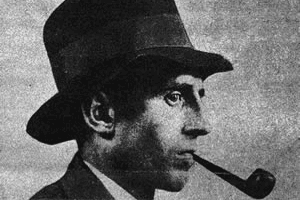
The paper would print Lobby's photograph, give a brief description of his appearance, and list the clothes he'd been wearing when last seen.
Readers were then challenged to find Lobby Lud in a particular place. Anyone carrying a copy of the Gazette could do this with the specific phrase, “You are Lobby Lud and I claim my five pounds". £5 was the equivalent of £400 today and the prize would, over the years, increase to £50 (£4,000). It would then be increased to £100 (£8,000) if Lobby remained undetected for one week; £150 (£12,000) after two weeks; and £200 (£16,000) after three weeks.
Initially, Lobby was dispatched to a different London neighbourhood each day, but then the newspaper started following their readers to where their vacations were taking place. Accordingly, Lobby started touring seaside resorts throughout the summer, including Torquay, where the prize stood at £50 (£4,000) at that point in the competition.
This was serious money and Lobby told his Gazette readers that he had often been punched by people who thought they should have won the prize. He also remembered being hit over the head with a handbag by a woman who thought it was misleading of him to wear a beard.
All those who looked even vaguely like Lobby found themselves hunted down by Gazette readers. “Everyone went about challenging everybody else. Some innocents who bore a resemblance to me were pulled up six times. Every few seconds, someone would be mobbed by a crowd… Some men were heavily mobbed, and I saw one sitting in despair on the grass…”
The mystery man's visits became tourist attractions in themselves. Special trains for Lobby-hunters were arranged to Brighton, Margate, Hastings, Bournemouth, and the Isle of Wight. In one Lobby visit to Brighton, over 50,000 people turned up.
It was recorded that local councillors in places such as Torquay, Blackpool, Scarborough, Harrogate, Aberdeen, Llandudno, and a dozen other towns then realised that the influx of Lud-hunters meant extra income and so actively lobbied for a mystery man visit.
Such was the popularity of the Lobby Lud phenomenon that there was even an official song, scored for a ukulele accompaniment and sold as sheet music through the Gazette's pages.
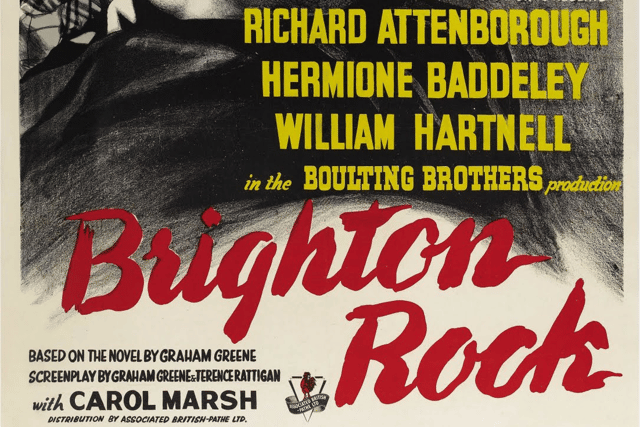
Popular culture also recognised the public’s familiarity with the seaside competition. Graham Greene's 1938 novel Brighton Rock, for example, is the violent story of teenage gangster Pinkie Brown in the south coastal town. In the book, a mystery man by the name of Kolly Kibber helps progress the narrative.
Lobby Lud became Lucky Len in the March 1993 ITV adaptation of Agatha Christie's The Jewel Robbery at the Grand Metropolitan. Although the original story was written in 1924, before the Lobby Lud phenomenon, the mystery character was nevertheless added for comedic purposes: on holiday at the seaside, Poirot is repeatedly mistaken for the man in the newspaper contest.
After the Gazette closed in 1928, the competition continued in The Daily News, which became the News Chronicle from 1930 until it was absorbed into the Daily Mail in 1960.
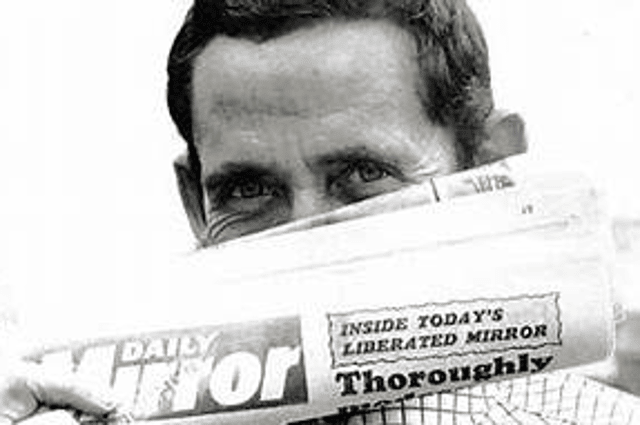
Other newspapers ran similar schemes, the other best-remembered mystery man being the Daily Mirror’s Chalkie White. The name came from Andy Capp's mate in the Mirror's popular comic strip.
From the 1950s onwards, each summer day a picture of Chalkie's eyes appeared in the Mirror, and the holidaymaker or resident memorised the correct phrase to claim the £50 prize (£1,400 in 1960). To ensure continuing sales, the words changed with each edition of the paper, something like "To my delight, it's Chalkie White" or "Tonight's the night, Chalkie White."
The Mirror sent Chalkie out to our coastal resorts on and off for three decades. However, this seems to have left our mystery man somewhat traumatised as he daily witnessed men, women, and children physically fighting each other in attempts to catch him and claim the prize. This was a job that exposed the man who was Chalkie White to seaside human nature in the raw.
"People think it's a cushy job but sometimes I hate it," Chalkie remembered. "You get this terrible sense of paranoia. Everywhere you go, you think everyone's looking at you…”
The mystery man’s tactics may further tell us something about the post-war holiday experience: “I start by staying in a hotel two or three miles out of the resort, otherwise you get collared at breakfast by a waitress. After that you try to look exactly like the rest of the people on the beach - miserable and aggressive."
Eventually, the days of Lobby, Chalkie, and all those other mystery men and women came to an end. Unless, of course, we reinvent that old seaside tradition.