

Kenny Ball: The Rise of a Traditional Jazz Legend – Torbay’s Musical Connection
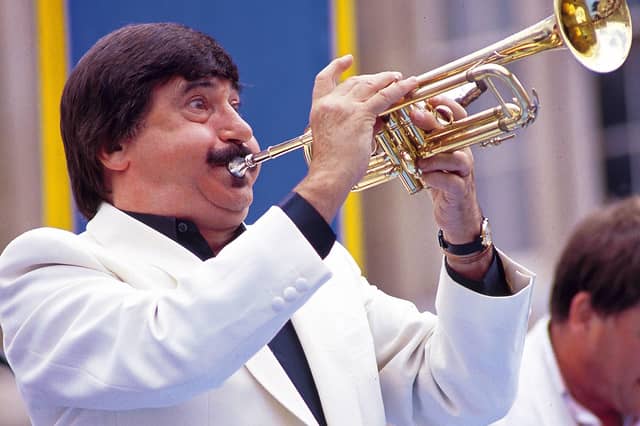

Discover how Kenny Ball rose from humble beginnings in Essex to become one of Britain’s best-loved traditional jazz musicians, following his early years, musical influences and the formation of his own band, with a connection to Torbay.
Born on May 22nd 1930 in Ilford Essex Kenny Ball left school at age 14 and became employed as a messenger with the Walter Thomson Advertising Agency. Even at this young age he had been undertaking lessons on how to play the trumpet (already his favourite instrument) and was soon playing favourite music on his favourite instrument. The youngest in a family ten Kenny with the whole family did a sing-a-long most Sunday afternoons when he did his party piece not on trumpet yet but when playing the harmonica.
Larry Adler was the star of the era on harmonica and he was another of Kenny’s early heroes. Traditional jazz was having to compete with modern jazz yet not equally promoted but it still remained Kenny’s first choice as did the love of the trumpet sound. When Kenny finally joined the local Sea Scout group his first choice became a little nearer as the scout leader let him use their club Bugle. At home meanwhile the family moved from Essex having suddenly chosen to live in what they imagined, would be a better living in the Midlands. They soon discovered Worcester was not really for them and with the Capital city calling them back they soon returned to now inner London area and where in Soho they were welcomed in by the local wit who said back “just in time for the blitz”.
Kenny had soon mastered the sea scout’s Bugle when in Essex and had then responded to an advertisement in the “Melody Maker” magazine and later purchased his first Trumpet for just £10. That trumpet would formed the foundation of a future jazz career once he had learned to play it, so took formal lessons on the cheap trumpet. Kenny already visioning he would ultimately have his own band and even get rich. Within a year of obtaining a first professional trumpet Kenny took professional lessons on how to play “trad-jazz” music to his mates. At the same time he was changing jobs trying to find an employer that would let him work the hours to suit his new lifestyle. In this way it became Kenny’s first “professional decision” towards that “visioned career” and he was also constantly practising while keeping an eye on the type of music jazz stars of the day were playing for radio or television. By age seventeen Kenny was playing the trumpet well and also he had become engaged to Betty Tracey though it would be six more years before they married.
Meanwhile Kenny having been called to do his National Service went into Army who gave him new skills through the Royal Electrical & Mechanical Engineers. But more interesting to him was the fact they allowed him to play jazz in the Army Naafi giving him more time to hone his skills for when he return to civvy life and the trumpet and hopefully the stage.
With the Second World War at an end and still alive Kenny immediately toured London’s entertainment shows before then in Soho meeting a Charlie Galbraith who played trombone. They teamed up to find work as Kenny finally decided to turn professional. Yet it would still take until 1953 before they found a band. It was in this year that Betty and Kenny finally married and they soon produced their first child who was named Keith. Meanwhile Kenny and his new mate Charlie were searching for a bandleader who was needing new players. Kenny was generally perceived as a cheerful cockney and was now playing local clubs and pubs in and around Greater London being what today we might call “a natural entertainer”. Having adopted the cockney quiff and always dressed well many years later having once formed his own band he dressed in a white Tuxedo before even later when appearing on TV he generally opted to use a dress-suit with dickie-bow. By the mid fifties Kenny would joined his first jazz-band before in 1958 he would finally establish his own “trad -jazz” band.
It had been when he was age 24 that Kenny was approached by band-leader Sid Phillips (a clarinettist) who having seen Kenny perform in solo in a local club then had offered him a “handsome salary of £30 a week” in 1954. At last his vision was here through a place on the “Sid Phillips Band” where he remained for four years until it became time to form his own band.