

Stargazing with John Stapleton: James Webb Space Telescope detects galaxies formed billions of years ago

Stargazing with John Stapleton of Torbay Astronomical Society: At the time of writing, NASA’s James Webb Space Telescope (JWST) has successfully obtained dozens of images using the various cameras on board to view the universe in a range of wavelengths f
Stargazing with John Stapleton of Torbay Astronomical Society:
At the time of writing, NASA’s James Webb Space Telescope (JWST) has successfully obtained dozens of images using the various cameras on board to view the universe in a range of wavelengths from near infra-red to ultra-violet.
The JWST has imaged galaxies and nebulae in multiple wavelengths so that different details show up in the images. NASA scientists have combined some of these 'raw' images to create 'final' beautiful images that contain information from each of the source wavelengths.
The JWST has also detected galaxies of previously unknown types that were formed over 13.8billion years ago, close to the time of the Big Bang itself.
Other previously 'hidden' galaxies have also been found in JWST images where the mass of a distant galaxy has bent the light from a more distant object along the same line of sight around itself so that a glimpse of the further object can be seen.
This process is known as gravitational lensing and was originally predicted to happen where light passed sufficiently close to a supermassive object by Einstein.
Torbay Astronomical Society are, therefore, fortunate to have a talk by one of the country's leading researchers on galaxies giving a talk this month.
The JWST has also now spectroscopically analysed the atmospheres of three exoplanets. One of them seems to contain a lot of water vapour while the other two contain a mix of water, carbon dioxide, carbon monoxide and sulphur dioxide – all gases associated with normal geological processes.
The hope is that this experiment may eventually analyse an atmosphere that contains 'fingerprint' gases or combinations of gases that would suggest the presence of biological processes, which would have to - for our understanding of life - include oxygen. The search is ongoing.
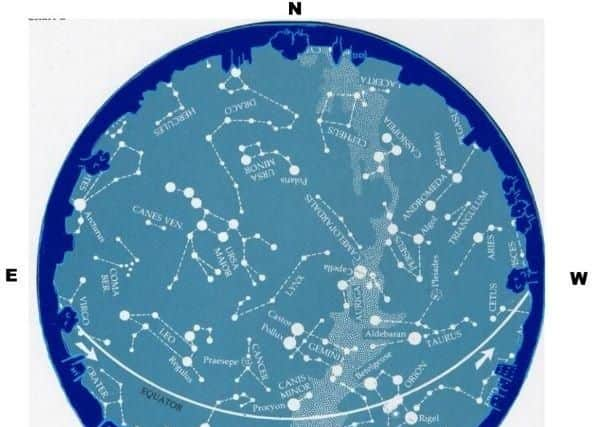
The sky will look like the chart on February 7 at 9pm and again on February 21 at 8pm. And four minutes earlier on each successive night e.g. 8.56pm on February 8.
To use the chart hold it above your head while facing south so that you can look directly from the chart to the sky.
SKYNOTES
Sun: At the start of the month there are just nine hours of daylight but as February progresses, the length of day will increase to almost 11 hours.
Mercury: Mercury is technically visible in the morning sky rising about 40 minutes before the Sun yesterday (February 1) and is low in the sky in a south-easterly direction, after which it becomes much more difficult to spot.
Venus: Venus is an evening object, setting over two hours after the Sun throughout the month, seen against the background constellation of Pisces. It is, by far, the brightest object visible after the Sun and Moon and, when seen low in the sky, is often mistaken for a UFO or even a street lamp. On February 28, Venus will lie close to Jupiter (the next brightest object in the sky).
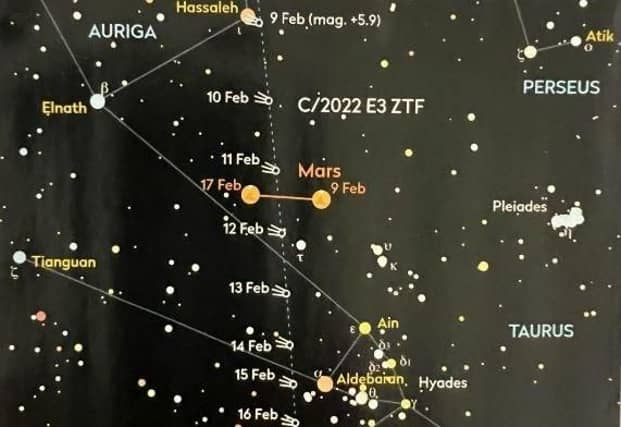
Mars: Mars is still a bright object visible throughout the night against the background stars of Taurus. Mars can be seen roughly between the Hyades - V-shaped star cluster that forms the head of the bull - and the Pleiades star cluster which marks the shoulder of Taurus. Mars’ reddish-orange colour is also distinctive even when compared to the red-giant star at the top of the V-shape which is called Aldebaran. Mars will gradually get fainter as the month progresses.
Jupiter: Jupiter sets at about 10pm at the beginning of the month and by 8.40pm by the end of the month, so it is visible in evening skies but is getting lower in altitude and becoming more difficult to see at the end of February. The giant planet is seen against the background stars of Pisces and will be close to Venus on February 28 which would make a good photo opportunity.
Saturn: Saturn reaches conjunction - lies in the same part of the sky as the Sun - on February 16 and so is not visible this month.
Uranus and Neptune: Uranus is seen against the background stars of Aries and close to the Pleiades star cluster. It is visible, although small and difficult to find, throughout most of the month. At magnitude 5.8, it is visible in binoculars. Look for a tiny greenish disc compared to the pinpoints which are the stars. Neptune is much lower in the sky and becoming increasingly difficult to spot. At magnitude 7.8, it will require large binoculars or a small telescope to find it. Neptune displays a smaller and truly blue disc compared to that of Uranus although it will appear only as a bluish star to most small instruments.
Meteor shower: There are no regular meteor showers this month. However, stray or sporadic meteors can still be seen at any time. Some of these can be very bright.
Comet: Comet C2022 E3 (ZTF) will make its closest approach to the Earth on February 1. In the last week of January, it passed close to Polaris, the Pole Star and, this month, travels from that direction to pass close to Mars on February 11 and 12 and close to the V-shaped Hyades star cluster between February 13 and 15. The comet is expected to reach magnitude +6, which technically makes it a naked eye object viewed from a dark sky.
Moon: The full Moon occurs on February 5 with last quarter on February 13, new Moon then follows on February 20 and first quarter on February 27.
Data supplied by Simon Harding, Observations Secretary Torbay Astronomical Society
DIARY DATES
The next meetings of the Torbay Astronomical Society will be held at Torquay Boys' Grammar School. On February 9, Dr Julian Onions of Nottingham University will give a talk on 'Galaxies - One Gigayear at a Time' via Zoom. And on February 23, an observational evening will be held in Room PL4 and the Observatory, weather permitting, when members will be delighted to provide views of the objects discussed in this article. In the event of bad weather, short talks and videos will be presented alongside informal discussion and an opportunity to get to know the society. For details, contact the secretary of TAS on [email protected]. Visitors and prospective members especially welcome.