

Stargazer: First of many such discoveries NASA scientists are confident of making

Stargazing with John Stapleton of Torbay Astronomical Society: The James Webb Space Telescope has been spectroscopically studying the atmospheres of previously discovered exoplanets, all of which have been super-sized bodies discovered from Earth-based o
Stargazing with John Stapleton of Torbay Astronomical Society:
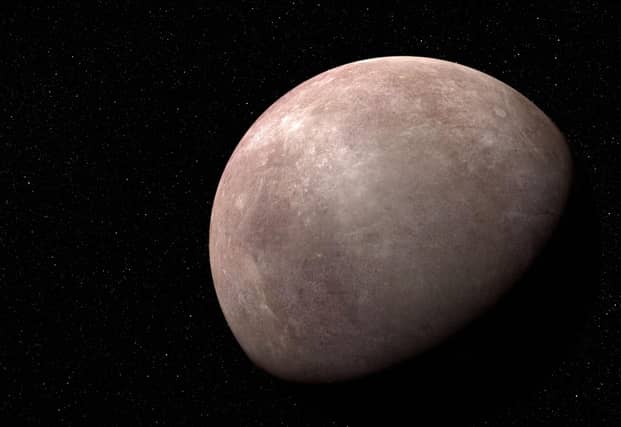
The James Webb Space Telescope has been spectroscopically studying the atmospheres of previously discovered exoplanets, all of which have been super-sized bodies discovered from Earth-based observatories but now a team working with the JWST has, for the first time, discovered an exoplanet using the space-based observatory.
This exoplanet, known as LHS 475b, orbits a star, which, seen from the Earth, lies in the southern constellation of Octans and is a mere 41 light years distant from the Earth - a light year is the distance light travels in one year at a speed of 18,600 miles (300,000 kilometres) a second, so about 6trillion miles - 9.5trillion kilometres.
LHS 475b is a small rocky planet, almost the same size as the Earth.
Because the JWST has such a large mirror and is outside of the Earth’s atmosphere, it has been able to detect this much smaller, and fainter, planet. The JWST has also made spectroscopic measurements of the planet’s atmosphere but at the moment, due to its small size and proximity to its star, analysis has been difficult.
The team are fairly sure that it does not possess a methane-rich atmosphere like Titan, the giant moon of Saturn, but are not sure if there is a carbon dioxide atmosphere or even no atmosphere at all. Further observations and analysis are planned.
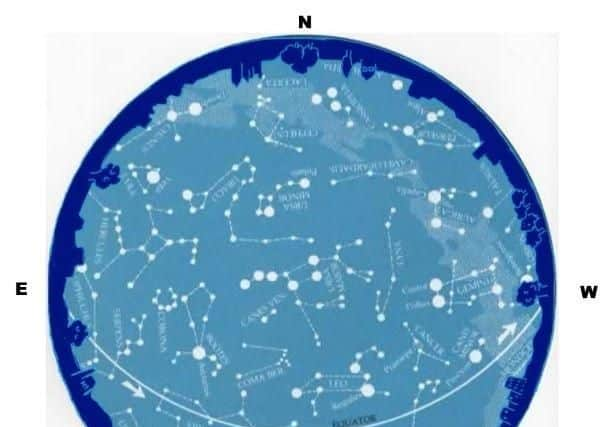
The Star Chart
The sky will look like the chart tomorrow (Friday, April 7) at 9pm and again on April 22 at 8pm. And four minutes earlier on each successive night e.g. 8.56 on April 8.
To use the chart, hold it above your head while facing south so that you can look directly from the chart to the sky.
Skynotes
Please note all times given in this article are in GMT so remember to add an hour to get the time in BST which started on Sunday, March 26
Mercury and Venus: Now is the best time to spot Mercury as it sets well over an hour after the Sun during the first half of the month and is higher in the sky than the much brighter Jupiter. Mercury can be seen against the background stars of Pisces and because of its rapid motion will be in conjunction (the same part of the sky as the Sun) by the end of the month. Venus is a brilliant object in the evening sky, setting three and a half hours after the Sun at the beginning of April and more than four hours after the Sun by the end of the month. Venus is seen against the background stars of Aries and so is even higher and brighter than Jupiter. It is very close to the Pleiades star cluster on April 10, and this would make a good photo opportunity.
Mars: Mars is an evening object in Gemini for most of the month. Early in April it lies close to a star cluster known as M35 and at the end of the month lies between the bright stars, Castor and Pollux. However, Mars is now moving away from the Earth and consequently appears much smaller and fainter so telescopic and binocular views are disappointing.
Jupiter: The largest planet is in conjunction with the Sun on April 13 therefore is not easily visible this month.
Saturn: The ringed planet rises just an hour before the Sun but remains low in the south-eastern sky so it is also difficult to see this month.
Uranus and Neptune: Uranus is still visible in the constellation of Aries and sets at about 10.45pm at the beginning of the month but by 9pm at the end of the month. Neptune is a morning object seen against the background stars of Aquarius however it remains a difficult object to spot in the dawning sky.
Meteor shower: April is our first chance of the year to see shooting stars, or more formally meteors. The Lyrid meteor shower falls in April. It appears to come from a point in the sky lying in the direction of the background constellation of Lyra and so is known as the April Lyrids. Look out for these meteors between April 16-25. The peak time falls on the night of April 22-23. Meteors are the remnants left in the path of comets as they orbit the Sun. We see them when the Earth passes through a cloud of these remnants. The April Lyrids are the remnants of Comet Thatcher. This year the Moon does not interfere with the seeing conditions so this would be an ideal time to watch out for meteors. The Lyrid meteors are relatively slow-moving and can include some bright shooting stars.
Comet: There are no comets predicted to be visible this month.
The Full Moon occurs today (Thursday, April 6) with Last Quarter following on April 13. The New Moon is then on April 20 with First Quarter on April 27.
Diary dates
The next meetings of the Torbay Astronomical Society will be held at Torquay Boys' Grammar School. On April 13, the society’s patron, Professor Chris Lintott of Oxford University and presenter of the BBC Sky at Night programme, will give a talk entitled 'How the Universe Can Still Surprise Us'. Prof Lintott is also a former member of Torbay Astronomical Society and an alumnus of Torquay Boys’ Grammar School. On April 27, an observational evening will be held in Room PL4 and the Observatory, weather permitting, when members will be delighted to provide views of the objects discussed in this article. In the event of bad weather, short talks and videos will be presented alongside informal discussion and an opportunity to get to know the society. For details, contact the society secretary on [email protected] - visitors and prospective members are especially welcome.