

PETER MOORE: Great to jet away - or should we holiday at home?

I enjoyed my holiday in Tenerife with grandchildren, although when I got off the plane at Bristol, the weather was hotter than the Canaries. Flying over South Devon was beautiful. Perhaps I should try a holiday here occasionally. It is easy to take home f
I enjoyed my holiday in Tenerife with grandchildren, although when I got off the plane at Bristol, the weather was hotter than the Canaries. Flying over South Devon was beautiful. Perhaps I should try a holiday here occasionally. It is easy to take home for granted.
Despite the doom-laden reports about queues at airports, we were lucky but there are still a few quirks about flying which have me baffled.
On the plane, the leaflet explained that the full menu was available if I clicked on the QR code. Great idea except that the QR code links to a website. Once I was settled on the plane, my phone had to be set for airplane mode, so I had to make do with the leaflet.
We were all asked by the cabin crew to put our seat belts on as we sat down. The advice seemed sensible but then, when the cabin crew run through the safely procedures, they explain how to put on the seat belts we are already wearing.
It is easy to reminisce over the days when planes had proper names like the Comet, Trident or Concorde. Sitting in an A321 sounds like a road near Reading.
In my childhood, there were no motorways. For most people in the UK a holiday in Devon would have meant hours on a traditional A road (not the A321) or a train journey. The idea of a holiday in Spain would have seemed impossible until the advent of the package holidays in the 1960s.
In the early 1960s, we visited my uncle and family in Norway. This was an adventure. It meant a journey to London to catch the boat-train to Newcastle where we joined a small ship. This took us on a rough journey across the North Sea to Stavanger which lasted over two days when I was very sick. We came back from Oslo on a Fred Olsen ship which was somewhat smaller than the current Fred Olsen cruise liners. Today, we could fly from London to Oslo in 1hr 20 mins for £125.
We went back to Norway in 1967 flying in a Comet, the world’s first passenger jet. This was not my mother’s first flight. During the war, she was in the ATS, the women’s branch of the army, and flew into Belgium. Although it was after the liberation of Belgium, the war was still going on. She told me that they got into an empty plane where there were a few folding deck chairs which she had to put up, so that they all had somewhere to sit.
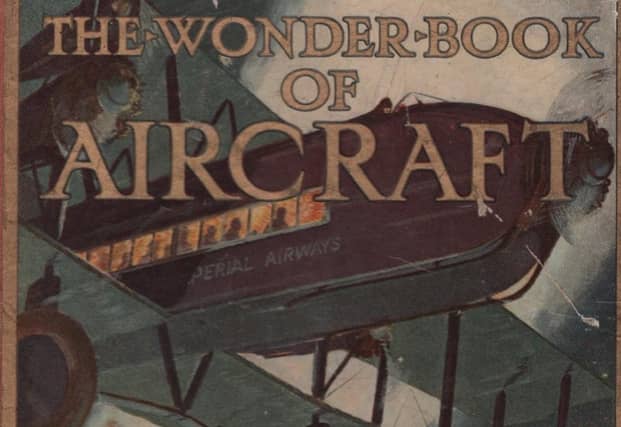
I don’t think my father had flown before, although he never discussed his time in Burma. But he may have had an interest in flying. I have found his copy of “The Wonder book of Aircraft” from 1927 when he was twelve.
There’s a fascinating chapter “Round Europe in a week”. Starting at London’s great aerodrome, Croydon the “giant airliner” took fourteen passengers. Two and a half hours later they were over Holland flying at 95 mph. They flew “high in the sky” over Berlin at 1,000 feet. In 32 hours, they travelled 2,700 miles. This summer, I flew 1,764 miles from Bristol to Tenerife in 3 ½ hours but at least in the 1920s they had comfortable leather armchairs which are not provided by EasyJet.
And what was the future of flying in 1927? High altitude flying would be capable for rising “ten miles in the air or higher” where the thin air would allow faster speeds. High altitude would mean specially designed engines and propellors. Unknown to the writer of “The Wonder Book of Aircraft”, Frank Whittle was working on his invention, the jet engine, and took out the patent in 1930. Sadly, no one in the RAF was interested.
What will the Wonder book of aircraft look like in another one hundred years? No one predicted the jet engine in the 1920s and so will there be an invention in the 2020s no one has predicted? Or perhaps we should all enjoy a holiday in South Devon.