

MP warns 'a cliff could fall on a train' as Dawlish rail resilience work is put on hold

MPs warn that HS2 works at Old Oak Common near Paddington will cause at least two years of delays for passengers travelling to and from the West Country, as they highlight the need for climate resilience in the region's rail infrastructure.
Crumbling rock faces and disappearing dunes pose a fresh threat to rail services in and out of Devon and Cornwall, local MPs have warned.
Torbay’s Liberal Democrat MP Steve Darling told a Westminster debate: “The cliffs are the enemy now, rather than the sea.”
The only railway line in and out of the two counties was breached by a ferocious storm in February 2014 which left rails dangling in mid air after the sea wall at Dawlish was smashed to pieces.
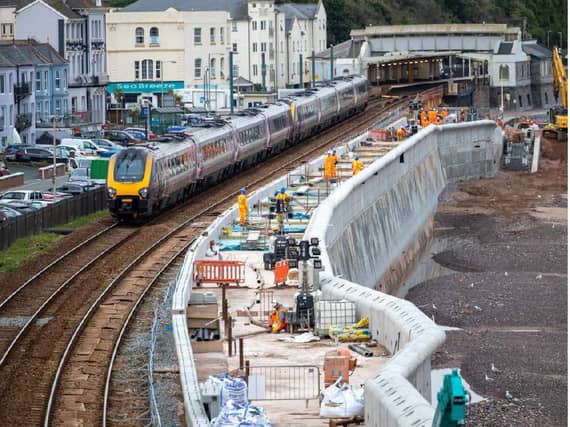
Since then Network Rail has spent £165million on a resilience programme which has included a new sea wall, a redesigned station at Dawlish and work to prevent crumbling sandstone cliffs falling onto the railway line below.
But the fifth and final phase of the work – protecting the line between Parson’s Tunnel and Teignmouth – has been put on hold indefinitely because it is judged to be too expensive.
Jayne Kirkham, the Labour MP for Truro and Falmouth, told fellow MPs: “There is a very real risk that a cliff could fall on a train.”
And, she said, people in the West Country were expected to put up with disruption that would not be tolerated elsewhere.
Mr Darling said climate change was the real enemy in the form of extreme heat or storms.
And he warned that the line at Powderham was now under threat thanks to the Environment Agency’s ‘managed retreat’ from Dawlish Warren, where the dunes could break up and leave the line vulnerable.
Hot summers also meant less moisture in the soil, he added, leading to slow travel on buckling rails as the ground shifts. And, he said, trains in the West Country were often made up of poor quality rolling stock, and were ‘hand-me-downs’ from elsewhere in the country.
Richard Foord, the Liberal Democrat MP for Honiton and Sidmouth, said students travelling to and from Exeter were facing long delays and cancelled trains. Summer services often had no air conditioning.
“Passengers deserve railways that withstand the climate conditions that we are set to face,” he said. “Too much of our infrastructure, particularly in the West Country, still relies on Victorian earthworks and drainage systems and assets that were not designed for today’s climate.
“How will the government accelerate investment in climate resilience so that we can get ahead of the changes we know are coming down the track and make sure that our students, workers and most vulnerable members of society get the transport links they deserve?”
South Devon Liberal Democrat MP Caroline Voaden, who missed the start of the debate because her train was late, said people travelling to and from the West Country faced at least two years of delays because of works for the HS2 project at Old Oak Common near Paddington.
Department of Transport under-secretary Simon Lightwood, the Labour MP for Wakefield and Rothwell, said ‘all endeavours’ were being made and a great deal of funding had gone into making the track through Dawlish and Teignmouth as resilient as possible.
“I do not think that anybody wants to suspend services through that area,” he said. “But unfortunately there will be instances where that may have to be done.
“The investment that has been put in has made it more resilient. We saw that during the latest storms, when the line was reopened the day after its closure.
“The new seawall performed as designed, helping to protect the infrastructure from major damage.”
He said investigative work was still continuing on the unfinished final phase of the resilience project, including a drainage trial to remove water from the cliffs.