

The Babbacombe boy who dived down to a unique British record
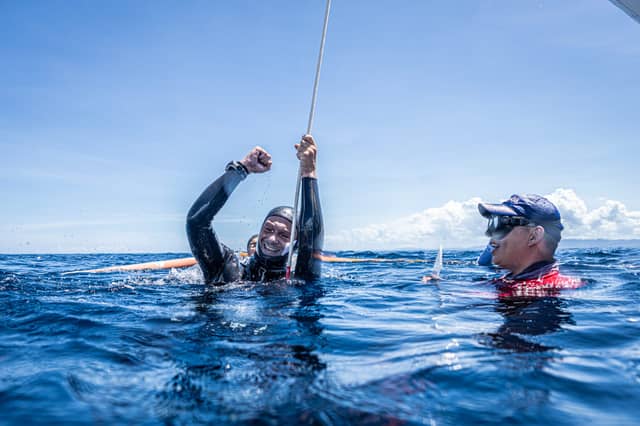

Matt Hill breaks the British record for freediving
Off the coast of a beautiful island on the other side of the world, a boy from Babbacombe has broken the British record in an incredible sport that combines courage, relaxation and a very deep breath.
Matt Hill grew up in the stunning surroundings of Torbay and nurtured his love of the sea from a very young age, diving around the beaches of Babbacombe, Oddicombe and Meadfoot with friends and a big spear.
He later joined the Royal Marines and continued his passion for the water, but that grew to a whole new level when he moved to the island of Bali in Indonesia
“I grew up in Torquay and was spearfishing from the age of around 12,” said Matt. “I lived in Babbacombe and we would go spearfishing from Babbacombe beach, Oddicombe and Meadfoot.
“I did a lot of spearfishing competitions when I was young and then joined the Royal Marines for 12 years, where I took up a lot of diving. When I left the Marines three years ago, I went back to spearfishing and found myself going deeper and deeper.
“Forgive the pun, but I fell into freediving after taking a course and became addicted to seeing how deep I could go.
“I moved to Bali last November and set up a school teaching spearfishing and freediving. I was already competing in freediving and I went to the World Championships for freediving in Cyprus last year.”
As his passion for freediving evolved, Matt realised he had a genuine talent for the sport and that led to an attempt at the British record, something he achieved on the final day of competition.
But what is freediving, and how does anyone stay calm at such immense depths?
“I managed a 92m at the World Champs, which wasn’t the British record, so when I moved to Bali, my training continued and I attended a competition off an island in the Philippines,” said Matt. “I dived down to 95m and then 100m, which is basically the benchmark for a world class dive.
“More people have been to space than have dived 100m in a single breath, so that was a major milestone. After reaching 100m, I knew the British record was 103m, so it made sense to attempt 104m on the final day of competition.
“I managed to pass the dive and, to get that official recognition, you have to dive down the 104m and retrieve a white tag at the bottom of the line. You then have to bring it to the surface and give judges an okay sign within 20 seconds, and basically not pass out on the surface.
“There are different disciplines in freediving and record I broke is a dive without fins, so you just pull yourself down on a rope, grab the tag and then pull yourself up. I believe the world record in free immersion is 132m.
“When you take the dive, you go through different pressure changes. For every ten metres, you add a bar of pressure and the deeper you go, the smaller your lungs get. They reduce to the size of a satsuma and the blood in your body shifts to your lungs to prevent damage.
“Eventually, they reduce to about the size of a lemon and it feels like you’re being crushed on the way down, so the whole point of freediving is to be able to relax enough to withstand those crushing pressures.
“It is a psychological and physical challenge. You have air inside your mouth that you use at different depths, so your eardrums don’t get sucked in. The deeper you go, the more taxing it becomes, because you know how deep you are.
“Relaxation is absolutely crucial in freediving, so you spend time meditating before the dive and getting yourself in a relaxed frame of mind.
“When you get very deep, your body experiences something called nitrogen narcosis, which makes you feel very high from the pressure changes in your body. You can feel yourself being crushed, so the nitrogen in your body gives you a high experience.
“The key is to stay relaxed and not panic because, as soon as you do panic, the dive will end. For the British record dive, I was underwater for three minutes and 35 seconds.
“From the surface to around 20 metres down, you are positively buoyant, so your buoyancy is trying to pull you up, which means you are pulling down on the rope.
“Beyond that point, you reach something called freefall, which basically means you can stop pulling because your body is sinking at around one metre per second. You’re sinking at a rapid rate and you don’t wear a mask either, just a nose clip, so you can’t see anything.
“On the way down, it is about relaxation but on the way up it is athletic because you’re pulling on the rope and your arms become heavy with the lactic acid. You obviously have to keep pulling but still stay relaxed because any panic will use up more oxygen.
“There are no scuba divers down there, you are totally by yourself and in the dark, just the blur of the rope, so a real challenge of the mind and body.”
It is a remarkable achievement for Matt and a moment of great pride for Torbay. His journey will later take him to further competitions in Greece and we can help along the way.
Freediving is an incredibly expensive sport, with all the travel and medical support required. If you would like to sponsor Matt, visit www.spearfishing-freediving.co.uk and get in touch with a Babbacombe boy taking on the world.