

Historic Brixham pub could be converted into three new homes
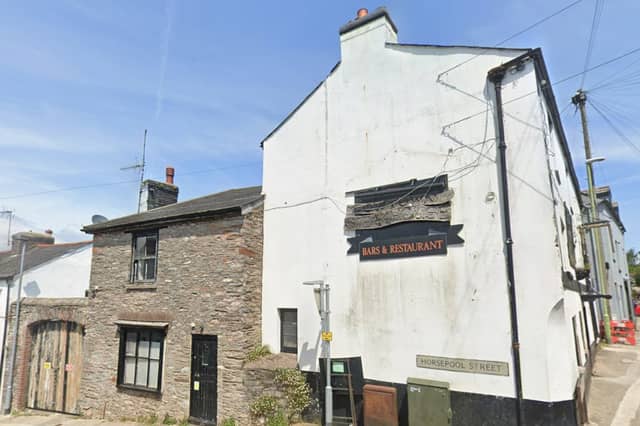

The Grade Two listed Watermans Arms in Drew Street, Brixham, could be converted into three 'high quality' new homes, according to plans submitted to Torbay Council.
A former Brixham pub which was once a meeting place for the port’s football teams, could be converted into three ‘high quality’ new homes.
The Grade Two listed Watermans Arms in Drew Street, just off St Mary’s Square, was most recently in business as the Cow Town Bistro, but has been empty for a number of years since the bistro closed down.
The ‘Cow Town’ in the name refers to the area of Brixham in which the building stands. The inland area of the town became known as Cow Town and even had its own carnival while the area around the harbour became known as ‘Fish Town’.
Historic England says the three-storey building dates originally from the 17th Century, and was altered in the early 19th Century.
It features some distinctive windows with small panes as a result of the alterations and has a wide arched rear gate.
During the 1980s, it was a popular post-match meeting place for the town’s sports teams. No extensions to the building are planned, and its external appearance would be largely unchanged.
The application to Torbay Council, on behalf of a local business, says: “The proposal focuses on securing the long-term viable use of the building through careful internal adaptation whilst preserving its architectural and historic significance.”
It says the Waterman’s Arms has served the Higher Brixham community for centuries, but while the applicant bought it in 2019 with the intention of re-opening it as a pub, changing trading patterns, increased operating costs and a long-term decline in the hospitality sector have made that commercially unviable.
The application goes on: “Having remained vacant for a prolonged period, the building is increasingly vulnerable to deterioration unless a viable long-term use can be secured.
“The proposed conversion to three residential dwellings provides that sustainable future while respecting the special interest of the building. It will secure the optimum viable use of an important heritage asset, preserve and enhance its contribution to the Higher Brixham Conservation Area, and provide lasting public benefits.”