

What Does It Really Mean to Be British?
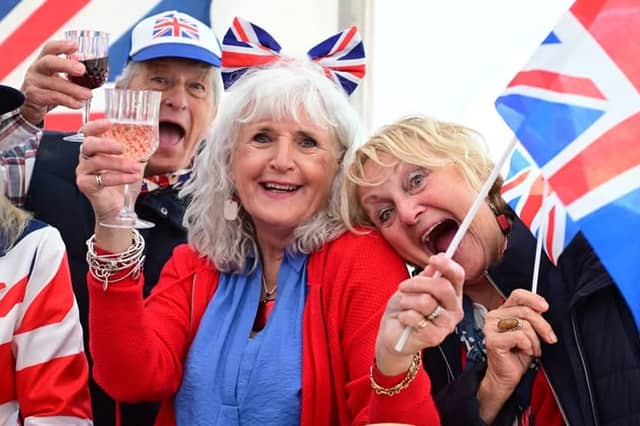

From family roots and birthplace to humour, humility and Union Jacks, one columnist reflects on what Britishness really means — and why it may have more to do with attitude than ancestry.
As I waved my Union Jack at the Rotary Proms recently and sang Land of Hope and Glory
out of tune I wondered how do we define someone as British? My father was born in Peking,
now Beijing, and his father Dublin. When I showed my passport at American passport control
the officer looked at where I was born and said, “Newton Abbot. That sound like a beautiful
little English town”. Perhaps he imagined Downton Abbey or Midsomer without the murders.
If, to be British, you must be born in the UK that would exclude not only my father but such
terrible foreigners as Cliff Richard (India), Boris Johnson (USA), Feddie Mercury (Tanzania)
Emma Watsoon (Paris) and Richard E Grant (Swaziland). I can just about accept Roger
Taylor the drummer of Queen and Mike Fleetwood of Fleetwood Mac as British as they were
born in Cornwall.
If being truly British meant both parents born in the UK I’m out. I once told one of my sons
that, with an Irish grandfather I could play football for Ireland. He answered “no you
couldn’t. You’re rubbish” which is true. When I mentioned this to an Irish friend he said,
“you have never lived in Ireland, have no connection to Ireland and are rubbish at football.
That’s our whole team”.
Can anyone be British if one of their parents was a foreigner? That would mean neither
Winston Churchill whose mother was American, nor Isambard Kingdom Brunel whose father
was French were British.
So how can we define Britishness? A friend who was a typical rugby playing Yorkshireman
spent a year working in America when he had a young family. He found a different culture.
When others told him his children were very bright, he pointed out that they had started
preschool in England earlier. Not naturally brilliant. This shocked the Americans who do not
criticise their kids in front of others. The American answer to “your child’s very bright” is
“yes. He’s a genius. He is going to be a lawyer or a doctor”. A sign that I am British is to add
that not every doctor is a genius. Look at me.
In the US hyping up talent is not confined to the kids. Perhaps we are too self-effacing but in
the US it is a whole different ball game, to use their expression. I am not sure that Donald
Trump’s approach would work for a British politician. I cannot imagine a UK Prime Minster
adding their name to a performing arts centre, building a grand arch in their name or wanting
his face printed on our notes. Would a British PM want a large statue of himself in
Whitehall? Any UK politician with such an obvious ego would be a gift to ‘Have I got News
for you’ or ‘Private Eye’ but not to the voters. Trump has even tried to change the name oof
the Gulf of Mexico to the Gulf of America. Would we ever change the name of the sea south
of us to English Channel? Oh no, we already have.
My friend also found that their humour, or humor, was more “in your face”. He would make
a dry sarcastic comment at a meeting before realising that everyone was taking him seriously.
This difference becomes clear watching the American version of the BBC comedy Ghosts.
The British version is more subtle with less obvious jokes. I am not sure the expression
‘tongue in cheek’ works in America.
Perhaps real “Britishness” was found when we were asked to choose the name of a research
ship and voted for Boaty McBoatface or the sarcastic comments after the horrific Salisbury
poisonings by Russians who claimed they were fascinated by medieval architecture. When
my father was on the beach at Dunkirk in 1940 the soldiers waiting to be rescued were all
telling jokes and laughing. It is how the British cope with stress although this was not shown
in the movie Dunkirk.
When I waved my Union Jack, sang “Land of Hope and Glory” and danced the Hornpipe I
had my tongue firmly in my cheek. A true Brit when asked “are you the most brilliant person
in the room will answer with a sarcastic “yea right”.