

Unearthing Paignton’s Roman past

Karen Chapman documents how archaeologists revealed the fascinating discoveries made at Preston Down before the ancient site was backfilled
ARCHAEOLOGICAL SITE VISIT – Thursday 06 August 2026
Preston Down Road (on left, just after turning for Sandringham Drive)
A group of about 16 (mainly members of Paignton Heritage Society) met with archaeologist, Simon Sworn of ISCA Archaeology Ltd, for a tour of the archaeological site.
The land is being developed for housing, and this was the very last day before the archaeological site was backfilled.
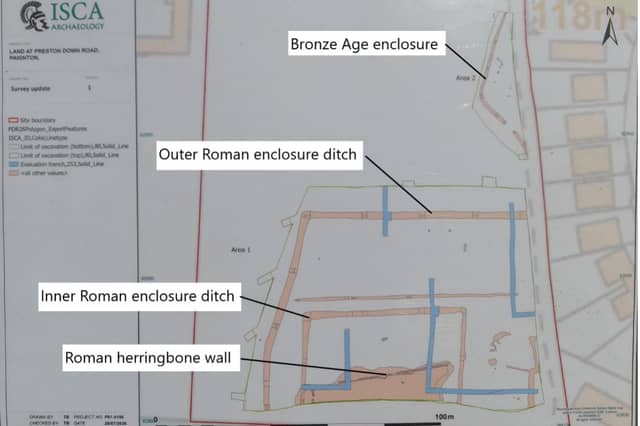
In 2018, an aerial survey picked up signs of a large regular enclosure. A 2022 evaluation predicted the age, depth etc. of this enclosure and targeted exploration was undertaken (highlighted as blue trenches in Fig. 1), which indicated a large outer enclosure ditch, with a smaller square enclosure within. Both these enclosure ditches extend into the woodland to the lower southern extent of the site. Also identified was a smaller, curved enclosure ditch towards the northeastern part of the site. The smaller enclosure ditch was thought to extend beyond the other side of Preston Down Road, and to the east, below the present adjacent houses.
The smaller enclosure is thought to be an animal enclosure, possibly over three thousand years old from the Middle Bronze Age (circa 1100 BC). No dwellings have been found.
The two larger enclosures have been tentatively dated to the Roman period, most likely dating to the late 1st – mid-2nd century AD.
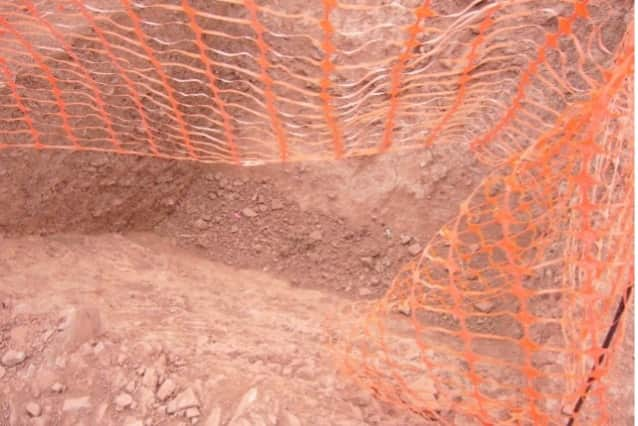
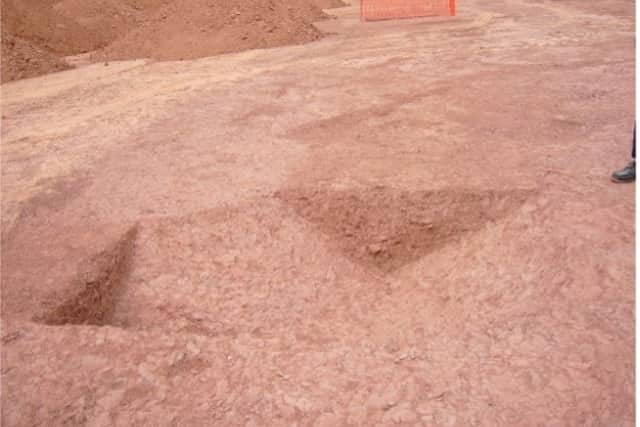
The Roman enclosure and its associated remains in the area are completely unrelated to the Bronze Age remains and there appeared to be no continuity between the two phases of occupation. As it stands, the earliest evidence of Roman occupation appears to be from the late 1st century, which does not suggest an earlier military origin, rather a later date, one where the native Britons had been subjugated and had accepted the Romans and had largely integrated.
The Roman site is thought to be a well-to-do farmstead with its large enclosure ditches being a display of both wealth and power, and providing a safe enclosed area for livestock, as opposed to being purely defensive (though an element of defense would have also been considered). The ditches measured around four to six feet in depth, though medieval and later ploughing over the years has greatly lowered the height of the ditch. It is thought that there was an associated farm or manor house that controlled the area, though if so, this was located beyond the limits of these excavations.
The site is on the top of a hill, with its extensive vista across the bay, looking out towards modern day Brixham and Berry Head, would have been clearly visible on the hill, and may have dominated and controlled trade in the area.
Locally made Roman pottery remains have been found.
Next we were shown the corner of the ditch – as said, not defensive. If it were, it would be two meters deep with ankle-breakers at the bottom.
To the lower, southern side of the site, a well-constructed stone wall, measuring nearly 40 meters (100 foot) in length, had been built into a terrace. It appears that the area in front of the wall had once been sloping southwards towards the valley, but at some point, possibly towards the middle of the 2nd century AD, the ground had been levelled, to form an even, flat area. The higher remaining slope of the terrace had been faced with this wall which was constructed in a herringbone (known as ‘Opus spicatum’) style which is indicative of high status occupation.
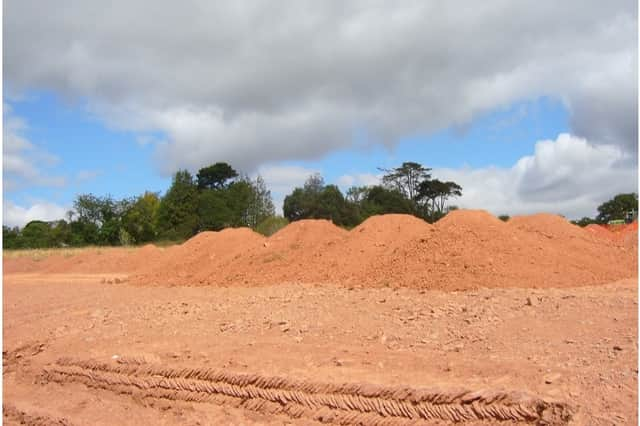
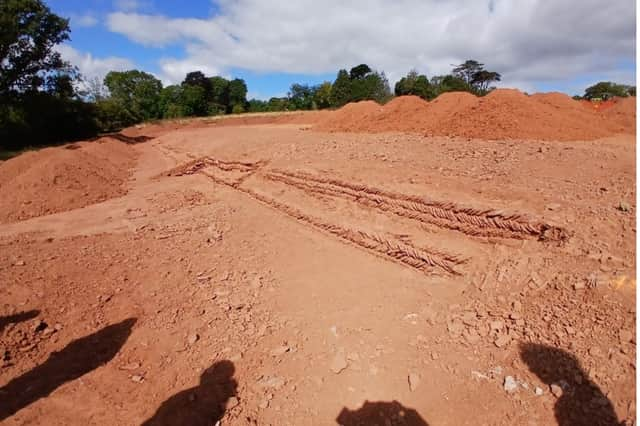
LIDAR results and topographical evidence indicate that within the woods to the south the land drops off again twice, forming further terraces, and it is thought that there may be remains of occupation there, possibly a high status house or villa.
Pieces of Samian decorated pottery from Gaul and amphora jugs from France and Spain have been found, along window glass (very high status) and very fine table ware glass. It indicates high status as glass was normally melted and re-used – these people could afford to just chuck it out!
We asked what would happen to the site. It has all been recorded and will be available to the public online (Google - Archaeological Data Service (ADS), Archaeology) in about 12 months’ time.
The finds, once fully analysed, studied and reported upon, will be offered to local museums e.g. RAMM (Royal Albert Memorial Museum, Exeter) or Torquay Natural History Museum.
Tomorrow the machine excavators will begin back-filling the ditches. The herringbone wall has been fully recorded, including detailed high-definition 3D photography.
If the wall was left uncovered, he predicted it could be washed away by the first heavy rain and/or subjected to accidental or deliberate human damage. To that end, a four meter section of the best preserved part of the wall has been carefully recorded, cataloged and each stone numbered, then hand removed so that it can be rebuilt either somewhere close to the site, or reconstructed ‘as was’, at the Torbay museum.
The rest of the wall has been reburied, and it is hoped that the development will be able to avoid the majority of the buried wall.
Simon speculated that the high status building would likely have been involved with local trade.
Perhaps the export of salt from the salt marshes (now Preston and Paignton Beaches), or furs, livestock or even slaves (which were highly prized across the Roman empire). These may have been traded and would explain the finds which included the imported pottery and Nene Valley ware from Peterborough, East Anglia.
In the past, a shipwreck has been found in the bay by archaeologists, and pottery finds have confirmed it is Roman, suggesting the presence of a Roman harbor nearby, most likely Brixham.
Previously thought – the Romans came no further than Exeter, but this is now disproved by our site, and sites at Ipplepen, Tiverton and others in Cornwall.
Simon then showed us the best of the finds –
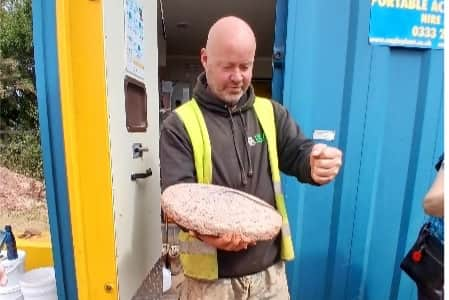
- A complete quern stone – used in food production when corn would be dried in a corn drying kiln and then ground down by the quern stones. The volcanic stone used comes from Cornwall and was a very high status artefact.
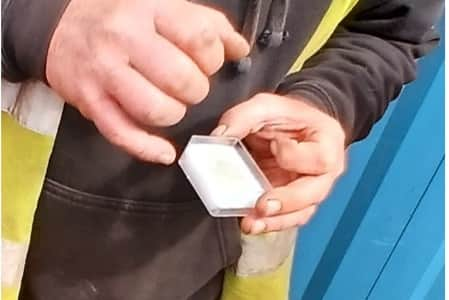
- A Roman coin – possible depicting Hadrian or Trajan Decius and dating to the late 1st to early 2nd century AD. It may show Britannia on the reverse.
- A large piece of the base of a Spanish amphora
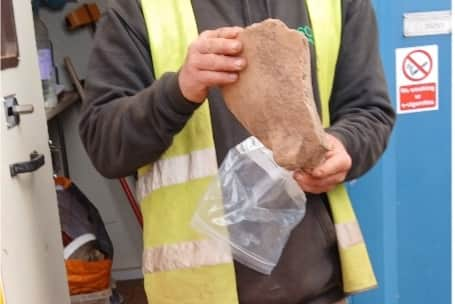
- Samian ware from Gaul
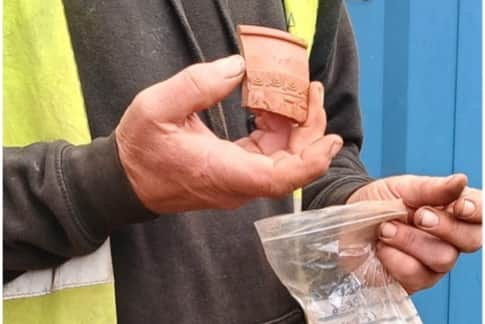
- Piece of Nene Valley Ware from East Anglia
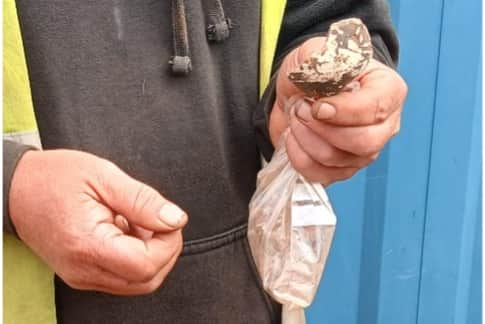
- A glass handle from a probably imported large glass jar (he also showed us a picture of what this might have looked like when whole) – this is rare, as broken glass was usually melted down and re-used. The fact that this was just thrown out suggests high status.
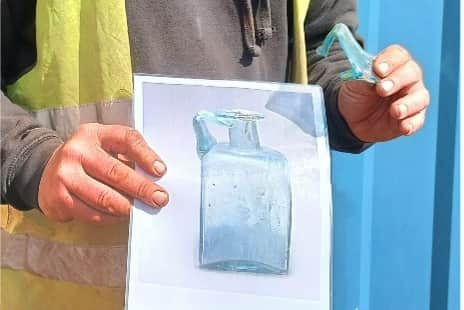
- Roman window glass
Paignton Heritage Society were fortunate to be invited to see this amazing find. It opens up the possibility of further discoveries in the future.
The society will shortly be embarking on its Autumn program. The monthly meetings will recommence, with the first being held on 17th September in the Gerston Chapel, Torquay Road, Paignton, starting at 7pm.
The talk will be on Oldway and will seek to explore some of the many changes that have taken place there over the years.
Our Junior Explorers group has a busy program for the Autumn. The first meeting will be on Saturday 26th September when the group will be visiting Paignton Parish Church.
Set up to encourage an interest in local history, the age of the group is 8-13 years.