

Torquay’s Hardcover Horror Heritage

A sweeping look at Torquay’s unexpected but enduring role in the evolution of horror writing, from Gothic classics and Victorian ghost stories to modern psychological and cosmic horror, and the real-life links between the English Riviera and some of the genre’s most iconic authors and ideas.
“Witches... All of them witches!” Rosemary’s Baby
In Ira Levin’s 1967 novel Rosemary’s Baby, a New York newlywed suspects that her neighbours have sinister satanic plans for her baby. The following year Roman Polanski turned the book into a hugely popular psychological horror movie starring Mia Farrow. As with much horror literature, Rosemary’s Baby reflected the cultural fears of its time, in this case concerns about manipulation and conspiracy. Both novel and movie feature a fictional book called All of Them Witches, by JR Hanslet, supposedly published in Torquay in 1934. Although the product of an American writer’s imagination, this does indicate the dark reputation Torquay had long possessed, much of which came from the resort’s enduring relationship with the literature of the mysterious and macabre.
“If I cannot inspire love, I will cause fear!” Mary Shelley, Frankenstein
The origins of modern horror literature can be traced back to the eighteenth century when Gothic fiction began to feature the supernatural, death, and romance. The first of these Gothic works was Horace Walpole’s hugely popular 1764 novel The Castle of Otranto which then engendered successive generations of uncanny writing. In 1815 the 18-year-old Mary Wollstonecraft Godwin visited Torquay with her future husband Percy Bysshe Shelley. The following year, the so-called Haunted Summer, Mary, Percy, Lord Byron, and John Polidori holidayed in the isolated Villa Diodati by Lake Geneva. There they held a contest to produce a horror story, which led to the famous Gothic title; Mary Shelley's Frankenstein; or, The Modern Prometheus. Torquay’s specific link to the Gothic novel still has resonance today. In 1806 Edward Montague wrote The Castle of Berry Pomeroy in which he adapted local folk tales into a saga of horror, jealousy, and revenge. The plot has Lady Elinor de Pomeroy becoming envious of her beautiful 18-year-old sister, Matilda. Deciding to have her murdered, Elinor enlists the aid of evil Father Bertrand in the dirty deed. Matilda’s spectre, however, haunts Elinor and Bertrand and the body count rises. Yet, this is a ruse as Matilda was alive all the time, though confined in the castle’s tower. This is clear Gothic fiction; there is no record of an Elinor and Matilda de Pomeroy. Many, however, still visit Berry Pomeroy Castle in hope of seeing Matilda’s White Lady ghost.
“Where there is no imagination, there is no horror,” Torquay visitor Arthur Conan Doyle
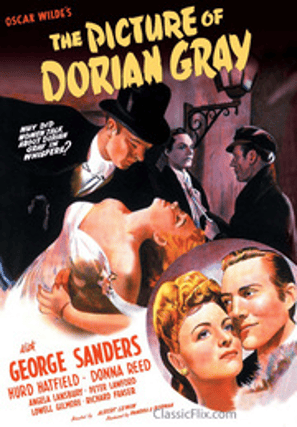
The Gothic took many forms, often with hidden meanings. The only novel by Oscar Wilde, for instance, was The Picture of Dorian Gray (1890). While the homoeroticism is subtle, it depicted the underground Victorian culture that Wilde was a part of and was subsequently labelled obscene. The book was then used at Oscar's trial in 1895 to prove his homosexuality, accusations that arose from a relationship with Lord Alfred Douglas, known as Bosie, the two having stayed in Babbacombe during the winter of 1892-3. A persistent theme in the genre is that of the revenant, with one of the earliest Victorian ghost stories coming from the pen of Torquay’s Edward Bulwer-Lytton. The Haunted and the Haunters was first published in Blackwell’s Magazine in 1859, and the story’s scenes of malicious spectres, secret rooms, and the past returning to impact the present, are still to be seen in many modern haunted house movies.
“The ghosts of dead people, who are not easy in their graves, keep the day they died upon”, Charles Dickens
The best-known author of the ghost story is, of course, Charles Dickens. In January 1862 Charles gave a reading of David Copperfield at the Marine Spa; in 1869 he read from his Pickwick Papers at the Royal Theatre on Abbey Road. During his career, he wrote more than two dozen ghost stories, many of which appeared as smaller episodes within larger novels, including The Pickwick Papers, Bleak House, and Nicholas Nickleby. His most familiar supernatural stories are A Christmas Carol and The Signalman, though Charles also wrote tales of murder, suicide, existential terror, undercover ghosts, cannibalism, deals with Satan, and executions. Edgar Allan Poe was in communication with Charles and the English author’s influence can be seen in Poe’s American tales of terror. While Charles Dickens was a sceptic, Sir Arthur Conan Doyle was convinced of the claims of his fellow Spiritualists; in August 1920 the Sherlock Holmes author gave a lecture entitled Death and the Hereafter at Torquay Town Hall. But Sir Arthur was likewise important as was Charles in the development of literary horror. His two mummy stories were merged to form the plot of the 1932 Boris Karloff film and he contributed tales of pickaxe-wielding serial killers, haunted torture instruments, spectres in the sunless North Pole, werewolves, monsters in the skies, and seances gone wrong. In 1901 while on holiday with his friend Bertram Fletcher Robinson, Sir Arthur was taken on a tour of Dartmoor and told about Devon’s local legends. The driver employed by Bertram was called Harry Baskerville; in 1894, Harry Baskerville and Alice Perring married at Torquay’s Wesley Church. Bertram later gave Harry a copy of The Hound of the Baskervilles that was inscribed, “To Harry Baskerville, with apologies for using the name.” Consequently, that Torquay driver’s name is now known throughout the world. The monster is a recurrent theme and often especially prominent in times of disease, foreign threats, or environmental change. In HG Wells' 1896 short story The Sea Raiders, a previously unknown sort of squid like beast is found to be attacking humans in Torbay. If the description seems familiar, a similar creature, this time alien, almost destroys humanity in Wells’ later War of the Worlds. Alongside external threats come menaces from within. These mirror fears of science gone awry or disease and often occur in times of medical or technological change. In the novella by Scottish author Robert Louis Stevenson, Strange Case of Dr Jekyll and Mr Hyde (1886), an investigation takes place into disturbing events linking the upstanding Dr Henry Jekyll to a murderous criminal named Edward Hyde. Robert suffered from consumption, a disease we now know as tuberculosis. Jekyll and Hyde can then be seen as a reflection of Robert’s experience of living with a debilitating illness while striving to maintain a fulfilling life. He spent several years in search of a location to improve his health, including convalescing in Torquay in 1866. The visit left an impression as he used the resort as a location in his short story The Dynamiter (1885).
“The oldest and strongest emotion of mankind is fear, and the oldest and strongest kind of fear is fear of the unknown,” HP Lovecraft
Over time, the horror genre has evolved to encompass a wide variety of themes which often overlap with other genres of literature, such as science fiction, fantasy, and thriller. Cosmic horror, for example, emerged after HP Lovecraft published The Call of Cthulhu (1926). Though an American author, Lovecraft’s family came from the Newton Abbot area, and it has been suggested that he was inspired by Devonian folklore. One local writer that was influenced by Lovecraft was Brian Lumley. A one-time resident of Torquay’s Shedden Hill, Brian achieved fame in the 1980s with the best-selling fifteen volume Necroscope series. The horror genre is as popular as ever, with novels becoming best-sellers and adapted into films and television series. And so, we have Torbay’s award-winning Adam Nevill’s novels The Ritual and No One Gets Out Alive being made as feature films. The continuing attraction of horror fiction comes from its adaptability and diversity and in how it evolves to reflect the concerns of a specific time. The journey from Gothic beginnings to multiple modern incarnations has seen Torquay’s residents and visitors always as active participants and, at times, leaders in a genre that confronts our fears and challenges our boundaries.