

Torbay Connections: How wireless pioneer Guglielmo Marconi's work reached the Bay
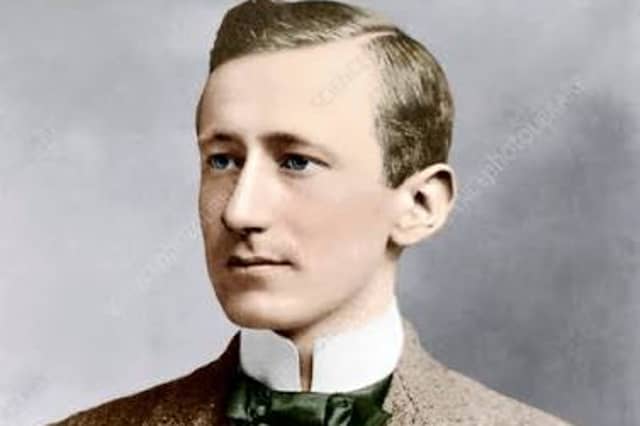

In the latest instalment of his local history series, Torbay Civic Society President Ian Handford explores the early life of wireless pioneer Guglielmo Marconi and his links to Torbay through fellow scientist Oliver Heaviside.
The second son of Guiseppe Marconi and his wife Annie daughter of Andrew Jameson
of Irish whisky fame Guglielmo was born on April 25 th 1874 in Bologna Italy. Due to
poor health (later diagnosed as angina) he never attended school but was privately
tutored at home before spending time at the Instituto Cavallero in Florence. There he
struck up what became a lifelong friendship with an Marchese Luigi Solari who in adult
life would became his greatest Italian supporter.
Due to ever failing health Guglielmo was sent in to the resort of Leghorn in 1891 and
there became even more fluent in English than his native Italian. He was always deeply
interested in physics and had a growing interest with electricity which led him to
studying many books on technical material before eventually attending a conference on
physics. Now he met Professor Giotto Bizzarini and he introduced him the possibility of
extending wired transmission and the new techniques of morse code which he taught
privately. He now also met Professor Vincenzo Rosa.
Guglielmo in deciding to read the biography of Benjamin Franklin and a publication by
Oliver Lodge knew both were currently debating the theory of electrical waves. Now
lady luck intervened when in 1894 Guglielmo met Professor Rosa a second time together
with his colleagues Hertz Righti and an Oliver Lodge. He soon discovered all were fairly
matched about theories on radio physics. Guglielmo would later then attend Bolgana
University and met again the famous physicist Professor Righti who like Rosa and Lodge
had been continuing to research their theories which now included electromagnetic light.
Marconi’s learning curve was huge and included familiarising him on oscillators,
resonators, short wave radio and micro-wave possibilities, although so far none of the
scientists he had met ever linked any to the transmission of signals.
It was during the winter of 1894 that Guglielmo started using oscillators as transmitters
and resonators as potential receivers and in the following six months he developed a very
simple form of non-wired telegraphy by managing to send a signal from his barn at home
to a receiver placed over 1.5 kilometres but behind a hill. On finding the receiver had
received the signal this immediately posed the question - how did the signal find a way
through, over and down or around the hill to get electronically captured on it’s far side.
How on earth could an electronic signal bend itself and avoid the hill ?. Guglielmo
immediately realised that by accident he had stumbled on something very important.
He now approached officials within the Italian Government whose only suggestion was -
that he get in touch with the Italian Patent office. Very disappointed he decided to contact
his cousin Henry Jameson (innovators on mothers side of the family) and eventually they
together decided to come to Britain bringing all Guglielmo’s apparatus with them. They
arrived in London on February 2 nd 1896 and with Guglielmo holding a letter of
introduction to Sir William Henry Preece - (Chief Engineer at the British Post Office)
they soon discovered he was also researching the transmission of electromagnetic signals
but using an inductive process. All three were aware that the British scientist Oliver
Heaviside who had been suggesting in the 1870’s, that metallic circuits should be used as
guides and by the 1890’s had even developed induction coils which would later be used
by the Post Office when sending messages back and forth through morse code
telegraphically.
By 1896 Preece and Marconi were testing the transmission of signals across the rooftops
of London, from the General Post Office at St Martin-le-Grand to a private bank in
Queen Victoria Street some 300 metres away. That success determined inventor
Guglielmo Marconi alone to widely travel England testing that non-wired signals from
places as distant as Salisbury Plain to Telegraph Hill in Devon could be received
anywhere. In March 1896 he lodged his first patent in England then later withdrew this in
order to replace it with a second patent (No.12039) on July 2 nd 1896. He explained the
new patent was - “For Improvements in transmitting electrical impulses and signals in
apparatus thereof”. Then finally on July 13 th that year Marconi filed a first patent in
America to cover what was “the earliest aerial antennae” (receiver) ever. Meanwhile
Oliver Heaviside had now retired to Paignton in Devon and must have either have met
Marconi there or at his later home in the Warberry’s Torquay. Both were of course now
experimenting on the same wavelength - ie wireless transmissions. Oliver had already
suggested a layer of ionised particles must be sitting on the upper atmosphere and that
they perhaps bounced back radio signals to earth. His idea was not officially proven by
and accepted by scientists for another twenty years. Meanwhile Guglielmo merely
accepted the now tested radio signal could be picked up anywhere but still had no idea
how signals did what they did. (Continued next week)