

Tommy Cooper: The magician who turned failure into comedy
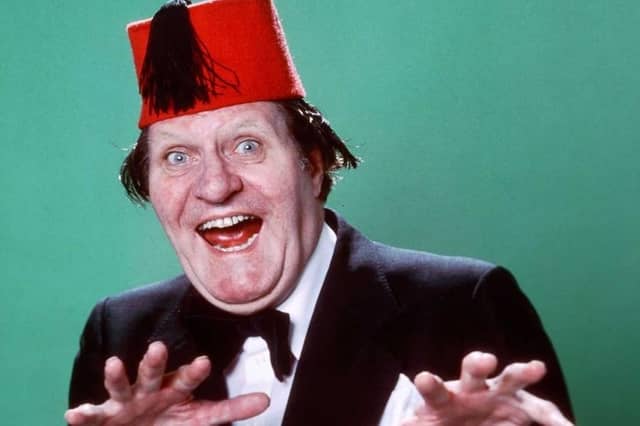

How a Welsh-born entertainer turned bungled tricks and comic chaos into one of Britain's most beloved acts
The elder of two sons of Thomas Cooper (Welsh miner) and Catherine Gertrude Wright, Thomas (known as Tommy) Frederick Cooper was born in Caerphilly, Glamorgan, on March 19th, 1921. From an early age Tommy seemed virtually destined to entertain, and he certainly did become eventually Britain's most loved comic of his era.
His autobiography tells us at birth someone grabbed his legs, held him upside down and whacked him. He recalls: “Already I could see life was not going to be easy. I cried like a baby. Is it any wonder I took to the bottle?” This deluded illusion and later his ineptitude at magicians' trickery when on stage all became the basis of an act which ultimately enraptured audiences everywhere.
Although born in Wales, Tommy was still a child when brought up in Exeter and later attended the Radcliffe School, Exeter, before the family moved to Southampton. During his youth Tommy was always fascinated by handicrafts using materials or paper, metal, wood, plastic items or even hats, which probably explains how he was so adept at using just about anything he found lying around the stage when undertaking some magic act.
He was given his first box of magic tricks at age eight, which he later used to perform tricks in school and then later at works canteens. As a teenager he joined the local branch of the Boy Scouts but then failed, or perhaps refused to even try, knot-tying, seen as one of the first things expected of new applicants. It was a basic skill and led to the scout master “drumming him out” for not trying.
But soon he was working as an apprentice shipwright before realising his talent for making people laugh. It was a natural talent which, when performing as a magician, soon saw an early first appearance on a stage.
Yet in his biography he confirms his early appearances on stage were very difficult. “I always had awful stage fright. It was terrible. You can’t talk and every trick I did went wrong, but audiences loved it and laughed like mad. I just wanted to mystify them with magic trickery, but it went wrong, leaving me often in tears.”
Yet his audiences were also in tears through laughter and that convinced him that chaos was no bad thing, and so he started to make trickery that often went wrong rather than right. It was, of course, the very essence of Tommy Cooper’s lifelong act, being not only unique but quite brilliant in concept, as no-one in the audience knew if Tommy had deliberately done a trick wrong or if it had simply failed.
But this didn’t matter anyway as his audiences just adored the chaos and failure, although not every time. Being witness to a very tall gangly man striding about the stage seemingly purposefully, as perhaps only a trained Horse Guards soldier can do, while wearing a fez on his head, was just humour.
Later we all witnessed Tommy often peeping out from behind the closed stage curtains before the show, uttering not a word, as we presumed he needed to make sure someone was in. Again it was unique, funny and brilliant.
That pre-entrance idea would be extended when his next unique idea evolved, when Tommy strode purposefully onto stage doing a “strange walk and gestures” without again saying a word. With the audience “in bits”, the man with the fez then finally spoke some aside or inane comment or a “one-liner”, which was all stupid but funny. Nothing quite like it had ever been seen on stage before and even today comics rarely try to imitate his style.
But now it was 1939 and Tommy, having received his call-up papers, somehow managed to end up in the Horse Guards (perhaps because he was over 6' 3" tall), yet was then picked out by the Combined Services Entertainment Players, who added him to their group about to perform in the Middle East.
It is believed this is where Tommy adopted the fez, whereas later others said he had swapped a Welsh miner's hat for his first fez. It really doesn’t matter which is true as, in time, it certainly became his lifelong “trademark” as an entertainer.
Throughout the war years Tommy performed with NAAFI groups all over Europe until, when demobilisation came in 1946, he finally came home.
Tommy now knew his future lay with show business and so immediately after 1946 he joined the only theatre open in London, the Windmill Theatre, which was hardly a place for a comic, let alone a magician. When not appearing here he more fully honed and refined his act in clubs, music halls and in theatres all around the country.