

The rise and fall of the Torbay Hydro
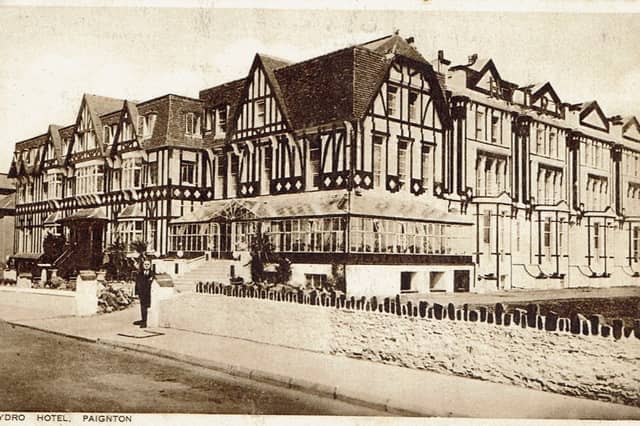

The Bay’s famous hydros once promised health and healing, but changing tastes transformed them into ordinary hotels.
Hydropathics – or hydros – were institutions created to practice hydropathy. This was a cure-all which played an important part in Torquay and Paignton's development as tourist towns.
From its very beginning as a resort, Torquay catered for the needs of the sick, the dying and the incapacitated. The Guide to the Watering Places of South Devon (1817), for example, states that the town “was built to accommodate invalids”; while Octavian Blewitt’s Panorama of Torquay (1832) confirms that “houses were erected for the accommodation of the invalids”.
Ever since, this somewhat downbeat genesis has caused some in the tourism industry embarrassment and has been quietly forgotten.
By 1840 the illness industry was well entrenched with Dr AB Granville writing, “The Frying Pan along the Strand is filled with respirator-bearing people who look like muzzled ghosts, and ugly enough to frighten the younger people to death”. Torquay was indeed “the south west asylum for diseased lungs”, with the hotels “filled with spitting pots and echoing to the sounds of cavernous coughs, outside the only sound was the frequent tolling of the funeral bell”.
The primary cause of such sickness was consumption, a term for the wasting away of the body particularly from pulmonary tuberculosis. The town eagerly promoted itself as a place to be cured and in 1830 Dr Clark praised Torquay, claiming that the town “possesses all the advantages of the South-Western climate in the highest degree” for the treatment of the disease. The following year the Irish surgeon James Johnson wrote a very successful book, Change of Air, or the Diary of a Philosopher in Pursuit of Health and Recreation, which recommended visiting health-giving coastal resorts.
By 1850, 90% of travelling British invalids suffered from consumption and up until the 1870s they dominated the peripatetic ailing community. Initially TB was not even seen negatively as the affluent ailing generated an all-year-round income for many hotels.
For many, consumption was even fashionable as it was associated with poets and artists and known as ‘the romantic disease’. Visitors to Torquay who suffered include Percy Bysshe Shelley, Robert Louis Stevenson, Elizabeth Barrett Browning and Charles Kingsley. Crucially, TB was not understood to be infectious and so health resorts inadvertently helped spread the disease when sufferers freely mixed with residents, care workers, and especially with healthy tourists who would then return to their hometowns.
Offering cures, or at least some relief, were a variety of competing systems. Among these was hydropathy, the therapeutic use of water. This covers a broad range of approaches and methods, such as temperature and pressure to stimulate blood circulation and to treat the symptoms of a range of ailments.
Hydropathy’s creator, the Silesian ‘peasant’ Vincent Priessnitz, developed the treatment by experimenting on livestock and his willing neighbours; and in 1826 he established at Gräfenberg a system of baths and compresses involving wrapping patients in wet sheets. His procedures were satisfyingly uncomfortable, so they were assumed to be doing some good.
In search of relief people came from all over Europe. One of those who experienced the water cure was Captain Richard Tappin Claridge, who in 1842 wrote a glowing account in Hydropathy; or the cold water cure. The captain then encouraged the development of the first British hydropathic establishment at Malvern, where the water was “famous for containing just nothing at all”.
Hydropathic institutions subsequently began to appear, initially in spa towns where there were already the fashionable pastimes of promenading, bathing, and the quaffing of foul-tasting mineral waters. It was inevitable that the hydropathic model would transfer to the new holiday resorts like Torquay which were already in the health business. Torquay would later, of course, adopt the Latin motto, Salus et Felicitas, meaning Health and Happiness.
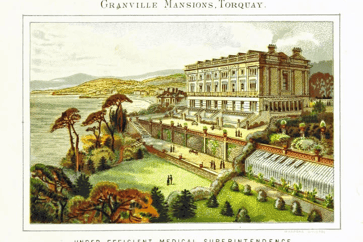
Many in Torquay’s medical profession were, however, unconvinced by hydropathy’s cure-all claims. Sceptical, they classed hydropathy alongside other locally popular pseudo-scientific offerings such as homeopathy, mesmerism, phrenology, and the sale of patent medicines. Nevertheless, there was money to be made and so from the 1840s hydropathic hotels were established across our Bay.
Initially, these were small institutions but by the later nineteenth century they had evolved into substantial hotels with baths and recreation rooms under the supervision of qualified medical practitioners.
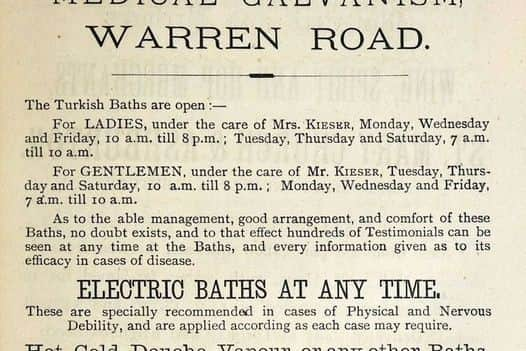
It wasn’t just hotels that offered these water treatments. Hydropathic electric baths could be accessed in Torquay’s Warren Road while in 1937 the Marine Spa was “recognised by Medical Hydrologists” for offering internal or external “water remedies.”
At their peak there were over fifty hydropathic hotels across Britain. However, by the late nineteenth century two types of visitor were arriving; the patient and the tourist. Gradually more visitors were coming for a straightforward holiday, and they came expecting a variety of leisure and recreational facilities, not just a rigorous and sometimes less than pleasant health experience.
One notable regular visitor to Torquay’s Hydropathic Hotel was the Irish playwright George Bernard Shaw. George wrote more than 60 plays and is the only person to have been awarded both a Nobel Prize for Literature in 1925 and an Oscar, for Pygmalion in 1938.
He much appreciated, “No housekeeping, plenty of bathing, taxicabs to get around in, shops galore, and every sort of urban amenity.” In 1897 he used his knowledge of Torquay to base the play You Never Can Tell in the resort.
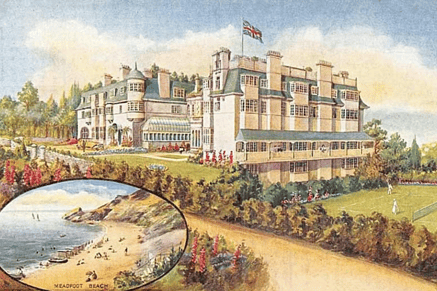
By the time of George’s visit, the Torquay and Paignton hydros had therefore moved on from offering purely curative and often uncomfortable treatments. They had acquired tennis courts, croquet lawns, and golf courses; while the smoking of tobacco, once prohibited, was now tolerated. Less acceptable was alcohol, many hydropathics originally being temperance institutions. Nevertheless, eventually the hydros had to offer what the paying guest demanded and so they became little different from other Bay hotels, only the treatment rooms setting them apart.
By 1906 Chambers’ Encyclopaedia recognised this change: “Most so-called hydros originally started with the full equipment for treatment, including a resident physician…but many now are merely high-class country boarding-houses.”
And so, across the nation, many would eventually move away from therapeutic purposes altogether to become tourist hotels. Some did retain the name ‘Hydro’ but not those in the Bay which were demolished, remodelled, or renamed. George Bernard Shaw’s much-admired Torquay Hydropathic Hotel, for instance, is now The Headland Hotel.