

The practical and romantic Torbay beach hut

From Victorian bathing machines to modern status symbols, beach huts reveal two centuries of changing leisure, class and coastal life
The Torbay beach hut is an example of British ingenuity, creativity, heritage, and social aspiration.
These small and brightly-coloured structures are far more than mere shelters from unpredictable weather. They embody two centuries of an idiosyncratic approach to leisure, privacy, and the curious democracy of the seaside holiday.
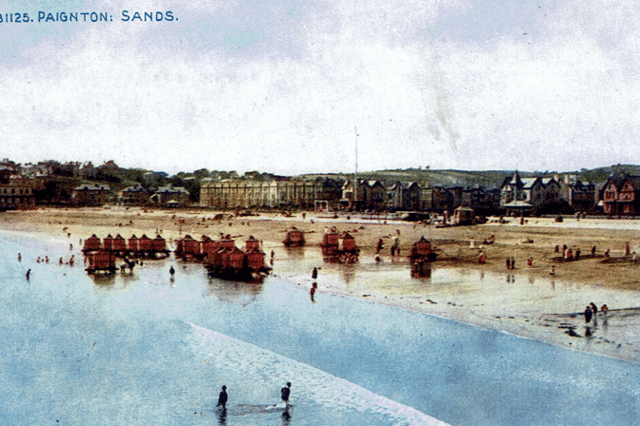
The origins of the modern beach hut lie in the 1730s when coastal towns began introducing bathing machines. These were wheeled cabins pulled into the shallows so that bathers could change in private and step directly into the water. Some were made of wood, others had canvas sides over a wooden frame and curtained doors at each end. Not all were of the same design; Paignton’s featured a conical tent-like roof, for example. As this was a competitive rental business, the machines were often brightly painted, maybe with advertisements, beginning a tradition we still see today in the Bay’s beach huts.
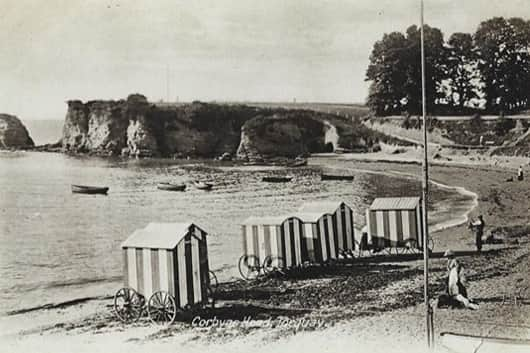
In its early days, using a bathing machine was a pastime for the elite, with George III giving his royal approval when he took a medicinal bath at Weymouth to the musical accompaniment of 'God Save the King'; in the 1840s, Queen Victoria installed a machine at Osborne House on the Isle of Wight.
Bathing machines then increased in popularity, firstly to cater for the enthusiasm for salt-water health cures, and later in response to emerging Victorian moral codes. Mixed bathing had come to be considered improper, even seeing someone of the opposite sex in their bathing suit being unacceptable, and so beaches were segregated with sections cordoned off for men and women.
It was the bathing machine that allowed people to access the sea without ever being seen.
Customers would enter the machine while it was on the beach, wearing their street clothing, and change into hired bathing attire. The machine would be wheeled or slid into the water where the occupants disembarked. A ‘dipper’ would often be present to physically guide the swimmer into the sea and back. As some machines were equipped with a canvas tent lowered from the door, giving the bather greater privacy, and a small flag that could be raised to indicate when a session ended, these contraptions took on the title of bathing machine.
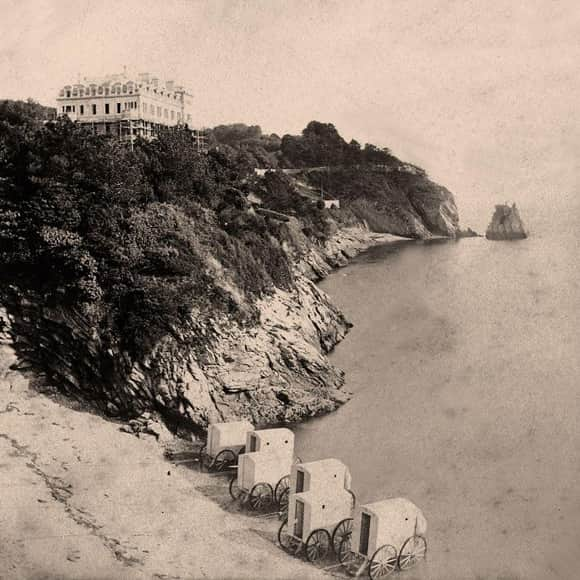
By the end of the nineteenth century, however, Victorian moral standards were loosening. Beachgoers wanted to socialise and enjoy their vacations together and so restrictions gradually eased. The comparatively wealthier resorts, such as populist Paignton and Dawlish, were the pioneers in mixed bathing. The more conservative, elitist and aloof Torquay followed, likely persuaded, as always, by the example of the liberal continental resorts.
In 1901 segregated bathing officially ended and by the 1920s the bathing machine was a slightly embarrassing anachronism. Some of those redundant bathing machines were pulled up onto the beaches, the wheels removed and repurposed as beach huts. Indeed, the layout of today’s huts still reflects where the bathing machines once stood as they waited for business.
But even though both sexes could now see each other in swimwear, undressing in public was still not acceptable and could result in a fine. This was even if indecency was avoided by ‘Macintosh Bathing’, changing under a raincoat. The solution, of course, was a changing room near the waves.
Following the introduction of bank holidays in 1871, more families could afford regular seaside excursions, which generated a need for changing facilities, storage for bathing costumes, towels, and other beach equipment. Early purpose-built huts to satisfy this demand came in the form of simple wooden boxes positioned above the high-water mark. But as holidays became even more accessible to the emerging middle classes, these huts changed from the merely functional into ways to display the sophistication and aspirations of their owners and tenants. Once just "holiday homes for the toiling classes", their image was further enhanced when George V and Queen Mary spent the day at a Sussex beach hut.
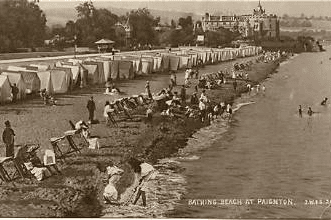
The period between the two world wars was the real golden age of beach hut culture. The introduction of paid holidays and improved transport links created a boom in domestic seaside tourism. It also engendered a democratisation of ownership as smaller and simpler huts became accessible to working-class families.
Even more affordable were tents, often brightly painted or decorated with stripes. Unlike the bathing machines, which were usually hired for around half an hour, both huts and tents could be taken on for the day, the week, or even the season.
The 1950s and 1960s saw more expansion, driven by increased prosperity, car ownership, and weekend trips to the coast. Beach huts then multiplied along the coast, and began displaying the personal touches that would become their hallmark; the bright high-contrast colour schemes, the hand-painted signs, the nautical motifs of stripes and anchors, and the etiquette of small-space living. As retreats from the public sphere of the beach, they became quirky extensions of the home, furnished with deck chairs, small stoves, pictures and family photographs. Some became competitively elaborate, with verandas, decorative woodwork, and gardens in the sand.
Despite the rise of Mediterranean package holidays and the subsequent decline of many resorts, beach huts proved surprisingly resilient. Then in the 1990s came another wave of interest in these iconic seaside features. After languishing as unfashionable and unsellable, property prices began to rise as leisure time and disposable incomes increased. Over time the humble beach hut gradually emerged as a counterintuitive status symbol, almost like possessing a classic car. At Mudeford Spit in Dorset, beach huts have sold for over £500,000; around the country the wait for a hut can easily be over a decade.
On-the-surface, this is an irrational level of demand for a small box, designed to be used as a shelter from the sun or wind and for changing into and out of swimming attire. You can’t even move in; strict planning regulations generally prevent overnight accommodation or permanent utilities.
Something much more is clearly going on to make the beach hut a repository of cultural memory and the embodiment of values and experiences. Part of this is the way the huts have become the visible core of a type of leisure; unhurried, family-oriented, connected to the weather and the natural rhythms of the coast. We see this in the ways beach huts are presented in literature and on our screens as symbols of tradition, identity and seaside nostalgia. Once the stereotypical preserve of the elderly, the huts now feature as sophisticated accessories in lifestyle magazines, their elaborate interiors occupied by celebrities.
Despite this appropriation, beach huts continue to serve a democratic function. Premium locations may be exceptionally expensive, though many remain accessible to middle-income families, maintaining a connection and tradition of use across the generations.
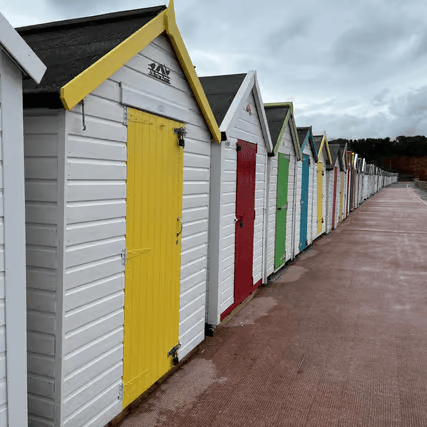
These coastal micro-societies may even offer inspiration to designers and architects as they consider increasing urbanisation and population density. For well over a century, coastal communities have been creating efficient interiors, maximising space with fold-away furniture, sustaining informal governance structures that preserve standards, assuming environmental stewardship of what is available, satisfying a need for retreat and contemplation, and just getting along with very close neighbours. All while ingeniously making the seemingly identical personal and so very different.
An estimated 25,000 beach huts are out there, concentrated along the south and east coasts. Beginning as practical solutions to the challenges of wind and rain, beach huts have evolved into emblems of brief escape from urban life and are now part of our national identity.
They may be slight structures, but they illuminate those greater stories we tell ourselves.