

The day the French burned Teignmouth down

How a French victory at sea led to the last successful foreign invasion of England
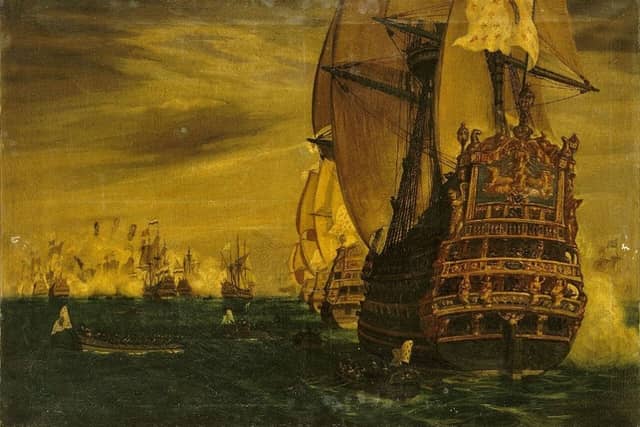
In July 1690, a French fleet arrived in Torbay. This unwelcome visit followed a victory over the combined navies of England and Holland. The French then used the Bay as a base to launch a raiding party which devastated nearby Teignmouth.
This attack was an episode in the Nine Years War, a world-wide conflict that took place between 1689 and 1697. Indeed, as fighting extended far beyond its European roots, it has been called the first ‘world war’. On one side was a European alliance which included Britain; and on the other, France.
At the same time, fighting was taking place in Scotland and Ireland between the supporters of King William III and the deposed James II. This was only a few years after William landed in Brixham to claim the English throne.
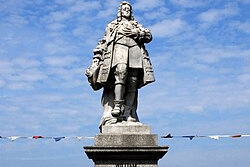
The French fleet came to the Bay following their success at the Battle of Beachy Head on 10 July. The allied English and Dutch fleet were outnumbered by the French and, by the end of an eight-hour battle, seven Dutch ships of the line and three fire ships had been destroyed; the English also lost one ship of the line. The French didn’t lose a single vessel.
This was the most significant French naval victory over their Grand Alliance opponents during the war. However, to much later criticism, the French Vice-Admiral Anne Hilarion de Tourville failed to pursue the Anglo-Dutch fleet, allowing it to fall back to the Thames.
The defeat at Beachy Head caused panic in England. The diarist John Evelyn wrote, “The whole nation now exceedingly alarmed by the French fleet braving our coast even to the very Thames mouth”.
The war was certainly going badly for the Allies. On 1 July, the French had been victorious at the Battle of Fleurus (now in modern Belgium) and, as Tourville was now in control of the Channel and able to roam without hindrance, an invasion was feared; only 6,000 professional troops, alongside the militias, were available to defend the homeland.
Following his success at Beachy Head, Tourville’s intention was to sail the French fleet to Ireland to intercept William and prevent his army from returning to defend England. But instead, the French dropped anchor in Torbay.
On shore, beacons were lit along the coast as they had been in the days of the Spanish Armada in 1588. Alerted to the danger, the English militia then gathered in Torbay expecting the French to come ashore.
A French incursion was indeed being organised, but this was not to be in the Bay. It may well have been the English militia that saved our communities from attack, or it could have been the walls and gatehouse of Torre Abbey. Even though the Abbey had lost its defences many decades before, from out at sea the medieval gatehouse still appeared to be a formidable obstacle to any pirate or invader.
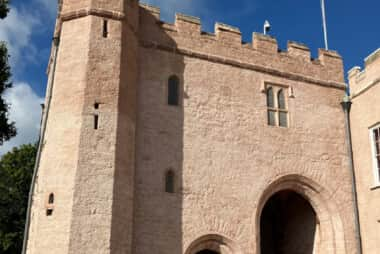
Hence, only a small French detachment made a false landing in the Bay - we don’t know where - to divert the local militia from the real objective.
Instead, Tourville left his ships of the line where they were and, on 13 July, he sent several of his galleys eastwards. These vessels were rowed by slaves and designed for inshore work, and they carried 2,800 sailors and troops to their destination. This was soon to be revealed as “a weak, unfortified place, called Teignmouth, about seven miles to the eastward of Torbay. Coming very near and having played the cannon of their galleys upon the towns, shooting nearly two hundred cannon balls to drive away the poor inhabitants, they landed about seven hundred of their men. Then they began to set fire and plunder the towns of East and West Teignmouth, which consist of about three hundred houses.”
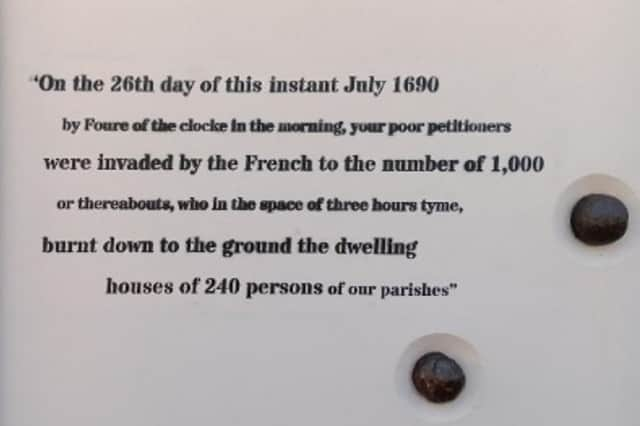
The town’s only defenders were a small force of around 100 poorly armed militia, and they were easily swept aside by professional soldiers. The inhabitants also fled, leaving the French free to ransack the town for twelve hours, destroying ships, houses, fishing boats and their nets, while also “killing very many cattle and pigs which they left dead in the streets”.
Reinforcing the religious aspect of the conflict, French troops “entered both churches, tore Bibles and Common Prayer Books in pieces, broke down the pulpits, and overthrew the communion tables".
After the French had withdrawn, the Justices of the Peace investigated the attack and examined 'creditable persons'. They reported that:
“By the late horrid invasion there were within the space of 12 hours burnt down and consumed 116 dwelling houses and also 172 dwelling houses were rifled and plundered and two parish churches much ruined, plundered and defaced, besides the burning of ten sail of ships with the furniture thereof, and the goods and merchandise therein”.
When Teignmouth’s residents returned, they found their homes had been wrecked. In response, the Crown issued a church brief that authorised a collection for the aid of the town. Churches from across the nation made contributions of £11,000 (an equivalent of around £2,300,000 today).
Having caused much damage, the French fleet weighed anchor and sailed westwards. It was recorded that as the ships passed Berry Head, “two slaves leaped from one of the galleys into the sea – one was recaptured; the second, a Turk, after a desperate struggle for liberty, swam on shore, and was secured by the people who had witnessed the incident.”
England’s moment of peril then passed. By the end of August, the Allies had 90 vessels cruising the Channel and French control came to an end. News also came in of the 1 July Battle of the Boyne, where King William had decisively defeated the exiled James II. This victory reassured William’s European allies of his ability and his commitment to the defeat of all French-aligned forces.
The French soon realised that their failure to exploit their success at Beachy Head was a missed opportunity. The burning of an obscure English coastal town with no strategic importance was clearly pointless and a waste of resources.
The tide soon turned in the naval war. In May 1692, two years after Beachy Head, a superior Anglo-Dutch fleet destroyed Tourville’s at the Battle of Barfleur/La Hougue, off the Cherbourg Peninsula. Winston Churchill called the battle “the Trafalgar of the seventeenth century”, a defeat that caused France to abandon their goal of naval superiority, adopting instead a continental strategy on land and a war against trade at sea.
The Nine Years War is now largely forgotten, though the attacks on the Bay and on Teignmouth should be remembered as the last successful foreign invasion of England. This was our part in that long war, a global conflict that extended far beyond its European roots, to be also fought in North America, India, Africa, and the Caribbean. This was the first ‘world war’, but not the last.
So, the next time you visit Teignmouth, do look out for the French cannon balls that were found embedded in the walls of the town’s St Michael’s Church. Also, take a walk along the charming 'French Street', which was named in memory of 13 July 1690, the day that Teignmouth burned.