

Sir Ernest Shackleton’s final expedition - Part 3
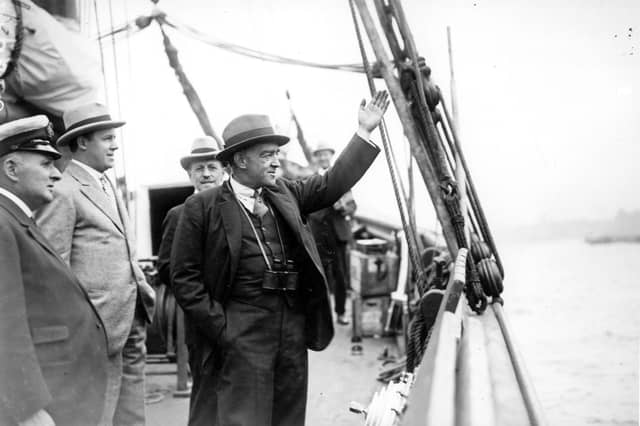

The remarkable final chapter in the life of Britain’s greatest polar explorer
It was three long years before Sir Ernest Shackleton was called by the sea. At first he thought of going North to the Arctic, but Government said Antarctica. The expedition would involve two ships: "Endurance", carrying the sledges and dogs, and a relief ship, “Aurora”. The expedition was named the Imperial Trans-Atlantic Expedition, which ultimately would create a land depot on McMurdo Island in the Ross Sea.
With the 1914 war about to commence, Shackleton offered both his ships and his men to the Admiralty, though both were refused, as they said, “proceed with the expedition”. No-one then could imagine a modern war lasting four years, so “Endurance” set sail for South Georgia and found it was a bad year for pack ice at Antarctica. Endurance safely passed Bruce’s Coats Land and even discovered the Caird Coast. However, she was then trapped by thick sea ice on January 18th and survived only by drifting for nine months before she yielded to the ice, which crushed her on October 27th, 1915 — 200 miles from any land. More important, she was 1,000 miles from any known human settlement.
Shackleton now established a base camp, then chose five men to accompany him to Elephant Island by rowing boat. They arrived there on April 15th, 1916, when they made camp again, though realising the island was not one likely for a search party to visit. Now Shackleton had to make the harder decision of rowing to South Georgia, 800 miles distant. Knowing a Norwegian whaling station was established on the North Coast, the sea journey crossed some of the wildest seas on the planet before, having landed on the South Coast, they endured a tough walk across the unknown interior with its difficult terrain. Exhausted, all six men fortuitously reached their goal safely and found help.
Meanwhile, the marooned twenty-eight seamen in the Ross Sea knew nothing of this and had to wait until August 30th before they were rescued, when one of the men said, “they had never given up on him — if Shacky lived he would return”, and he did. In fact, once his group were safely delivered to America, Shacky had sailed to New Zealand in the “Aurora” before having to fight the sea ice three times. Before he finally broke through the heaviest known sea-ice ever, on the third attempt he was successful. Thankfully, all his men were alive when rescued by Aurora on August 30th.
Now everyone was returned home to their families, including Commander Shackleton. With the end of the First World War in sight, the Government now sent him on a special mission to South America, where he was to explain (particularly to neutral countries) the reasons behind the “war-aims of the Allies” in this long war. On his safe return to Britain, he was given the rank of Major before being sent East to help the Russian expeditionary force of 1918–1919 “organise their winter equipment”.
Three months later, and back in Britain, he now resigned his commission in February 1919 to try and find ways of establishing income for his family. This proved difficult in the post-war era. For two years Sir Ernest tried setting up enterprises, all of which failed. Then he tried investing and even getting elected to Parliament, although both ideas failed. Meanwhile, he was involved in various casual affairs and had become a heavy drinker, so it must have been a relief when learning of a new expedition being financed by John Quiller Rowett.
Rowett wanted the unknown area of Enderby Land in the Antarctic fully explored. Shackleton was appointed Captain of “Quest”, a ship already purchased, which he found was seaworthy but old, with “imperfect engines”. Nevertheless, she safely reached South Georgia on January 4th, 1922, but then the very next morning Sir Ernest suddenly died. Whether the ship’s engines failing was just a last straw… we shall never know.
Sir Ernest had long suffered heart problems and angina pectoralis and, before leaving home this time, said to Emily, “he did not mean to die in Europe and wanted to die away on an expedition” — now how strange was that?..
Sir Ernest Shackleton C.V.O. died on January 5th, 1922, leaving his wife, two sons and a daughter in England. His body was returned to Britain, but Emily asked that he be buried on South Georgia. It would then take until August 2017 before Torbay Civic Society commemorated Sir Ernest’s visit to Torbay Hotel by unveiling a Blue Plaque at the hotel.