

Quest complete: Dartmoor letterboxer conquers the Sacred Crescent
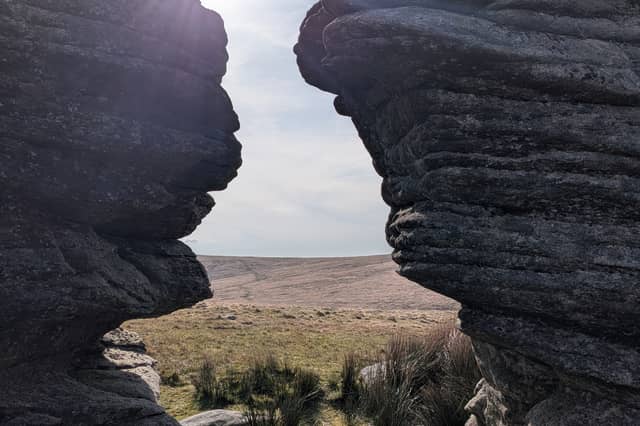

After six walks, nine hidden stamps and countless miles across Dartmoor, one dedicated letterboxer has completed the Sacred Crescent challenge, uncovering ancient stone circles, remarkable wildlife encounters and the enduring magic of the moor along the way.
Back in April, I told you about a mission I was undertaking, to collect all the
Letterboxes in a series dedicated to the Sacred Crescent of stone circles, located on
the north eastern edge of Dartmoor. Well, last week I completed that mission, having
collected all nine rubber stamps, over a series of six different walks. In this article, I
want to share with you the experience of this achievement...
For those of you who aren’t familiar with my favourite pastime of Letterboxing, it’s
something that is largely peculiar to Dartmoor, which involves following a series of
clues, using a map and compass, to track down rubber stamps, inside plastic pots
that are hidden all over the moors. There are thousands of them, and I’ve been
addicted to hunting them down, since I moved to Devon in the late 80s. There is a
more modern version, known as Geocaching, which uses the GPS system on your
mobile phone, but in my eyes that’s cheating!
This particular set, was inspired by a theory that a number of Dartmoor’s stone
circles, were purposely positioned in a crescent shape. Hence The Sacred Crescent.
Some are quite obvious; some are marked on the Ordinance Survey map, but not so
obvious; whilst a couple, that have only been discovered in recent years, lie buried
under the peat, and are not so easy to find. However, the clues have been designed
to take you to all the named sites, as you search for the associated box in the nearby
landscape. This is why I’ve enjoyed collecting these ones, as it combines my interest
in the antiquities of Dartmoor, with the thrill of the hunt.
In that first article, I wrote about starting this quest at Scorhill Stone Circle, before
moving on to the remains of another circle amongst the ancient settlement known as
Shovel Down. It was as I sought out that second box, that I was rewarded with the
magnificent sight of a herd of deer, out on the open moor, that allowed me to film
them for a good six minutes, before sauntering off to the safety of, nearby,
Fernworthy Forest, where they are normally seen.
Coincidentally, a few weeks later, when I resumed my quest, I headed towards
Buttern Hill, where a circle is marked on the map, but its remains are hard to spot
amongst the miry ground, where it’s supposedly situated. However, I did find its
associated box, and was pleasantly surprised to find that this particular stamp
features deer...
My third outing, in May, coincided with the last weekend before the annual Ten Tors
challenge, and lots of competitors were out in force, getting in some last minute
training, before the big event. On this occasion, I chose to park in Fernworthy Forest,
as my next target, pertaining to the circle amongst the trees, lay just outside its
boundary.
Having just arrived, and as I was getting suited and booted, I was approached by a
group of young lads, weighed down by their huge backpacks...some looked quite
done in...and one asked me if I’d seen a minibus...I hadn’t, during the short time I’d
been there, and in the small turning circle we found ourselves in, there wasn’t room
for one to park up anyway. He continued that they were late for their pickup, and they
couldn’t get a phone signal...I find Vodafone is the best network provider for use on
Dartmoor...so I suggested they followed the road, that we were at the end of, through
the forest, where they would find a bigger car park, and hopefully there ride would be
waiting there. They thanked me, and off they trudged. I hope they got home ok that
day.
As for me, I headed on, through the trees, passed the stone circle, until I came
insight of the view looking towards Teignhead Farm. This used to be one of my
favourite walks, through the overhanging trees, to the moor gate, where the
landscape on the other side was finally revealed. Now this last section has been
chopped down, it resembles a scene, post apocalypse...so not very scenic anymore.
At the gate, I encountered more Ten Tors competitors, some being greeted by friends
and family, before being ushered on their way.
I then went in search of my next box, which, once located, I had to stamp up
discreetly, for fear of many prying eyes. Usually I don’t encounter another soul,
during my Letterboxing walks.
Job done, I decided to take a circuitous route up to one of my favourite tors, Watern
Tor, which dominates the skyline above the Teign Valley. This meant crossing the
river using the Manga Rails...metal poles, strung between granite posts, that stop
you getting your feet wet. The name, Manga, comes from a nearby farm ruin.
Continuing upwards, I was approached by another Ten Tors walker, who asked me
where they were. When I informed him that he was nearing Watern Tor, he muttered
an expletive under his breath. It turned out his group were meant to be at Buttern
Hill, which was on the other side of the river, and quite a distance from where they
now sat. I tried to suggest the best route to take, which was to head in the direction I
was going, but, as I carried on upwards, they failed to catch me up, so for all I know
they are still sitting on that hillside, feeling very sorry for themselves...
After admiring the tor, and having stepped through the gap formed by the Thurlstone,
I followed my own advice, and headed back to the river crossing at the Teignhead
Clapper, via the ruins of Manga Farm, reaching it at dusk, meaning the last leg of my
walk was conducted through the spooky woods in dimpsy light...good job I’m a
hardened paranormal investigator!
The fourth walk, had me parking in a different part of the forest, and following a
different path out of it, so I could head straight to Grey Wethers, the only double
stone circle on Dartmoor, making it an important part of the Sacred Crescent. Having
located the attached box, I continued up the hill to Sittaford Tor, where its recently
discovered circle, still lies recumbent in the ancient peat.
Having secured two boxes for my set, I took the opportunity to continue my walk
towards a spot called Quintin’s Man, which is the name given to a fine example of a
burial cairn, sharing the space with a flagpole, and some other army furniture, as it
now serves as a magnificent observation post over that part of the military range.
Heading back into the Teignhead Farm Newtake, I suddenly found myself being
buzzed by two military helicopters, practicing flying low up the river valleys. Their
piloting skills were impressive, and I was able to take pictures and videos, as they
stayed in that area for a good half hour, before heading off in the Plymouth direction.
In light of the recent tragedy near Okehampton, I can’t help thinking if I had
witnessed one of the final training sessions of that ill-fated crew...
I reached the forest, just as it was getting dusk, and I was stunned by the different
types of birdsong I was privy to, as I made my way back through the trees. It felt like
each type of bird had its own territory to sing from...I recorded some of it as I
walked...wonderful stuff.
The penultimate walk, took me to the foothills of Cosdon Beacon, for two more
boxes. For this I parked in South Zeal, and followed a path through woodland, which
led me to the newtakes, before reaching the open moor. My route took me to The
Cemetery, a fine example of a triple stone row, which I’m sure was well used by our
ancestors. This then pointed me in the direction of my next target, Whit Moor Stone
Circle, with its magnificent views south, of Steeperton Tor and back towards Watern
Tor. Box found, it was time to head for the last circle in the crescent, on the slopes of
Metheral Hill, sadly another one no longer standing, and recently discovered buried
in peat.
The return trip gave me a close encounter with a wobbly feather bed, and a view of
my final objective, the remains of the Irishman’s Wall, on the slopes of Belstone
Ridge.
I reached this box, just last week, by parking in the village of Belstone, and passing
over Watchett Hill, where another army flagpole is located. Then making my way to
the top of the wall...a symbol of greed by a group of Irishmen, who wanted to secure
this portion of the moor for their own ends, and the locals objection to their plans by
knocking it down...where I finally completed my mission, locating the title stamp to
the set...Gateway to the Sacred Crescent, as there is a gateway in the wall, below
the box site.
My intention was to continue my walk south, for some more Letterboxing
opportunities, but, noticing a bank of fog descending from Yes Tor (the highest point
on all Dartmoor), I felt my best course of action was to head back to the car. This
route took me past Nine Maidens, another ancient stone circle, not included in the
crescent, where I stopped to take pictures, and as I did so, I realised I was about to
be enveloped in the fog, coming at me from all sides...What an eerily satisfying end,
to what had been a most enjoyable Letterbox hunt, over the last two months.
I must take this opportunity to thank Dylan and Ermintrude (they know who they are)
for continuing to combine my love of Dartmoor antiquities, and folklore, with my
favourite pastime. As they say on Strictly...KEEP BOXING!