

Peter Fluck's legacy lives on through Spitting Image satire
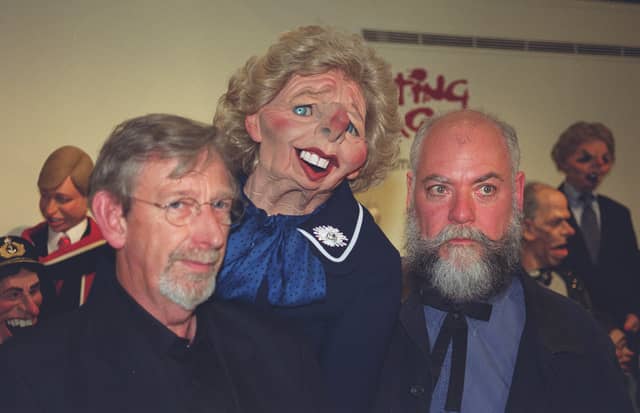

Peter Fluck, the satirist behind Spitting Image, left a lasting legacy in British satire, with his work continuing to influence contemporary comedy and politics.
I don’t suppose many people have heard of Peter Fluck who died recently but almost everyone in the 1980s knew his work. With his colleague Roger Law he created Spitting Image.
Spitting Image was classic satire, aimed at every political party and political view. Margaret Thatcher was a tough crazy leader, hitting underlings around the head. John Major was always grey, eating peas. David Steel was tiny and dominated by David Owen. Neil Kinnock was a string puppet who collapsed when a string broke.
One of the great strengths of our country has always been the ability to laugh at ourselves.
Perhaps the first real political cartoonist was William Hogarth in the eighteenth century. He started as an engraver. His first satirical cartoon was the forerunner of every political cartoon in today’s papers. During the South Sea Bubble many middle- and upper-class people lost money. Hogarth produced a cartoon showing the message “Who’ll ride” under a merry go round with well-dressed people heading towards the ride.
Most famously he produced “The Harlot’s Progress” in 1735 which was a series of paintings and then engravings showing a country girl who becomes a prostitute and dies the last picture. As we would say today, “strong message here”. He then produced a powerful picture of Gin Lane showing the dangers of the gin craze followed by “Four Stages of Cruelty” illustrating the horrific cruelty to animals which was common in his day.
Another eighteen-century satirist was Jonathan Swift. He also lampooned the investors in the South Sea bubble by writing a poem comparing the directors to conjurors appearing to make money increase when, in reality, it vanished. Swift’s Gulliver’s Travels (1726) is often seen as a children’s book, but it was really an attack on politics, vanity and general behaviour by “civilised people”. An even more horrific satire was “A Modest Proposal”. At the time the British establishment suggested that Ireland had two problems, starvation and too many babies. His “modest proposal” was logical and horrific, why not eat the babies. Today this joke would be too controversial.
James Gillray, who died in 1815, was probably the father of modern political cartoons. He also started as an engraver but went on to produce vicious cartoons of King Geroge III, Napoleon and Willaim Pitt amongst others. One famous cartoon called “Plum pudding in danger” showed William Pitt and Napoleon carving up the world as a plum pudding. It would be interesting to see how he would have depicted the meeting between Donald Trump, Vladimir Putin and Xi Jinping.
Gilbert and Sullivan operas are often seen today as harmless and middle class, but Gilbert was at the cutting edge of satire. Victorian theatre was strictly controlled by the Lord Chamberlain who would prevent any political satire, criticism of the Government or the Royal family. In his play “The Realm of Joy” he called the Lord Chamberlain “Lord High Disinfectant”. His play “The Happy Land (1873) was initially banned as he directly ridiculed Prime Minister Gladstone. In Utopia Limited he satirises Victorian England by setting it on a South Sea island which is trying to adopt everything English.
By the 1960s, when “That was the week that was” hit the TV screens many of the government controls on satire had gone. This was a direct, no holes barred lampooning of politicians.
Does it matter that satire has been so important in the history of Britain? Unlike most of Europe we have not had a coup since at least 1688. When Napolean or Hitler tried to overrun Europe as well as fighting we produced cartoons and laughed at them. Was this our superpower?
Today the nearest we get to satire on TV is “Have I got news for you” but this has been running for 36 years with the same two team captains. Why has not the next generation created new and fresh satire? Is it because people now go online and only read political opinions with which they agree? Have our more intense political activists lost the ability to laugh at themselves?
Spitting Image was a classic example of British satire. When will we see the next Hogarth, Gillray or even Peter Flunk? We need them for our sanity.