

No. 172: Sir Ernest Shackleton's Torquay connection - Part 1
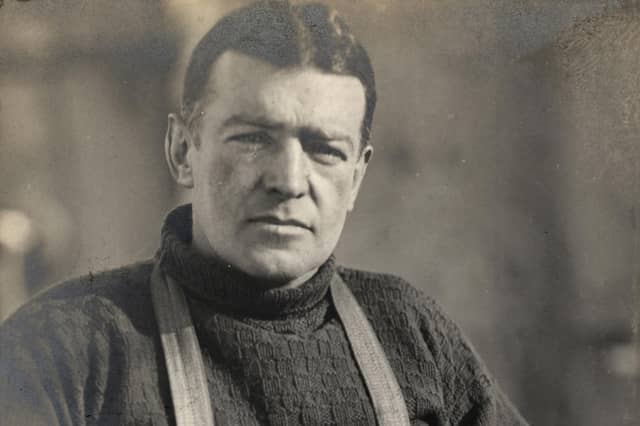

In this series of features Ian Handford looks at the famous individuals that either lived or have visited “Torbay” during the 20th century
With his younger brother permanently living at The Knoll in Torre, Torquay, it was inevitable Ernest and a sister would visit and stay with him from time to time in this family home. The last visit to Torquay was when Ernest attended a dinner at the Torbay Hotel on The Strand before giving a talk on the coming trip to the Antarctic.
Born on the 15th February 1874, Ernest Shackleton was to later recall his birth date as actually coinciding with the famous scientist and astronomer Galileo. Yet that year was also the disastrous year of the Irish potato crop failing. This had led to Ernest’s father moving the family to Dublin, Ernest now an honorary Dubliner.
Henry, with an Anglican background, and his wife Henrietta Letitia Sophia Graven had married in 1872 and had made their home in Kilkea, County Kildare. Henry was a typical bearded Victorian patriarch and, with Henrietta, sired some ten children, Ernest being the second brother.
Dr Henry Shackleton had qualified in 1884 and, when the family left Ireland, moved firstly to South Croydon and then Sydenham, a suburb of London. Henrietta was an invalid and so it was now left to Henry to bring up the family.
Ernest’s earliest education came via a governess who was employed in the home. Later, Ernest attended a preparatory school where he was reportedly seen as being rebellious and a misfit who hated all sport and was quickly bored. Nevertheless, he somehow managed to avoid any punishment and eventually coped with the discipline of Dulwich School.
Transformation came when a naval career was in view and, by 1890, he had come top of his form at “learning the ropes” – i.e. getting the names of the rigging right. Later, on his first ship, Hoghton Tower, with its two hundred named ropes, Ernest knew he had much to learn.
At sea, punishment was by a knotted rope each time a “Clewline, Halyard, Lee Brace or Weather Backstay” was misnamed. This seems hard to us, but a good thrashing was considered very “meaningful and necessary” to all sailors, as any error at sea could prove fatal.
With the experience under his belt, Ernest Shackleton, at the age of just twenty-two, passed out as a First Mate in 1896 and then, in April 1898, became a certified qualified Master, able to command any British ship on the seven open seas.
Sailors picked on his family name by naming him affectionately “Shacky”, while he reflected on a career where the skipper actually could go no higher. Nevertheless, “I thought I would still like to make a name for myself – and her,” he said.
The “her” was his great love, Emily Dorman, a friend of his sisters. They had met as he returned from a voyage to Japan in the ship Flintshire, which had unfortunately run aground near Middlesbrough. Fortunately for him, he had been able to return home for a surprise visit during the summer of 1897 and then met Emily.
She was six years older than Ernest, but he was immediately smitten for the first time and was seriously in love. A friend reported: “He gave the impression of inexhaustible animal spirit, of exuberant vitality, of explosive energy and yet, through Victorian morality, this he followed to the tee.”
But now he was separated from Emily as he was sent to China, though he wrote regularly “of the pain that separation brought”. On his return, he resigned from the Welsh Shire Line and its Eastern routes and joined the Union-Castle Line, which carried mail from England to Africa.
By 1900, Shacky was in London and regularly seeing Emily. Yet he now volunteered for a National Antarctic Expedition in September 1900 and, for the first time, met his rival, the formidable Commander Robert F. Scott.
With neither Pole yet reached, both men were desperately seeking advancement and both had high ambitions. Scott could hide his ambitious side, whereas Shackleton always “wore it on his sleeve”, as others noted.
His first ship, Discovery, was launched at Dundee on March 21st 1901, just months after the Queen’s death in January. Meanwhile, “Shacky” had convinced himself that he and Emily would surely marry in January, but she was not so sure.
Now he was sent north to the Tees to supervise the requirements for a steamship under sail. The hull strength needed special attention so that it could withstand being crushed by any ice floe. Shackleton also knew the coming exploration would be his opportunity to become a man of history.
Yet the Navy were determined their man should be at the helm, so they made Scott captain. Emily, meanwhile, had written to say she was in love with someone else, the second blow to a disappointed Shackleton about to sail.