

Marconi’s Lasting Legacy: From Morse Code to Modern Communications
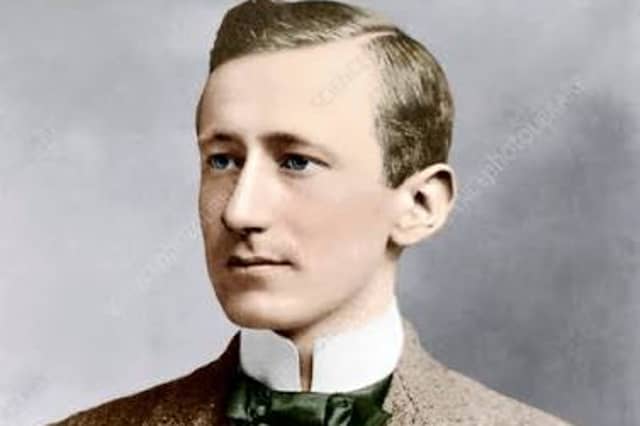

In this series of features, Ian l Handford of Torbay Civic Society looks at the famous individuals who visited Torbay during the 20th century.
In continuing my story of Guglielmo Marconi, he was now testing his transmitting and receiving equipment everywhere whilst building his first fifty four metres high aerial in May 1899. He was determined to prove his morse signals could travel long distances even to crews and passengers on ships at sea using the non-wired morse-code idea.
He actually proved signals would go all around the globe from Britain to Europe and over to Canada and America. He filed his first patent No 7777 in 1900 and it covered all “tuned or syntonic telegraphy”. This had allowed him to establish his “Wireless Signal and Telegraph Company” often referred to as “Marconi’s Wireless Telegraph Ltd”.
The Queen by now invited him to attend Osborne on the Isle of Wight in order that Her Majesty could contact the Royal yacht “Osborne”. Being keen on all new technology she using Guglielmo’s equipment successfully to contact her ship making the event a “Royal Coup”. Only months later Her Majesty died in 1901.
Meanwhile Guglielmo was still trying to prove transatlantic transmissions were factual and then Messrs Lodge and Braun lodged their first patent on his technology. Later this saw Marconi having to purchase the rival patent in order to protect his own authenticity. It was an important lesson to Marconi about timing which today is still appropriate to any budding entrepreneur or enthusiastic inventor.
Having established his first factory at Chelmsford it assembled his many products. Marconi had proved to the world that transmission by morse-code could deal with the curvature of the earth, though still not understanding why.
He had erected a high antennae on the Needles off the Isle of Wight, which was used regularly for communicating with Salisbury and the City of Bath.
Then in December 1901 he transmitted three dots (S) from Poldhu in Cornwall to a high flying kite off Newfoundland Canada, with an antennae was sewn on it.
Dozens of short and long wave experiments were now carried out in Britain with antennae being mounted on our 18th century building “Belvedere Tower” atop Telegraph Hill near the City of Exeter. This made it likely Guglielmo would have visited Torbay to see Oliver Heaviside living at Palace Avenue, the family home.
Later when returning to Devon, he visited Oliver (now retired) in his new home “Home field” on Lower Warberry Road Torquay,. Blue Plaques may be viewed at both properties although only one was from Torbay Civic Society.
It would now be twenty years before the mathematical theories of Oliver Heaviside were proven correct (he died in 1925), although had lived long enough to see his name honoured when “The Heaviside Layer” circulating earth was acknowledged.
He now married his first wife Beatrice O’Brien, daughter of a Baron and they soon produced two daughters.
Four years later in 1909, Marconi then shared the Nobel Prize for “Physics” with his rival Ferdinand Braun - the inventor of the cathode ray oscillator.
The importance of non-wired radio communication through morse now became vital to those at sea as the “SOS” sent from “Titanic” became world news. His SOS had ultimately saved over 700 lives.
Two years later World War I commenced and Marconi returned home to enlist in his countries “Army Corp”.
Soon he was transferred to the Italian Navy as his expertise was vital to sending and receiving secret messages at sea. Now he informed the Navy how to maximise energy while at sea and achieve more long distance communication time.
When the war ended by 1923, his was annulled and he remarried Cristina Bezzi-Scali, a true Italian “noblewomen”. They produced one daughter, Elettra ,while multiple awards of Honorary Degrees flowed and Marconi became President of the CNR - Italian Research Council - before finally in 1929 the Italian Government made him a Marquess-ate, now like his wife he was a member of the gentry.
He also had spoken at the New York Institute of Radio Engineers in 1922 and used the opportunity to announce that electromagnetic waves could reflected by conductive bodies to achieve the position of a rival ship.
This eventually became today’s radar detection equipment. Marconi never stopped inventing - even the death ray was predicated which later allowed journalists in science to feature the idea. Marconi lived long enough to see his electronic ray become fact.
With the Italian Government long ago having realised their wizard of technology had been lost to them thirty years ago, Marconi’s final invention came in 1934 when he devised a radio-beam micro-wave in Italy, to ensure ships could be “steered blind”.
Now those years of angina brought on a series of heart attacks before on July 20th 1937, Marquis Guglielmo Marconi finally died at his home on Via Condetti in Rome.