

Just Like That: Tommy Cooper's road to stardom
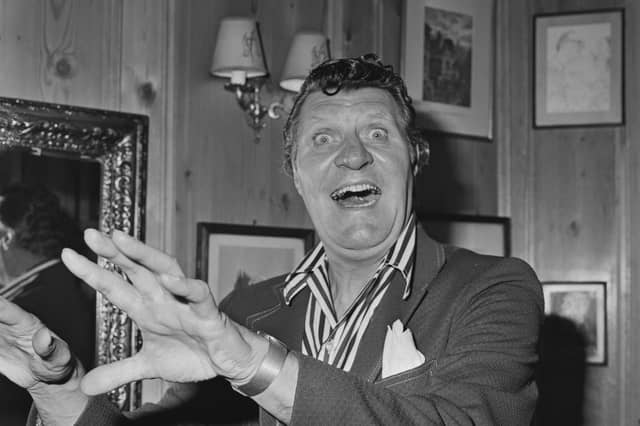

Tommy Cooper's post-war years saw him become a household name across Britain
Tommy had become a soldier in the Horse Guards Brigade when enlisting in 1939, but he was soon ordered to join the Combined Services Entertainment group, who sent players to support NAAFIs all around the world. He remained with the entertainers right through to the end of the war in 1946.
Once the end of the war was official, Tommy went to London and found the only theatre open was the Windmill Theatre. It was hardly the most sensible place to recommence his career as a comedian and magician, but the management soon became the instrument (or was it agent) to send him off to perform at dozens of music halls, local and regional theatres, and even men's clubs around Britain. This very busy schedule became excellent work experience for a rising star like Tommy Cooper.
Nearing the end of the fourth decade, Tommy's act was now being seen and was well received by audiences everywhere. This grounding saw him playing with the Combined Services Entertainment group at all their NAAFI centres around the world. This paid off as he became accepted as one of Britain's most popular comedians, being a true accolade for a rising star like Tommy. The accolade was to be repeated thirty years later after his death, as the Reader's Digest magazine ran a competition to try and discover who had been the funniest man in the century - the answer from their polled members - Tommy Cooper.
It was now in February 1947 that Tommy married Gwen Henty, daughter of Thomas William Henty (farmer), and soon the newlyweds were blessed with a daughter and a son. Meanwhile, at home Tommy would continually be discovering new ideas to add to his act, which was already looked upon as a professional act. But now that blatant absurdity and corniest of jokes told by a very large gangly man wearing a fez and billed as a magician and comic. In time his act of quick madness and magic trickery was unique and British audiences literally adored it.
To witness a six foot three inch man standing as only a Horse Guard soldier can do while acting as a clown by trying to be a magician was magical in itself. Tommy actually then carried out real magic tricks, although only occasionally one went right. He had already learned that tricks going wrong was far more funny than if the magic was right. Yet even when acting as a magician, he used his time to deliver more of those inane one-line jokes.
How this part of the act was discovered is unwritten, although my research brought up one fact - "The other week I shared my dressing room with a monkey when the producer came in to apologise, saying 'I'm sorry about this' and I said 'That's OK', to which he then replied 'I wasn't talking to you'." Maybe or maybe not this could have led to the manic humour on stage. Certainly, as time went on, he introduced numerous parts to his act, like the quick "hat-changing routine", which was hilarious.
All theatres had to ensure they placed a very large wicker basket on stage for Tommy who, having marched onto stage (he never walked), at some point during his act would "find" the basket. Then, having quickly pulled a first hat out while laughing, he wore it and two seconds later threw it aside to pick out another. Neither he nor the audience knew which hat might be grappled with, as next came a helmet, a cap, a trilby, a sun hat or even an added fez, which once worn was very quickly cast aside. It all proved to some that he had created and was acting out a new and quite unique form of brilliant humour.
When playing as a magician on stage, Tommy would generally manage to do the simplest of tricks wrong. He would, for instance, cut a large piece of thick rope into half and then display the four ends, which he was to restore, but didn't, so just threw the rope aside. Then came the hand-in-the-bag gag, when he pulled out an empty glass which should have been full. Yet when the bottle routine was done, we all watched as three empty bottles were put into three cardboard sleeves and yet came out full and, when done again, were empty.
He actually knew his audiences preferred his tricks to go wrong, as all by this time were "up in bits". Having done many tricks that went wrong, to Tommy's apparent astonishment one suddenly went right and an amazed audience now started to clap while laughing. It was all an act, of course, although Tommy knew more of his audience were laughing at the failures than ever laughed when he did things right.
His first television appearance came on the Leslie Henson Christmas Eve Party Show in 1947 and by March 1948 he had become a part of the BBC's Comedy Capers show. Another highlight in his growing career with the BBC came when their Lime Grove Studios opened in 1950 and they chose Tommy Cooper to front the initial celebration Gala Show.
Then by 1952 he was in his first revue, Sauce Piquante, which led on to another first by appearing at the Palladium Theatre in London. These were truly "magical times" for Tommy, who was now in demand everywhere. Many believed he could do no wrong as his act had been witnessed in most of the larger clubs and theatres in Britain and even when he did cabaret and pantomime, although he always remembered this success had all started with radio shows.