

Glimpses of a Celtic Torbay

The ancient communities that first called Torbay home
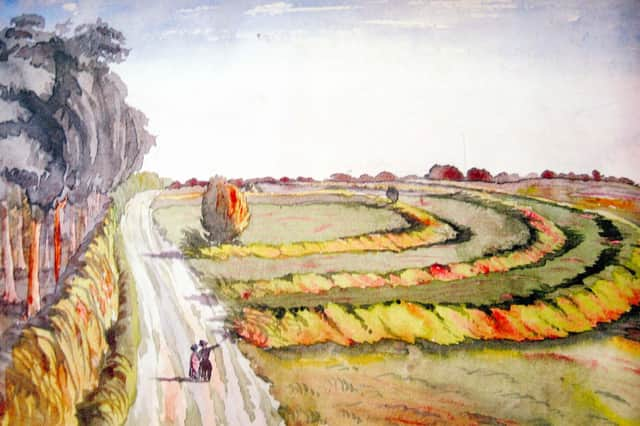
If you travel along the St Marychurch Road from Barton to Newton Abbot, it takes you through the very centre of the Iron Age hill fort at Milber Down. This ancient fort consists of four ramparts with outer ditches and was abandoned shortly after the arrival of the Romans.
Three exquisite bronze figurines were found buried in the hillfort. They have been dated to the first century AD, and comprise a deer, a bird with hinged legs, and a duck with a disc in its mouth. They can be seen at Torquay Museum.

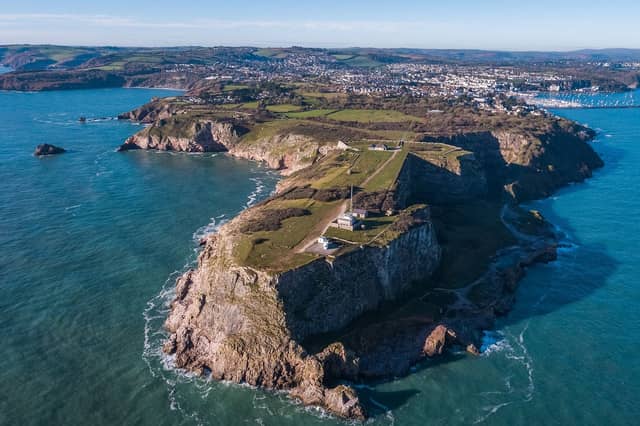
Over at Berry Head, there was a fort with a rampart across the neck of the peninsula to protect the headland. The fort likely dated to between 750 BC and 50 AD but was mostly destroyed during the construction of the Napoleonic-era fortifications.
And at Cockington, we have two possible Iron Age hill camps, while at Walls Hill, alongside the ancient field system, were more fortifications.
Hill forts are not uncommon. We know of over 2,000 in Britain, and there were once probably more Iron Age and later fortifications across the Bay. There were also certainly many more relics of domestic buildings, though much has been destroyed by ploughing and urban expansion.
And so, below our feet still lie the forts, hut circles and trackways of a long-lost civilisation. All offer glimpses of the communities of the Dumnonii, a recognisable society from at least the Iron Age up to the early Saxon period. These were the people who inhabited Dumnonia, a land which is now Devon and Cornwall, along with parts of Dorset and Somerset. Dumnonii probably means 'deep valley dwellers', and Devon took its name from that forgotten folk.
The Dumnonii left no written records, and so our descriptions come from the sophisticated folks of Greece and Rome. They found these Britons to be a strange, barbaric people on the cold and inhospitable fringe of Europe. Julius Caesar said that the men kept their hair long, had moustaches, wore animal skins, shaved their bodies and painted themselves blue in battle.
Alongside fishing and agriculture, the main economic resource of the Dumnonii was tin mining. The early third-century Roman Solinus, author of 'The Wonders of the World', noted that even though they had access to metals, they didn’t make coins but bartered for goods. He also commented that, “They reverence gods, and the men and women equally declare knowledge of the future.”
These Britons were accomplished sailors and, as it was easier and quicker to travel by sea rather than land, the south west peninsula had much closer economic, cultural and religious links with Brittany, Wales, and Ireland than with the east of Britain.
The people of Dumnonia spoke a Brittonic Celtic dialect, and we can see more threads of Celtic Devon through the place names they left behind. These are mostly natural features. For example, Tor means ‘rocky hill’; Dart is ‘oak stream’; Kent is 'land on the edge'; Teign is ‘stream’; Exe is ‘full of fish’; Lemon, the river that flows past Newton Abbot’s ASDA, is ‘elm’. All are ancient Brittonic Celtic names, in contrast to the names of most of our modern-day Torbay communities, which are Anglo-Saxon Old English.
When the Romans established their fort in around AD55 at the south-west terminus of the Fosse Way, this served as the base of the five-thousand-man Second Augustan Legion, which would dominate Devon for 350 years. The Romans referred to this place as Isca Dumnoniorum, ‘Watertown of the Dumnonii’. We know it as Exeter.
The Dumnonii seem to have accepted the Roman conquest without resistance, and so few garrison forts were placed in their sparsely populated territory; worth bearing in mind is that the population of the whole of Roman Britain was probably only about 4 million.
Unlike Somerset and Dorset, the far south west never fully adopted Roman ways, with lifestyles and types of settlements remaining little changed from the Iron Age through the Roman period. The newly discovered Ipplepen settlement has challenged old orthodoxies, however, and we may still discover more evidence.
By the beginning of the fifth century, Rome itself was under attack and, with the imperial dream disintegrating, the Romans left to defend what remained of their Empire. In AD410, the Roman Emperor Honorius sent a farewell letter. He wrote, “fight bravely and defend your lives...you are on your own now”.
After the Romans departed, our history of Dumnonia comes from a variety of sources. These include legends, pseudo-history, historical facts, place names, archaeological finds, and new DNA discoveries. Indicating just how much myth and legend contribute to our modern understanding and perceptions, it was during this period that we get the stories about King Arthur.
Christianity seems to have survived in Dumnonia after the Roman departure, and during the 5th and 6th centuries, we were further evangelised by missionaries from Wales and Ireland. We then have more hints of our local Celtic heritage in the names we give to our communities and holy places.
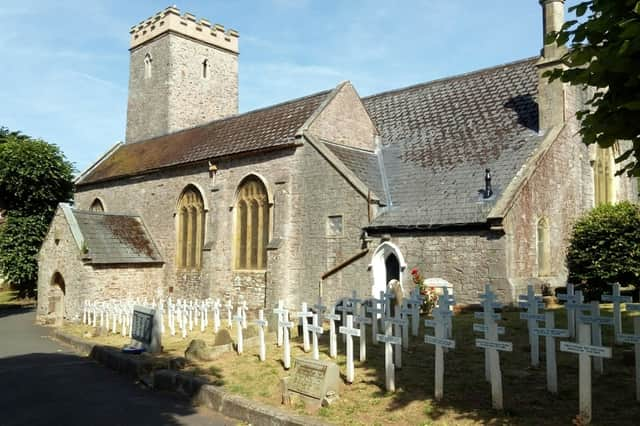
St Petrox is the original name of the church at Torre in Torquay. The saint was reputedly the son of a Welsh chieftain who ministered to the Dumnonians; across Devon, there are seventeen churches dedicated to the missionary. We consequently believe that St Petrox Church and its holy well date back to the late sixth century. Torquay therefore began as a Celtic village.
The Anglo-Saxon settlement of Britain progressed as the land gradually became occupied by pagan invaders. It was always assumed that these were new arrivals from northern Europe, though another suggestion is that these Germanic peoples had been living peaceably for generations on the British coast of the North Sea and only began spreading inland after the Romans had departed.
During the mid-fifth to early-seventh centuries, this process of settlement and warfare changed our language and culture from Romano-British to Germanic. These incomers, themselves of mixed origins, ultimately developed a common identity as Anglo-Saxons and established kingdoms in the south and east of Britain and later across the rest of modern England.
Yet, it took a long time for Anglo-Saxon movements westwards, beginning about 660, to end with a final conquest of Devon by Wessex under King Aethelstan (924–939). In 927, it was recorded that Athelstan finally evicted the Cornish: “Exeter was cleansed of its defilement by wiping out that filthy race”. It was Aethelstan who fixed the boundary between the English and Cornish peoples at the east bank of the River Tamar.
The ongoing relationship between the new Saxon overlords and the remaining indigenous Britons appears, on the other hand, to have been peaceable. We may even have local evidence of coexistence. It is thought that Brixham may have been founded by a man called Brioc; or perhaps was even named after the sixth-century Welsh holy man of that name. Brioc, intriguingly, is Celtic, while Paiga is an Anglo-Saxon personal name. And so, we have as neighbours Brioc's settlement and Paiga’s settlement, Brixham and Paignton. Did Celt and Saxon live side-by-side?
There’s one final glimpse of Celtic Torbay. In 2015, a study looked at genetic similarities and differences between Britain’s modern and ancient populations.
There was, as expected, clear evidence in modern England of a strong Anglo-Saxon presence in the south and east. In the ‘non-Saxon’ parts of the UK, there was no single 'Celtic' genetic group, however, but various subgroups reflecting the tribal kingdoms of the sixth century. It was predicted that Cornish genetics would reflect the geographic West Wales boundary, and they did. Surprisingly, Devon also had a Celtic genetic group, though different from that of its western neighbour. The division was almost exactly along the modern Devon county boundary.
So, the Devonshire Dumnonians are still out there in Torbay, and you may well be one of our Celtic ancestors…