

Art Deco for an Ultramodern Torbay

'You can do things at the seaside that you can’t do in town’
If there was an architecture for twentieth century Torbay, it was Art Deco. It was the design style of a new age that transformed the coastal resorts of Torquay and Paignton. Art Deco shaped how visitors came to experience the seaside and its influence is with us still.
Even if we can’t actually name the style, Art Deco buildings and furnishings are likely to be familiar. Perhaps we gained our knowledge of that inventive period through Agatha Christie’s eccentric Hercule Poirot?
For decades, Agatha’s Belgian detective appeared on the big and small screen exposing the intrigues of the upper middle classes. As he did so, we were introduced to a backdrop of late 1920s and 1930s buildings, décor, lifestyles, music, and the attitudes of the time.
Art Deco came out of a world ready to celebrate after the First World War. Though many nations competed to respond to this appetite for optimism and innovation, it was the 1925 Paris Exposition that successfully showcased an up-to-the-minute revolutionary style.
It was then, between the two World Wars, that Art Deco designs became a major influence in architecture, fashion, jewellery, furniture and cars. People wanted progress, and designers replied by delivering a fantasy of the future. This was consequently an approach to life that emphasised hopefulness, pleasure, escape, moving forward at speed, and the thrill of modernity.
Art Deco designs were appropriately rich, bold, and even decadent. They expressed glamour and luxury by using sharp lines, smooth surfaces, decorative patterns, exotic motifs, and geometrical shapes. Marble, glass and lacquered wood were blended with new materials such as chrome plating, stainless steel and plastic in design and construction. From the largest buildings to details such as door handles, elevator panels, and light switches, all were designed to fit a futuristic theme.
And then Art Deco came to the seaside. During the 1920s and 1930s, Britain’s resorts were beginning a reinvention stimulated by the growth of mass tourism and the modernisation of rail and road networks. By the early 1930s, 15 million people, a third of the population, went away for a week or more; and demand for vacations by the sea further increased in 1938 when the working class won the right to an annual week's paid holiday.
The resorts actively embraced the freshness of Art Deco architecture. The new designs quickly became a component in an alternative and healthier way of life away from the smoke-blackened inland cities; even though this could only be experienced by most for a few days.
Architects, creatives and designers saw the seaside as a creative space where they could experiment and celebrate a new freedom in places with inexpensive land and labour. Because of this demand and opportunity, it only took a few short years for Art Deco to be adopted as the signature style of the British seaside.
At the same time, there was a revolution taking place in the role of women in society. Female suffrage only came in 1928, but the resorts were always places where women could experiment and reinvent themselves away from home and family limitations. Some of the most significant social changes consequently could first be seen on the beaches and promenades of Torquay and Paignton.
Until the early 1900s, it was accepted that women would shield themselves with parasols, hats and gloves. This convention, however, was beginning to change as it became recognised that there were actually benefits in being outdoors.
The apocryphal shift took place on the French Riviera in 1923 when iconic designer Coco Chanel accidentally caught the sun and displayed bronzed skin. Her friend pronounced, "I think she may have invented sunbathing." French beachside resorts then started to remain open throughout the summer, their usual off-season, which led to the advent of sunbathing as a pastime for the rich and stylish.
Torquay and Paignton, always eager to replicate the look and feel of the Rivieras, took up the new pursuit. By the mid-1920s, sunbathing had become a health craze, offering significant benefits for an opportunistic tourist industry. This was a time of a reaction to Victorian constraints, with bronzed legs and shoulders a way to proclaim new ideas and freedoms.
Part of that escapism was an enthusiasm for the outdoors and a demand for new types of life-enhancing holiday experience. The trend went on to influence the town's architecture, with balconies, sun terraces, and flat roofs all facilitating sunbathing and a new exhibitionism.
Striving for relevance and new custom, long-established hotels and public buildings were updated for the times, such as Paignton’s seafront Esplanade Hotel, which acquired an Art Deco façade.
Torquay’s first public library was built in 1907, but more space was soon needed. The new library opened in 1938 with an Art Deco-style entrance; the doors have a glazed panel with a chrome geometric design, with some chrome door handles and back plates still in situ.
Still at Castle Circus, we have the Grade II Art Deco Electric House. Built in 1935, it was designed to show off the wonders of electricity with recessed panels proclaiming ‘Electric House’ in Art Deco letters. Still there are the original pair of bronze and glass doors while internally many original features survive, including handrails, radiator grilles and doors.
Across the Bay, we have some fine examples of Art Deco seaside villas, their exteriors a blend of white render and large curved windows.
Torquay has Mango House, designed with the involvement of Robert Lutyens, son of Sir Edwin Lutyens. In Brixham, we have Sunpark with its mix of curves and straight lines, balconies, roof terrace and Crittall glazing. Also in Brixham is Penhill House, which once belonged to Agatha Christie’s accountant; Agatha reportedly enjoyed sitting by one of the curved bay windows.
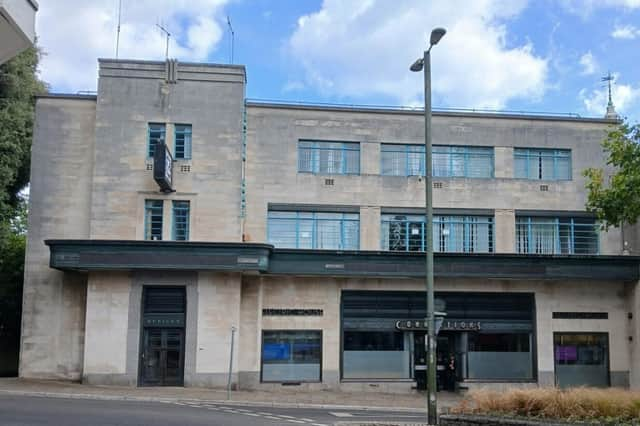
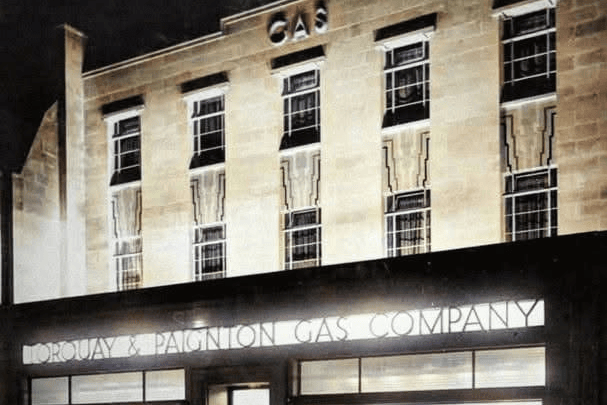
Much of our heritage has, of course, been eroded, dismantled and demolished in successive bursts of modernity. Many remember Torquay’s Art Deco Gas showrooms in Union Street. Its twin sets of mirrors on the ground floor façade created infinite reflections to the fascination of generations of children. Then there was the Regal Cinema at Castle Circus, demolished in 1992 to become the current Job Centre.
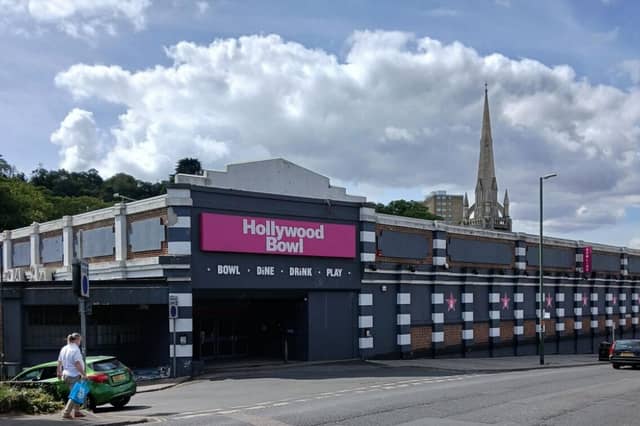
A good deal of our Art Deco heritage nevertheless remains, with some buildings remodelled for a new use. The 1937 Queen’s Hotel on the Strand became apartments with the insertion of entrances when the ground floor was converted to retail. The Grey Cars Coach garage in Torwood Street, purpose-built in 1929, is now Hollywood Bowl.
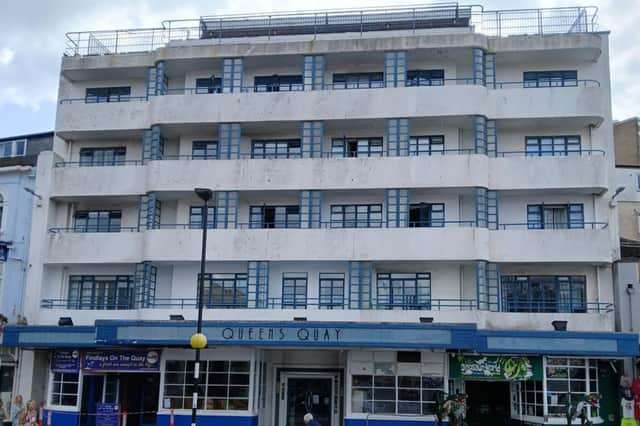
Upgrading and conversion should always be our goal, not the instinctive eradication of anything that appears representative of another age. After all, many come to the Bay to relive experiences from generations past, not to be faced with poorer replications of their hometown high streets. The seaside is supposed to be different.
Art Deco is therefore not just a relic of the 1930s. Its bold lines, rich materials, and geometric patterns live on in interiors, furnishings, jewellery and building design. The style will always evoke the Golden Age of the seaside and so remains popular in coastal architecture.
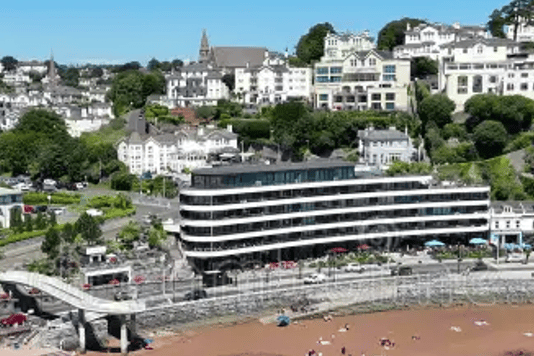
But Art Deco also evolves, adapting to expectations for quality living and vacationing. It was ever thus. Back in the late 1930s, a branch of Art Deco linked white exteriors, curving forms, and long horizontal lines with nautical elements, such as ship-railing balustrades and porthole windows. These features led to the adoption of the name ‘Ocean Liner’ style.
When, in 2021, developers wanted to impress on a unique site in Torquay, they looked backwards to a special time, but also forwards to a future of leisure and comfort by the sea. The resulting Abbey Sands development was subsequently promoted as being “inspired by the ocean-going liners of the Art Deco era”.