

A hole lot of fun: Torquay and the history of crazy golf

From Torquay’s colourful adventure golf courses to seaside windmills and quirky obstacles, crazy golf has a fascinating history. Kevin Dixon explores how this wonderfully eccentric pastime became a much-loved, democratic part of the British seaside holiday – and why its appeal continues to endure along the English Riviera.
“A game whose aim is to hit a very small ball into an even smaller hole, with weapons singularly ill-designed for the purpose,” Winston Churchill
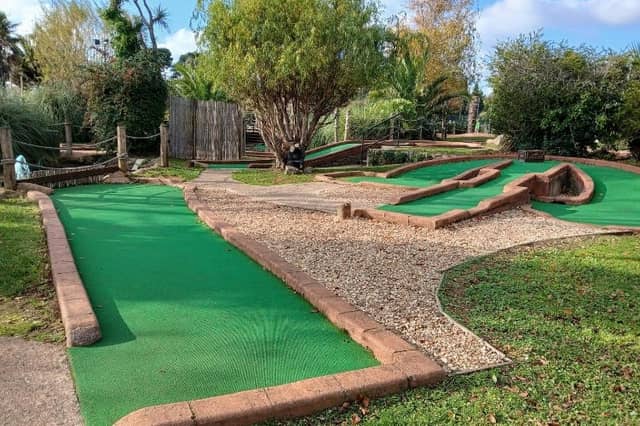
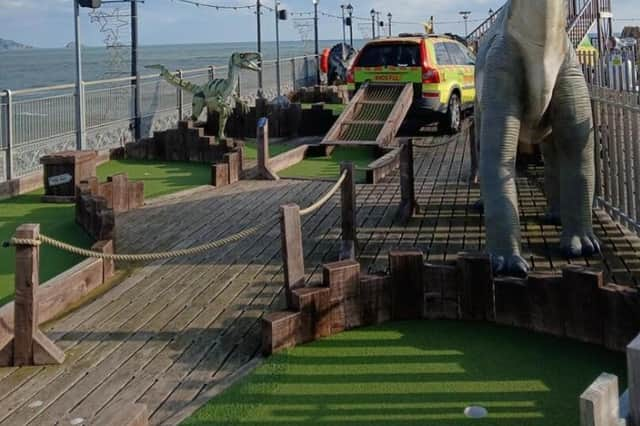
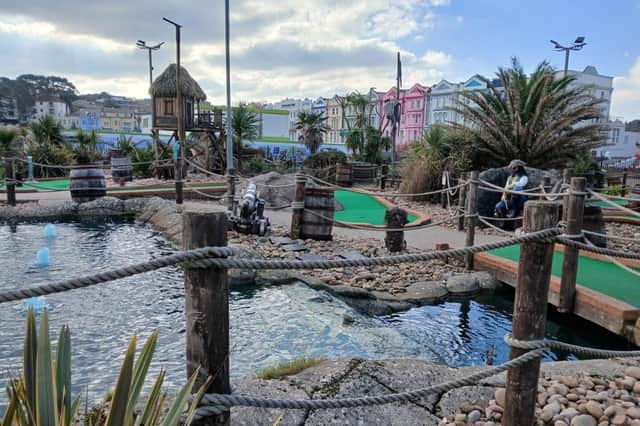
Torquay has Jungle Journey Adventure Golf, Paignton has Pirates Bay Adventure Golf, and, on the Pier, Lost City Adventure Golf, while there's Shipwreck Island Mini Golf at Goodrington. And, at one time, many of our hotels and holiday camps offered a synthesis of concrete and felt, often featuring a diminutive windmill.
These facilities were for the playing of miniature golf. An offshoot is crazy golf, an eccentric sub-style with exaggerated obstacles and a more informal and playful atmosphere.
We're all familiar with the geometric layout of this seaside tradition which requires non-traditional putts to overcome artificial obstacles such as tunnels, tubes, ramps, walls and moving obstacles.
The origin of the practice is said to be Scotland's St Andrews Ladies' Putting Club, the location of the first mini-golf course. This was designed in 1867 as a divisionary entertainment for the wives, sisters and daughters of the St Andrews club’s members; it was believed that swinging a golf club past the shoulders was unsuitable for a lady. A piece of rough ground was put aside, later known as The Himalayas. It proved popular and other clubs around Britain copied the idea.
In 1907 a mini-golf course called Gofstacle was patented by British army Colonel William Senhouse Clarke consisting of hoops, rings, a tunnel and a bridge. The London Illustrated News explained: “It is played like golf croquet. Its popularity is undoubted.”
The real home to the mini-golf craze, however, was America. It did, however, begin with a course built at the North Carolina home of the English shipping magnate James Wells Barber. In the typical English manner, he called his house Thistle Dhu: This will do. In 1928 it was described as “the world’s craziest, most scientific, and most aggravating golf course”.
Soon there were courses across the United States; 50,000 courses were built in 1930 alone with 150 courses just on New York rooftops. That summer, four million Americans played every night.
This was a very competitive market and innovation was rewarded. For instance, in Los Angeles the player had to putt through a cage where a trained bear would swipe at the passing balls.
Mini-golf was immensely fashionable. Mary Pickford and the Vanderbilts constructed their own elaborate courses; while Douglas Fairbanks, Fay Wray and Fred Astaire were avid players.
Then, during the economic depression of the late 1930s, miniature golf became too expensive for many, and many commercial courses closed. In their place, came 'Rinky Dink' courses utilising obstacles made of whatever materials were lying around, such as tyres and pipes. Due to their popularity, surviving miniature golf course owners began to adopt these makeshift obstacles.
Mini-golf courses were common across Britain by the early twentieth century. By October 1930, there were 60 mini-golf courses of varying forms. Midget Golf Limited operated 16 courses across Britain and was involved in building the first course in London at Regent Street’s Imperial House in September 1930. The first free miniature golf course opened atop Selfridges in the Hanging Gardens of London.
Yet, again following the American precedent, the game did lose some of its popularity. In 1932, the course on the shore end of Southend's Pier was removed to make way for a “dignified entrance.”
Despite some decline, the seaside remained the traditional home of idiosyncratic leisure forms. Entrepreneurs had found a way to make money which didn't involve much initial expenditure or ongoing maintenance, and which could occupy a small area of rented land. There were also technological advancements in malleable materials and artificial grass. No longer need rain stop play, or imagination be restricted.
During the 1930s mini golf became an expected part of the modern resort experience. Local councils were often supportive as the amenities seldom caused trouble. And they were respectable with Edward, Prince of Wales, planning to build a course in the courtyard of St James’ Palace.
Golf in its traditional form had become an absolute necessity for any resort aspiring to a middle-class clientele and courses were developed all along the coastline. The Bay was well aware of how its national rankings depended on a suitable offering, Torquay Golf Club having been established in 1882 at Walls Hill by the Royal Torbay Yacht Club. The pitch-and-putt courses, with landscaped hillocks, bunkers, ponds and streams, were generally a junior and limited replica of the senior game.
What was new was 'crazy' golf which emerged in parallel as the less reputable twin of the long-established sport and social ritual. The first was a fifteen-hole crazy golf course established in Skegness in 1927, so establishing the long association between the increasingly eccentric pastime and the seaside resort. Others quickly followed and, as in the United States, novelty, humour and excess, were great attractions. Taking on the example of the Los Angeles bear, for instance, a course in London used monkeys in a cage.
Crazy golf was the coastal inversion of the sacred tradition of golf. Just as the seaside could offer a hall of mirrors to take an image and reflect back a humorous distortion of reality, crazy golf seized on the obsessions of middle-class culture.
It gave everyone the opportunity to try the expensive pastime of golfing. It was accessible to those unable or unwilling to take part in the 'serious' game. It was a frivolous diversion, an upstart novelty sport which could be played outdoors or even at night. Its working class players, often excluded from participation, adopted the new game and created their own rituals, including the occasional raucous post-pub outing.
Crazy golf is a truly democratic sport because, in its ideal incarnation, it is anti-competitive. On offer is a budget parody in a scaled-down wonderland. The carefully designed rural freedoms and wide-open spaces of golf crammed into a confined space of tiny houses in primary colours.
Here emerged an affordable experience in a liminal place by the sea, a resort setting which proclaimed the irrelevance of class, age, ethnicity, gender, and even ability. It doesn’t matter if the player has no skill or aptitude. Not winning was the whole point. Rather, there is real pleasure in losing in a community of family and friends. This fellowship of artificially vivid 'grass' and sometimes barely functional clubs was never intended to be just 'for the kids'.
There are no complicated rules, no dress code, no segregation, and no membership requirement. It is both a sport and an art form miniaturised for the masses. Britain’s over a thousand crazy golf courses subvert the sport of the elite in a leisure environment that had evolved as a temporary refuge from the challenges of real life.
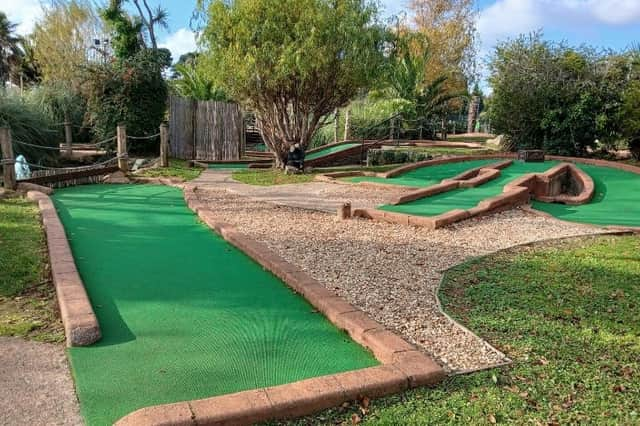
Over time the reconfigured building materials and surplus cement were upgraded, and the fantasy introduced fibreglass African wildlife, benevolent buccaneers and prehistoric predators. Regardless of such updating, and even though their makeshift roots and opportunism has largely been forgotten, these brief entertainments still express the charm, eccentricity and humour of their resort settings.
We may, of course, be reading too much into a simple pleasure. On the other hand, in February 1971 astronaut Alan Shepard smuggled a six-iron head and two golf balls on to Apollo 14. He attached the club head to the handle of an excavation sampling tool and became the first person to hit a golf ball on the moon. This may suggest that golf, in all its forms, has a symbolism far beyond its surface appeal.