

Torbay was home to man who uttered most famous words in sporting history
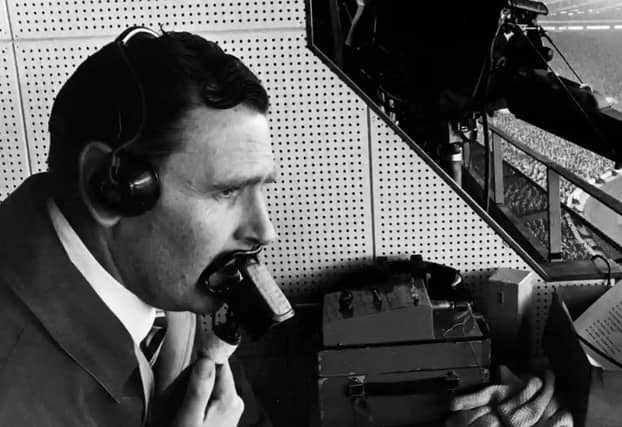

Shining the spotlight on significant people who lived in 20th century Torbay - not always famous - by Ian Handford, president of Torbay Civic Society. Number 5 - Kenneth Wolstenholme Born at Worsley, Manchester, in July 1920, Kenneth's parents Thomas and
Shining the spotlight on significant people who lived in 20th century Torbay - not always famous - by Ian Handford, president of Torbay Civic Society. Number 5 - Kenneth Wolstenholme
Born at Worsley, Manchester, in July 1920, Kenneth's parents Thomas and Euphemia (Effie) Wolstenholme introduced him to sport early.
At age four, he was taken to his first football match by Thomas and saw Bolton Wanderers play at Burnden Park.
Meanwhile, he was introduced to cricket by his mother who took him to Old Trafford and later as an adult, he remet many of the greats including Duleepsinghi, Hobbs, Sutcliffe, Verity and Woolley.
In spite of the recession, he was fortunate to attend Farnsworth Grammar before leaving to start a career in journalism. Having joined the Manchester News, he took a course in Pitman shorthand and gained the skills for his chosen career.
Like many of his age during the mid-1930s, Ken knew a war with Germany was imminent and in wanting to fly, joined reservists of the RAF and spent every minute of his free time at Barton Airport, Eccles, learning about the theory, engineering and navigation of flight before eventually flying.
That voluntary commitment paid off as on September 1,1939, he was picked as a potential bomber pilot and would survive no less than 100 missions by the end of the war.
Being part of Pathfinder, he became involved in highly dangerous, low-level daylight flights. As part of the Pathfinder Force, its task was to mark out enemy targets so that heavy bombers might find them later as easy targets.
The Pathfinder and Bomber Forces contended with enemy anti-aircraft fire by day and German fighter aircraft by night, making all missions risky. Yet Ken was eventually decorated twice with a Distinguished Flying Cross (DFC) and later Bar to the DFC.
Meanwhile, in 1944, he had married childhood sweetheart Joan and they had two daughters while in Manchester, where Ken had returned to his beloved journalism.
Now he secured a second career in radio journalism for the BBC before, in 1948, he was given the opportunity for a third career in the medium - television.
Now recognised as an exclusive commentator for the BBC, he spent 23 years commentating on radio and TV on football and covered all FA Cup finals and World Cup matches. Yet life always has downsides and for Ken, technology was odious as jamming cameras and loss of picture saw technicians struggle to keep TV screens live.
His career's worst two experiences, when Wales won over England as a goal was missed on TV and viewing audiences went ballistic. Later, Hungary thrashed England 6-3 at Wembley and he witnessed the return match when, in 1954, England were thrashed again, 7-1.
Yet in spite of the lows and highs of television, he knew it was to be the permanent medium on sport. The BBC Sports Special Programme went live in September 1955.
In 1971, he was much surprised to be called to Television Centre in Wood Lane by BBC top executives, having no idea why. He soon learned his former colleague David Coleman was to be installed as the BBC's main commentator.
Later, he said his BBC career ended at that moment and although offered a 'journeyman commentator contract' - an as-and-when-required commitment - he recalls going home humiliated.
Yet it would be Ken's commentary of the 1966 World Cup final we still recall today. Geoff Hurst had just scored to put England 4-1 in the lead when Ken commentated: “Some people are on the pitch, they think it’s all over... it is now.”
In 1997, following the death of his wife, Ken moved to Galmpton to be nearer his daughter. He was now involved in playing golf at Churston while attending football matches at Plainmoor.
Years later it would be his daughter Lena who was at his side when he died in a private hospital in Torquay on March 25, 2002, aged 81.
IAN'S COMMENT: Ken raised significant funds to build a sports pavilion while supporting charities generally. In retirement here, he a hugely popular local.
NEXT WEEK: Lord Walter M Citrine
An article about Ken may be obtained by sending two first class stamps and a small stamped addressed envelope to Torbay Civic Society, Suite 4, The Business Centre, 1 Palace Avenue, Paignton TQ3 3HA