

The Storyteller: Walking in the spooky footsteps of the dead - or sleeping alongside ‘salted down feyther’

Prior to 1260, it was the law of the land that all burials of the dead had to be made in their parish church. For the inhabitants of Dartmoor, this meant a trip to Lydford to the north-west of the moor.
Lydford was actually the biggest parish in England, back in the day, not by number of inhabitants but by the amount of acreage it covered, the northern part being amongst the wildest and most inhospitable country in the land.
Unfortunately, for those that lived in the south, this meant their deceased had to be transported either by pack animals or by teams of pallbearers across this wilderness, supposedly in all weathers and at all times of the year.
In order to facilitate this journey, a route was devised to try and make the crossing of the north moor as painless as possible. This track became known as the Lych Way, or The Way of the Dead.
You can still see it marked on the Ordnance Survey map today, and it is still used by walkers as an easy way to cross the northern wilderness, nowadays for pleasure and not to carry a body!
I myself have walked parts of it, and one day I’d like to do it all in one crossing whilst I’m still fit enough...
The route starts in Bellever Forest, not far from Postbridge, making this a good place to set out from.
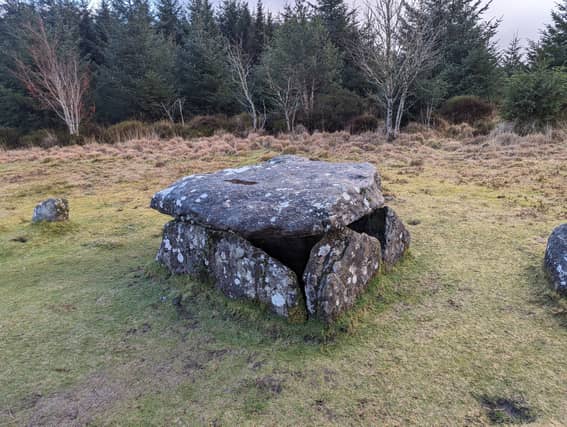
The forest is an apt beginning for a route to carry the dead as it contains many burial sites of our dead ancestors, marked by various stone artefacts, who were allowed to be buried near where they lived which makes more sense.
From here, they were carried through what is now the Powdermills, not far from the haunt of the Hairy Hands. Could this deadly apparition have some connection to these dead ancestors in the forest?
Then it’s up the hill to Longaford Tor, the Sleeping Dragon, before descending to a crossing point at the weir on the West Dart, above Wistman’s Wood.
The combination of the Devil’s connection to his Whist Hounds in the wood, and this route of the dead, makes this a very spooky part of the moor indeed, steeped in Folklore.
Having crossed the river, you head up to Lydford Tor, where the route is bisected by a track to another antiquity, Beardown Man, the standing stone at Devil’s Tor, which is a spot I visited only recently on my way to Panda’s Memorial Rock.
Then it’s down to another river crossing, at Travellers Ford, over the Cowsic, to reach Conies Down Tor. This is as far as I’ve gone so far, apart from a section at Wilsworthy Firing Range from where you can see the church and castle at Lydford so you know the journey is nearly over, but I want to link it up, as there are some Letterboxes along the route that I wish to collect. Apart from that, I want the satisfaction of having walked it all.
As you can imagine, the route has a peculiar atmosphere all of its own, taking in such aptly named sections as Corpse Lane and Coffins Wood.
The wood is said to be haunted by a group of pallbearers with flaming torches, still patiently awaiting their turn to transport a recently deceased on the next leg of their final journey. Whilst on another section, you can allegedly encounter a silent procession of monks, carrying the coffin of one of their brothers.
On the southern part of the moor can be found an interesting artefact from the days when the dead were transported for burial.
This is the Coffin Stone, which can be found on the hillside above Dartmeet. If you should come across it, you will notice the names and initials of some of the pallbearers, that would wait their turn to carry a coffin on the next leg of the journey, carved into the rock.
You will also notice the stone is split in two. This was because one day a particularly wicked man was being transported for burial and as one team of pallbearers was about to hand over to another at the Coffin Stone, the coffin was rested on the rock.
At that moment, a thunderbolt suddenly appeared out of a clear blue sky, striking the coffin, and immediately incinerating both coffin and occupant, splitting the stone in two in the process. God had performed his first cremation! It was said that the deceased was so wicked that he didn’t want him to be buried in consecrated ground...
Transporting the dead was nigh on impossible to achieve during particularly harsh winters and this predicament is best illustrated by a story that originates from the Warren House Inn, the inn where the fire allegedly never goes out. The tale concerns “salted down feyther”...
One snowbound winter, a traveller found himself caught in a blizzard, desperate for shelter for the night. He stumbled across the Warren House Inn, the second highest pub in England, and begged for a room. The landlord told him he was full, apart from a box room as long as he didn’t mind sharing with “salted down feyther”.
Not understanding the dialect, the stranger agreed to take anything, that’s how desperate he was. After a hearty meal, the traveller was shown to his sleeping quarters, and it was small.
It only had room for a bed, and a large chest. As he prepared to settle down for the night, his curiosity finally got the better of him and he just had to see inside the chest. Lifting the lid, he barely managed to stifle a scream, for inside was a dead body. He slammed it shut, and spent a very restless night trying to sleep next to a corpse.
The next day, as he was checking out, he asked the landlord if he knew there was a dead body in the room? The landlord looked at him puzzled...”I thought you said you didn’t mind sharing with salted down feyther?”
It was then explained to the stranger, that the landlord’s father had recently died and because of the thick snow they had to wait for it to thaw before taking him for burial. So instead, they had salted him down to wait out the winter...the traveller couldn’t get on his way quick enough!
Faced with this regular predicament, the inhabitants of southern Dartmoor petitioned the then Bishop of Exeter, one Bishop Branscombe, if it was possible to bury their dead closer to home at Widecombe, in St Pancras Church, instead of making the trek to Lydford. In 1260. He took pity on his flock, and granted their request.
So, if you ever want to see the oldest gravestones on Dartmoor, go to Lydford Church...everywhere else is a bit more modern...