

The Storyteller: Uncovering Dartmoor’s Hidden Ties to Arizona

Currently my life is full of really strong synchronicities that all seem to be pointing me in the right direction. These include working with people who share the same name and meeting people who through conversation reveal they have information relevant to my ongoing research. None was as astonishing as finding the picture of London Bridge standing in the Arizona Desert, as featured on Kevin Dixon's page in this very newspaper last week... a picture I saw for the very first time but three days previously when we Googled it whilst standing outside Haytor Quarry on Dartmoor, just prior to showing a couple of Americans all the way from Phoenix, Arizona, where the granite that had built their version of the bridge had come from.
Prior to that, I was happy to buy into the strongly held belief that the bridge had been bought by a stupidly rich American, who thought he was buying Tower Bridge, which looks a lot more impressive. Upon realising his mistake, he dumped his purchase into the desert and left it there to rot! I still love to share this version, but I now know it’s not true.
In reality, Robert P. McCulloch bought the bridge, originally built in the 1830s out of Dartmoor granite, from the City of London in 1967, to have it shipped out to a planned community site that he had established at Lake Havasu in the Arizona Desert back in 1964. It was completely dismantled but only the outer layer of granite was retained. I have one of those old videos that feature a specific event from each year covering the decades, and the extract for 1967 shows black and white footage of stonemasons taking apart each block and labelling them up before shipping them to the States. It must have been quite an important event that year...
Initially, the bridge was reconstructed in the desert, just as I imagined it to be, but then McCulloch constructed the Bridgewater Channel Canal to flow under it, separating mainland Lake Havasu City from Pittsburgh Point on the Peninsula, with London Bridge forming the road link between the two. This had been his plan all along, and it became a very profitable tourist attraction, finally completed in 1971... a smart move indeed!
Our guests had seen it back in the 80s, so I was very keen to show them exactly where the granite from which it was built had come... but first, we had to give them a guided tour of the moor...
They were staying in Exeter, so Richard, my driver, and I picked them up and headed north, taking the scenic route towards Okehampton, making our first stop in Lydford, where I showed off the castle and church. Then it was off to scale the heights of Brentor, where we took a moment to appreciate the peace and tranquillity that the tiny church, dedicated to St Michael, has to offer and admire the views of the surrounding rugged landscape.
Next, we headed towards the heart of the moor, where I regaled them with the tale of Vixana, the notorious Dartmoor Witch, as we passed her home on top of Vixen Tor, and the legendary Hairy Hands, as we crossed their patch at Cherrybrook Bridge, without incident, I’m pleased to report.
Passing through Postbridge with its picturesque intact clapper, we decided it was lunchtime, so we stopped at The Warren House Inn for some hearty home-cooked fare, seated by “the fire that never goes out”. After refreshments, another tale, this time featuring “salted down feyther”, and admiring the gully-scarred landscape that the (allegedly) second-highest pub in England commands, it was time to set off on our afternoon’s adventures.
Pointing out the Bronze Age village of Grimspound in the distance; the granite of old Bennett’s Cross beside the road; the rocky outcrops of Birch Tor beyond, and the stone enclosures of The Ace Fields below; and having made a quick detour to view the ancient Devon Longhouse at Lettaford; we finally came down off the higher moor, and made a right turn at the Watching Place (scene of much activity by local highwaymen, and many death by hanging), with Beetor Cross atop the wall on our left; to make our way down the lane and pay our respects to Kitty Jay.
Arriving at the melancholy grave, it was time for a few pictures of flowers past their best, and other headstone offerings; with tales of untimely pregnancy and suicide by hanging; followed up by my own invention of the Witches Triangle, which includes rituals at the grave itself; yonder, over at Bowerman’s Nose; and back up the lane at Easdon Tor, at the shrine of Granny Mann’s “friend”.
Tales told us it was time to fulfil one of our guests’ wishes, to see the remains of the abandoned Medieval Village in the valley below Hound Tor. It was a bit of a trek, but we got there in the end. As we stood there, admiring the surrounding landscape, we tried to imagine what life must have been like for our ancestors, way back then, before the Black Death chased them all away...
Next, dropping down into Widecombe in the Moor, with its tale of Tom Cobley, his mates and a Grey Mare going to the fair, which we had just missed, I took our guests into the churchyard to share the story of Jan Reynolds and his pact with The Devil, and to show them the plaques inside the church that tells of the day it was struck by a thunderbolt, causing death and destruction inside... or was it caused by the arrival of The Devil, coming to collect Jan’s soul when his seven years of good luck finally ran out? You decide...
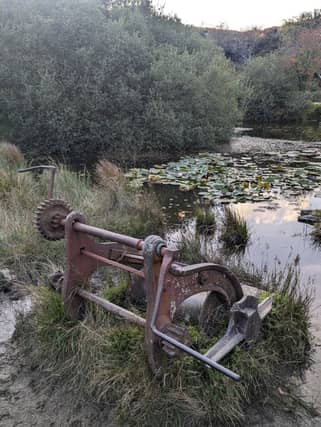
Finally, it was time for our last stop of the day, at one end of the remains of the Granite Tramway, before it dropped down off the moor. We walked back up it, into the seclusion of the disused Haytor Quarry, with its flowering lilies floating on the water-filled pits, and the long-time rusted remains of the old winding winch. Our guests said this was quite magical, the cherry on top of the perfect day, as we wandered beneath the towering outcrops of the unquarried rock faces.
Making our way back down the Tramway to the waiting car, and then Exeter bound, we discussed what it was like to see the New London Bridge, in all its glory, standing in the middle of a desert, and, with the help of Google, we researched the facts as outlined above. It’s good to know that a little bit of my beloved Dartmoor still survives, under the harsh Arizona sun, and is admired by all who see it, in the same way that I admire the landscape from whence it came.
Don’t forget, if you fancy a tour similar to the one we gave our American friends, you know who to call! Just email me at [email protected] and I look forward to being your guide...