

The Storyteller: My challenging walk to discover the Hunter's Stone and Bloody Pool

One of the most popular and easily accessible walks on Dartmoor is that from the car park at Shipley Bridge to the Avon Dam, following the course of the river. It’s mainly a tarmacked path with a few uneven, rockier sections as you near the dam, but that aside, it’s suitable for wheelchair users, offering stunning scenery and some unique places of interest, especially for a folklorist like myself. It also acts as a good jumping-off point for Letterboxing opportunities...which is exactly why I went there just the other week...
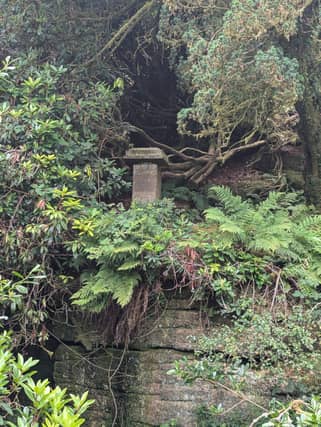
Further along the path, if you look up into the trees on the left, you can see a granite pedestal, standing on a rocky outcrop. Until recently, it was shrouded in foliage, but now it’s much easier to inspect, and, should you wish to do so, you will find it is a memorial to a Mary Meynell or Lily, as it states on the carved inscription. There is some confusion as to what exactly the plaque commemorates but Mary was the young daughter of the owners of Brentmoor House, the ruins of which can be found just around the corner, who sadly passed at the tender age of four in a local sanatorium after a short illness...and not from a horse riding accident or drowning in the river, as some versions would have you believe. Whatever the cause of the poor girl’s death, the tragedy of it at such a young age casts a morbid shadow over the remains of the house, making for an unsettling atmosphere when passing by at dusk. Having said that, many years ago, myself and a couple of friends chose that spot to perform some candle magic in the light of a full moon. They wished to have a baby, which they were blessed with the following year, whilst I wanted my group TIP to be a success, and here I am, still writing about my exploits, and still holding meetings...
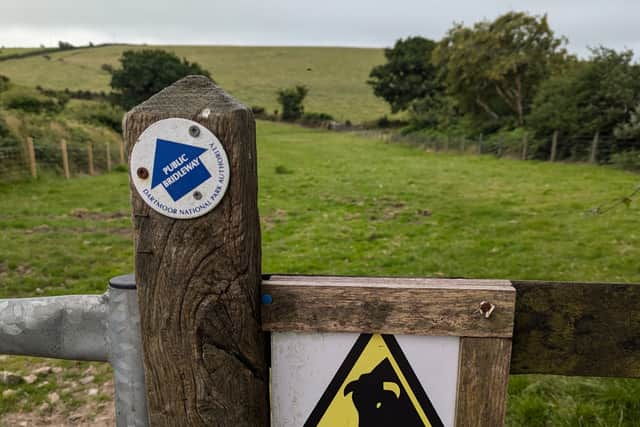
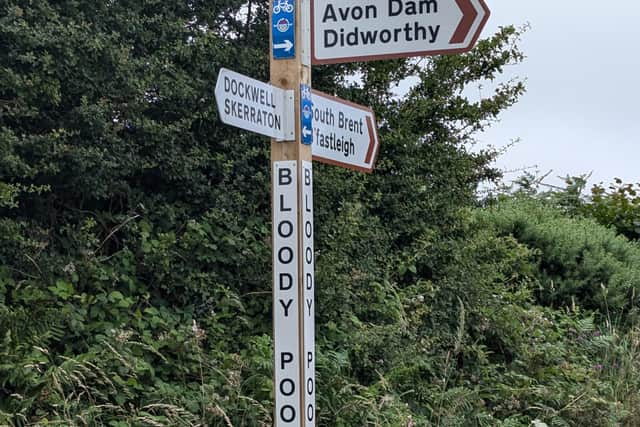
This was the one I was most interested in as it was part of a set depicting Sacred Pools on Dartmoor, many of which I have already found elsewhere. This one was for Bloody Pool, and a glance at my map showed it was to be found in the lanes below the hill I was searching on. I’d not walked those lanes before, but, as fate would have it, I was just about to. Once again, I found my target fairly easily, with a bit of help from Harbourne Man, a standing stone at the head of the nearby Harbourne River. Mission accomplished, it was time to decide on the route back to the car. Glancing over my shoulder, the decision was made for me, for the higher ground was now shrouded in mist, with the threat of rain in the air. So I planned to continue down the hillside, into the tree-lined lanes that would give me a bit of shelter should the rain kick in, taking me past the spot on the map marked as Bloody Pool...but one further obstacle lay between me and those lanes, a sign saying “Bull in Field”, along the route of a public bridleway, clearly marked on the map and signposted accordingly. Pausing for a moment, I weighed up my options, deciding that continuing forward was better than turning back at this stage, with rain still threatening which would soak me instantly if caught on exposed ground. Putting my big boy pants on, I opened the gate and went for it, half walking, half jogging to a bend in the wall, which I gingerly peered around to find some tree-shrouded rocks, but thankfully no bull. Seeing the route ahead clear, I continued walking swiftly, accompanied by the sound of a cow (or was it a bull?) coming from a neighbouring field. Reaching the far gate I was through it and into the safety of the lanes.
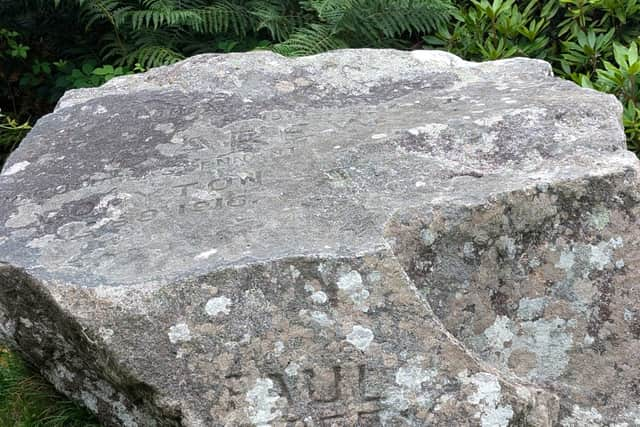
Once back home, I couldn’t resist doing a bit of research, and it didn’t take long to discover that Bloody Pool marks the spot of a ferocious battle between invading Vikings and the locals. Eventually, the moor folk proved victorious, forcing their attackers to flee back to their ships, but the fighting had taken its toll, leaving many dead and injured. It is said that on occasion, the sound of a fierce battle can be heard coming from the site of the pool and that the water runs red from the blood of the fallen, but this can probably be explained by the colour of the soil over that part of the moor. Sadly, in the 60s, the pool was filled in for road improvements, meaning there is nothing further to see now. But back in 1854, a hoard of broken Bronze Age spears was dredged up from the pool, leading archaeologists to suggest that these might have been votive offerings, destroyed and thrown in to appease whatever gods or beasts resided there, thus making it sacred.
Once again, this goes to show how useful Letterboxing is to my ongoing research into Dartmoor folklore, helping me to find new stories that I can then share with you all here.