

The Storyteller: Horseshoes have a tale to tell


Before setting off on my adventures with David Hammond, recording stories for his Thursday morning radio show on Riviera FM, I always like to do my research.
For our latest expedition, we wanted to return to Newton Abbot, so I went in search of something new to share. As I perused my books, my attention was drawn to an entry about a set of horseshoes that many years ago had been nailed to the wooden door at the church in Haccombe, a little hamlet just outside of Newton Abbot.
It suggested they might still be there, so I felt this was something we had to go and see. Possibly a suitable starting point for our day out, but more research was needed...
The church of St Blaise was built by Sir Stephen de Haccombe, upon his safe return from fighting in the 5th Crusade in the Holy Land. It was called a Crusader Church, not only because it was commissioned as a way of giving thanks to God for his deliverance, but also because it was built in the style of the places of worship that Sir Stephen would have come across during his time in the Middle East. He also dedicated it to a 4th-century Armenian bishop and martyr, St Blaise, whom he would have found mentioned there too.
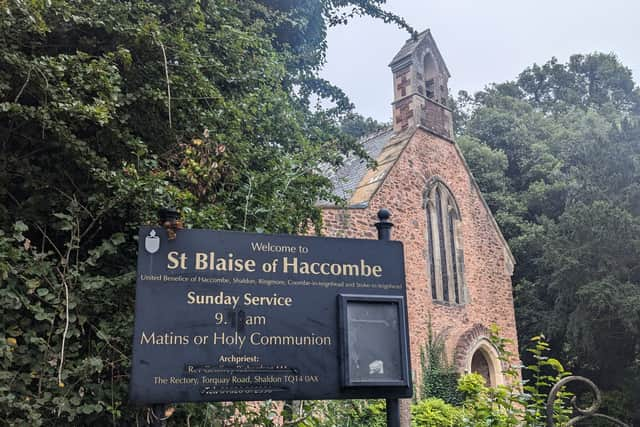
Fortunately, we were able to see what we had come in search of, the one and a half remaining horseshoes still attached to the wooden door. The reason they are there makes for quite a story and concerns a member of the Carew family from Haccombe and Sir Arthur Champernowne from Dartington Hall, near Totnes.
Legend has it that there was a long-standing dispute in the 16th century, between the two families over the ownership of Haccombe House. One day a wager was offered to settle the matter once and for all. A member from each household was to ride their best horse into the sea at Torbay, and whoever got the furthest, would secure the property for their family.
Carew chose a Devonshire roan whilst Champernowne rode a Barbary courser. The race started fairly evenly, with each rider staying neck and neck.
Then Carew started to pull ahead, leaving his opponent floundering in the waves. Feeling pleased with himself knowing victory was surely his, he suddenly heard cries for help coming from behind. Turning back, he saw that the courser had died from the strain of its efforts, under its rider, and now Sir Arthur was struggling desperately not to drown. Carew raced back to the rescue, his poor horse now having to carry both men back to the shore, but it managed it with the two rivals surviving their foolhardiness.
Carew was so impressed by the endurance of his trusty steed, that he vowed the horse would have an easy life from then on.

It is said that iron wards off the attention of witches which is why horseshoes are often found hanging up in other buildings, obviously the right way up for the superstition to work! If you also look closely at the stonework making up the archway to this door, you will notice some odd markings. They might just be Masons Marks, put there by the stonemasons who constructed it, but they could also be Marian Marks, named after the Virgin Mary asking for her protection, or Witch Marks, used to ward off evil spirits. Further examples of how superstitious our ancestors were, back in the day!
During the 19th century, a schoolmaster from Exeter Grammar School wrote a ballad about this particular legend, and a copy of it was said to have been pinned to the door alongside the horseshoes. Sadly that’s no longer there. Hopefully, it’s preserved elsewhere, but the remains of the shoes certainly are and I’m really pleased that we saw them on our recent visit