

Strike action is symptom of broken NHS after years of neglect
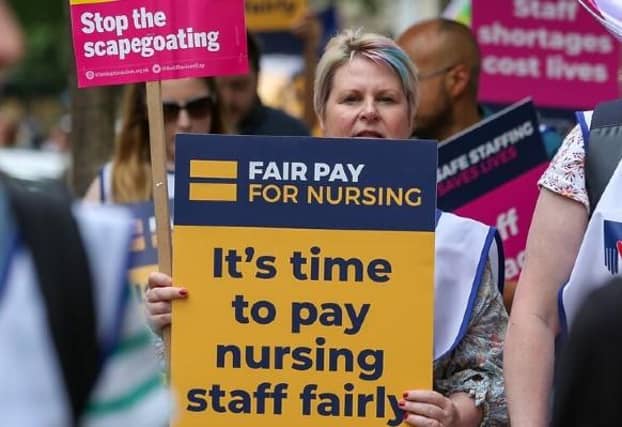

Our NHS has sometimes been described as a religion for our country. For my family, it is a core part of our lives. My wife Mandy has worked for more than 35 years for the NHS both at Moorfields Eye Hospital and here in Torbay Hospital, where my eldest so
Our NHS has sometimes been described as a religion for our country.
For my family, it is a core part of our lives. My wife Mandy has worked for more than 35 years for the NHS both at Moorfields Eye Hospital and here in Torbay Hospital, where my eldest son George is now a junior doctor.
We have many friends and acquaintances in the service and we know only too well that for many years it has been creaking at the seams.
Torbay Hospital, which desperately needs the £400 million investment that has been identified, is currently awaiting a decision from Whitehall as to when funding will be released. While occasional injections of cash help replenish elements of the service the core of the hospital needs a complete refresh.
It is symptomatic of our current political system that Steve Barclay, Secretary of State for Health, was accused by the head of the RCN, Pat Cullen, of bullying her at a brief meeting held last week. A behaviour of bullying others sadly appears to be an approach adopted by those some of those in power in Westminster as Dominic Raab, Deputy Prime Minister, is currently under investigation for similar behavior.
A national newspaper article last week on a government-commissioned report perhaps demonstrates the root cause of the current dispute.
A 'decade of neglect' by successive Conservative administrations has weakened the NHS to the point that it will not be able to tackle the seven-million-strong backlog of care, a government-commissioned report has concluded.
The paper by the King’s Fund health think-tank, says years of denying funding to the health service and failing to address its growing workforce crisis have left it with too few staff, too little equipment and too many outdated buildings to perform the amount of surgery needed.
The UK’s poor public finances, health service staff suffering from exhaustion, and a wave of NHS strikes this winter will also lead to ministers being unable to deliver key pledges on eradicating routinely long waits, the think-tank says.
The findings are especially embarrassing for the Conservatives because the report was ordered by the Department of Health and Social Care (DHSC) late last year. They are critical of the impact on the NHS of the austerity programme initiated by David Cameron in 2010 and continued by his successor, Theresa May.
“Though Covid certainly exacerbated the crisis in the NHS and social care, we are ultimately paying the price for a decade of neglect,” said the King’s Fund chief executive Richard Murray.
“The sporadic injections of cash during the austerity years after 2010 were at best meant to cover [the service’s] day-to-day running costs. This dearth of long-term investment has led to a health and care system hamstrung by a lack of staff and equipment and crumbling buildings. These critical challenges have been obvious for years.”
The report pinpoints Cameron’s decision to reduce the NHS’s annual budget increases from Labour’s 3.6 per cent to an average of just 1.5 per cent as the key reason for the service’s loss of capacity.
The service’s performance against a number of waiting time targets that Labour introduced began spiralling downwards in 2015 and has worsened every year since.
The report comes days after the latest official figures showed that the waiting list in England for non-urgent care in hospital had reached a new record high of 7.2 million people. Of those, 410,983 had been waiting for more than a year for treatment – such as a hip or knee replacement, cataract removal or hernia repair – that should take a maximum of 18 weeks.
The 81-page document says economic circumstances that apply today, mean that politically important promises made earlier this year in NHS England’s 'elective recovery plan' are highly unlikely to be met.